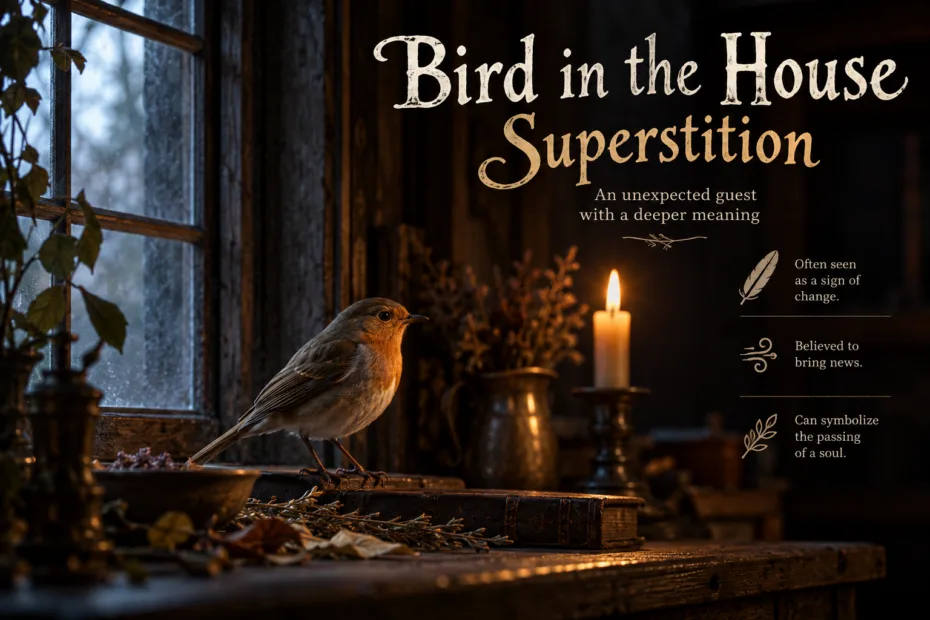
A wild bird unexpectedly entering a house has often been treated as an omen in recorded folk belief. The best-documented Anglo-American form connects the event with bad luck or a death in the household, but surviving folklore also preserves sharply different meanings.
What the Bird-in-the-House Superstition Says
In its familiar form, the belief begins with an ordinary but startling event: a bird crosses from outdoors into a living space without being brought there intentionally. Its arrival is then read as a warning rather than an accident.
Many collected versions associate the visitor with death, illness, or approaching misfortune. The predicted event may concern someone living in the house, a member of the family, or the household more generally. Some records simply say that the bird brings bad luck and do not specify what will happen.
The species is not always important. Several American folklore records speak only of a bird. Other versions become more specific and name a robin, raven, swallow, dove, or another bird. Those species-specific beliefs should not be treated as interchangeable with the general superstition.
An uninvited wild bird enters the home, and its unexpected crossing of the household boundary is interpreted as a warning about something that has not yet happened.
Death Is a Common Meaning, but Not the Only One
The death-omen form is well represented in folklore collections. Kentucky Superstitions, published in 1920, records both the general statement that a bird flying into a house is a sign of death and narrower versions in which the circumstances inside the room alter the prediction.
Later collected material preserves the same pattern. Records held by the James T. Callow Folklore Archive include versions learned in the United States in which a bird entering a house foretells death in the family or brings bad luck to the household.
Irish folklore collections also contain comparable beliefs. Some entries connect a bird or a particular species entering a home with death. Yet these records sit beside other bird beliefs with entirely different meanings.
There is therefore no universal bird-in-the-house rule. One collected Nebraska tradition says that a bird entering a room brings good luck, while another entry in the same collection treats a bird entering the house as bad luck. Such contradictions are normal in oral tradition, where beliefs can differ between families, communities, informants, and generations.
Small Details Can Change the Omen
Traditional accounts sometimes attach meaning not merely to the bird’s presence but to how it enters, where it lands, and what happens next.
- Entering through a door or window: Some collected traditions distinguish between the openings used by the bird.
- Leaving through the same opening: One American collection records this as good luck, even though other forms in the same collection describe the bird’s entrance as unlucky.
- Entering a sick person’s room: Some older death-omen records give the event a narrower meaning when illness is already present in the household.
- Landing on a particular object: A few local records change the predicted event according to where the bird settles.
- The species involved: Robins, ravens, swallows, doves, and other birds appear in separate local traditions, but their meanings are not consistent from one record to another.
These details matter because folk beliefs are often preserved as short formulas rather than as one organized system. A version collected in one district cannot automatically be expanded into a rule for an entire country or culture.
Why an Indoor Bird Became Such a Strong Omen
Birds have long occupied unusual positions in folk symbolism because they move between ground and sky and can appear or disappear quickly. Folklore and religious traditions have variously represented them as messengers, omens, carriers of souls, or beings associated with the dead. These ideas are much broader than the bird-in-the-house superstition itself, but they help explain why an unexpected bird could attract special attention.
The house also changes the character of the encounter. A bird seen outdoors is ordinary. The same bird suddenly flying through a kitchen, bedroom, or other enclosed room violates the expected separation between wild space and domestic space. That uncommon movement could readily become memorable enough to acquire an omen story.
Folklore scholarship has documented the association between birds and death across many traditions, while also noting that birds can carry positive meanings connected with life, fertility, luck, or renewal. The darker interpretation of an indoor bird is therefore one branch of a much wider and often contradictory body of bird lore.
The Superstition Is Older Than Modern Spiritual Interpretations
Historical collections show that the bird-in-the-house omen was circulating well before contemporary online explanations of bird symbolism. Early twentieth-century American compilations already recorded the entrance of a bird as bad luck or a death sign, and later field collections preserved closely related statements from individual informants.
Records gathered in Ireland during the twentieth century provide further examples of birds entering or approaching homes being interpreted as warnings. These archival entries are valuable because they preserve what particular people reported hearing or believing rather than presenting a single standardized meaning.
No surviving record establishes one identifiable person, date, or place where the superstition began. Claims that the belief has one precise origin should therefore be treated cautiously. What the documentary record shows more clearly is a recurring idea: an unexpected bird crossing into domestic space could be interpreted as a message about future fortune.
A Bird Indoors Does Not Always Carry a Dark Meaning
The familiar death interpretation can make the superstition sound more uniform than the historical record actually is. Some collected traditions describe an indoor bird as lucky. Others connect the event with news, marriage, weather, visitors, or another future occurrence.
Even neighboring or overlapping traditions may disagree. The same species can be unwelcome in one account and favorable in another. A general bird may carry one meaning while a named species carries another. These differences are part of the folklore rather than errors that need to be reconciled.
Folklore record: The recurring death or bad-luck interpretation is well documented, especially in Anglo-American collections. It should be described as a traditional omen, not as a prediction that an actual event will follow when a bird enters a home.