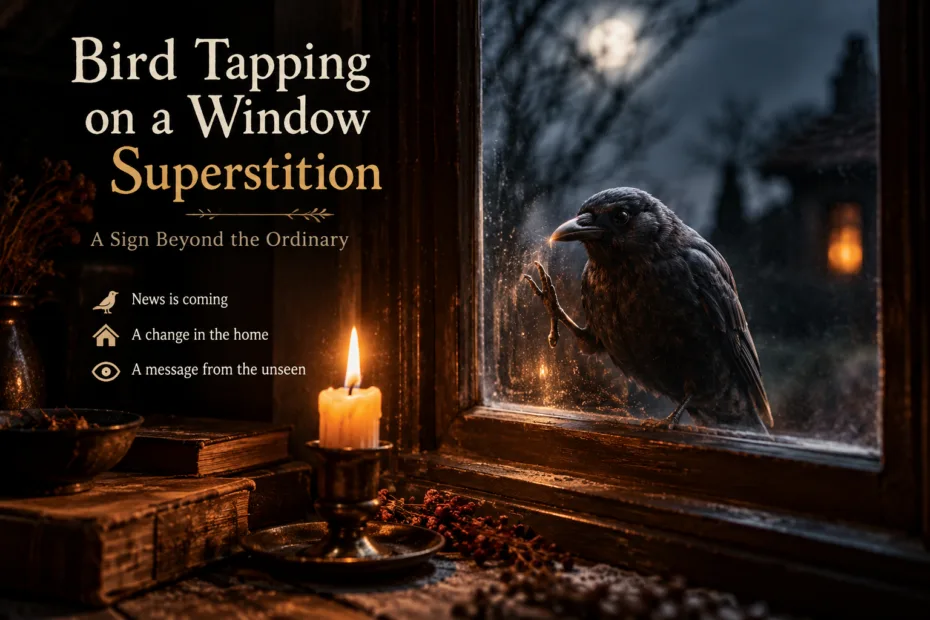
A bird repeatedly tapping or pecking at a window has been treated as an omen in several recorded folk traditions. The best-known interpretation is a warning connected with death, but historical records also attach the behavior to news, good luck, and approaching hard weather.
What Does a Bird Tapping on a Window Mean in Superstition?
There is no single traditional meaning. In nineteenth-century British folklore, birds hovering around a house or tapping against a window-pane were sometimes listed among omens of death. T. F. Thiselton-Dyer recorded this association in Domestic Folk-Lore in 1881.
Some records are much more specific. William Henderson described a Northamptonshire belief in which a robin was said to tap three times at the window of a dying person’s room. Irish folklore collections preserve similar death-related window beliefs involving other birds, but they also contain examples where pecking at a window predicted hard weather rather than a death.
The event therefore did not carry a fixed meaning even within older European folklore. The bird, its behavior, the circumstances inside the house, and the local tradition could all change the interpretation.
Recorded Meanings Are Not Consistent
| Recorded Behavior | Folklore Interpretation | Recorded Context |
|---|---|---|
| Birds tapping against a window-pane | Omen of death | Nineteenth-century British domestic folklore |
| Robin tapping three times at a window | Death associated with a sick or dying person | Northamptonshire tradition recorded by William Henderson |
| Bird picking at a window | Hard weather approaching | Irish Schools’ Collection, County Leitrim |
| Wagtail repeatedly picking at a window | Death omen | Irish Schools’ Collection, County Monaghan |
| Bird fluttering against windows | Good luck | Adams County, Illinois folklore collected by Harry Middleton Hyatt |
| Bird flying against a window | News expected soon | Adams County, Illinois folklore collected by Harry Middleton Hyatt |
The Illinois material is especially useful because closely related window behavior received two favorable readings in the same collection: good luck and approaching news. This makes it difficult to treat the darker interpretation as a universal rule.
Why Three Taps Appear in Some Versions
The idea that a bird must tap exactly three times is not a general rule of the superstition. It comes from particular recorded traditions.
Henderson’s Northamptonshire account gives the robin three taps at the window of a dying person’s room. Shropshire Folk-Lore also notes a related death omen involving a bird flying against a window or entering a room, with repeated appearances—especially three—receiving extra attention.
The Number Belongs to Particular Traditions
A bird tapping once, twice, three times, or returning for several days should not automatically be assigned a different folklore meaning. The surviving records do not provide a universal numerical code for window taps.
Tapping Is Different from a Window Collision
Older folklore sources sometimes use words such as tap, pick, flutter, fly against, and dash against for related encounters at windows. These descriptions should not all be treated as the same physical event.
A bird gently pecking the glass again and again may be deliberately interacting with its reflection. A bird suddenly flying into a pane at speed is experiencing a window collision. A bird sitting on the sill or hovering outside creates yet another situation.
Folklore records also distinguish these behaviors unevenly. A belief attached to a robin tapping a sick person’s window does not automatically apply to every bird that accidentally strikes glass.
Does the Type of Bird Change the Meaning?
Some traditions name a particular bird. Robins, wagtails, owls, magpies, crows, ravens, and swallows all appear in older bird-omen material, but there is no universal species code for a bird tapping on glass.
The Northamptonshire three-tap belief concerns a robin. One Irish record connects a wagtail picking at a window with death, while another Irish record simply describes a bird picking at the window as a warning of hard weather. These traditions cannot safely be combined into a rule that every robin, wagtail, black bird, white bird, or other species carries the same message.
Color-based explanations found in modern retellings also need their own folklore evidence. A bird’s color alone does not establish what a window-tapping tradition originally meant.
Why a Bird May Keep Tapping the Window
Repeated tapping has an ordinary bird-behavior explanation. Birds can see their own image in reflective glass and react as though another bird has entered their territory. Ornithologists commonly describe this as reflection aggression.
The behavior is especially noticeable during breeding season. American Robins and Northern Cardinals are well-known examples in North America, although other species may do it as well. A bird may return to the same pane many times because the apparent rival keeps reappearing whenever the reflection is visible.
This kind of repeated pecking is different from a high-speed collision caused by a bird mistaking reflected sky, trees, or vegetation for open space.
- Repeated light pecking or fluttering often points to a bird reacting to its reflection.
- A sudden impact at flying speed is more consistent with a window collision.
- Repeated visits over several days do not create a stronger or more certain folklore omen.
- Reducing the reflection on the outside of the problem window can discourage persistent tapping.
The natural behavior explains why the same bird can return to one window again and again. The older superstition records document the meanings people attached to such encounters; they do not establish that the tapping predicts a future event.