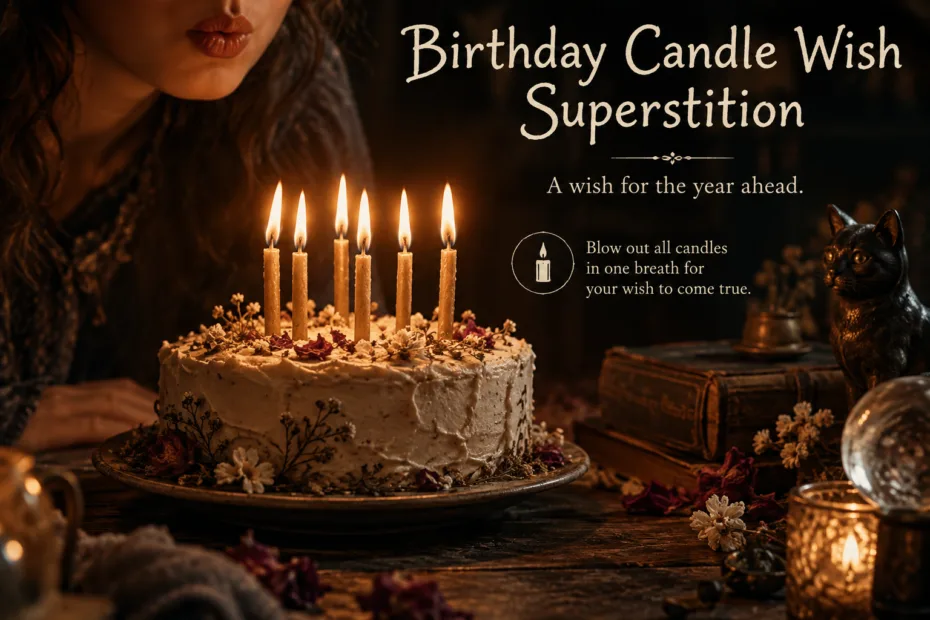
The birthday candle wish superstition holds that a private wish made before blowing out the candles on a birthday cake may come true, especially when every flame is extinguished in a single breath.
How the Birthday Candle Wish Works
The familiar ritual usually begins after the birthday cake is presented with its candles lit. The person celebrating silently thinks of a wish and then blows out the candles.
In the best-known form of the superstition, all of the candles must go out in one breath. If one or more remain burning, the wish may be considered unsuccessful or less likely to come true.
These rules belong to folklore rather than to a fixed ceremony. Families and communities may follow only part of the pattern. Some emphasize the single breath, while others pay more attention to keeping the wish secret.
Why the Wish Is Kept Secret
The secrecy rule is an important part of many versions of the belief. Telling another person what was wished for is often said to prevent the wish from coming true.
This gives the birthday person a private moment within an otherwise public celebration. Everyone can see the candles being blown out, but the content of the wish remains known only to the person making it.
The superstition does not require the wish to be spoken aloud. In fact, silence is often treated as part of the condition that preserves the wish.
From Birthday Candles to Wish-Making
Candles on birthday cakes have a longer documented history than the complete modern wish ritual. European records describe birthday cakes decorated with lighted candles, often corresponding to the person’s age, before every element of today’s familiar custom appears together in written accounts.
A nineteenth-century folklore record from Switzerland, based on observations made in 1881, describes a birthday cake with one lighted candle for each year of life. The birthday person was expected to blow out the candles before the cake was eaten. That account records the candle-blowing custom but does not describe the modern secret-wish rule.
German children’s birthday traditions are also closely associated with the development of candle-topped birthday cakes. Later forms of the custom combined the candles with the idea of making a wish, while the rule about extinguishing all the flames in one breath became a familiar part of birthday folklore.
The One-Breath Rule
The single breath turns a simple action into a small test. Instead of merely extinguishing the candles, the birthday person has to complete the act successfully under a particular condition.
Folklore collections preserve versions in which a wish is expected to come true when all the birthday candles are blown out with one breath. The rule remains recognizable even when modern cakes use fewer candles, number-shaped candles, or other decorations instead of one candle for every year.
The wish is made privately and every candle is extinguished in one attempt.
A candle remains burning, or the wish is revealed when the local version of the belief requires secrecy.
What the Candles Represent
The candles have not always carried one universal meaning. Historical birthday customs have connected them with age, life, good fortune, celebration, and the passing into another year of life.
The practice of using one candle for each year made the cake a visible representation of age. Some birthday customs also added an extra candle connected with continued life or the coming year. Such ideas helped give the candle display meaning beyond simple decoration.
The later wish superstition places another layer on the same objects: the flames become something that must be extinguished at the precise moment a private hope is made.
An Evolving Birthday Tradition
It is tempting to assign the entire candle-and-wish ritual to one ancient origin, but the surviving record is less tidy. Ancient uses of ceremonial fire and candlelit offerings are sometimes proposed as distant parallels, yet they do not establish an unbroken historical line to the modern birthday wish.
The clearer evidence concerns European birthday cakes with candles and the later development of candle blowing into a wish-making custom. By the early twentieth century, versions of the ritual linked successful wishing with blowing out all the candles in one breath. The custom then became increasingly familiar through family celebrations and popular culture.
Today, making a silent wish before blowing out birthday candles remains a small piece of participatory folklore: a rule learned mostly by watching other people perform it, hearing someone say “make a wish,” and repeating the ritual from one birthday to the next.