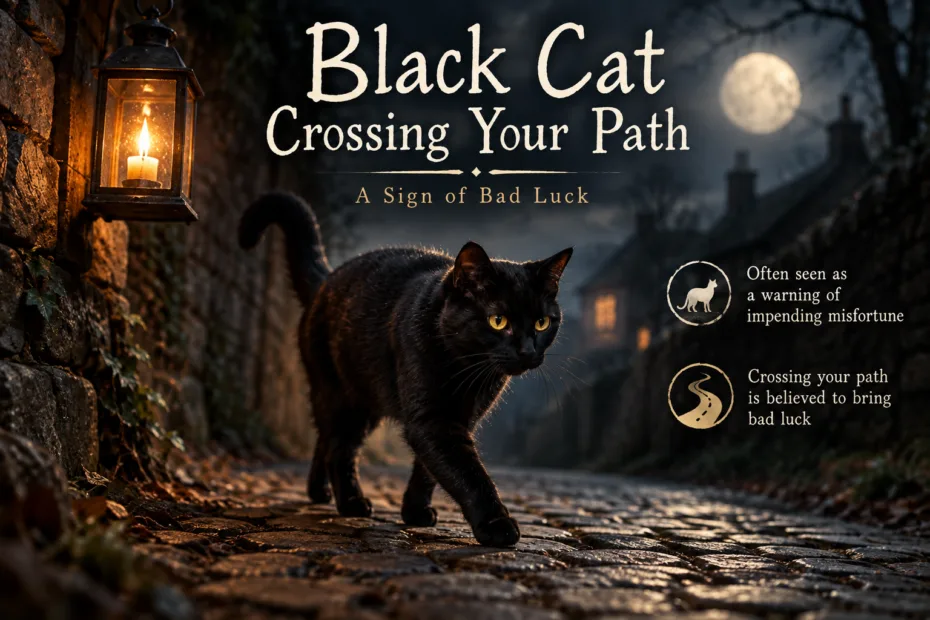
A black cat walking across someone’s path is widely known as a luck omen, but the meaning is not universal. American folklore collections preserve many versions in which the crossing predicts bad luck, while British records also preserve the opposite belief: the same encounter may be fortunate.
What Counts as a Black Cat Crossing Your Path?
The familiar form of the superstition concerns a black cat passing across the route directly ahead of a person. Merely seeing a black cat is not always treated as the same omen. The crossing itself creates the sign: the animal moves from one side of the traveler’s route to the other before the traveler passes that point.
American folklore records collected during the twentieth century repeatedly state that a black cat crossing in front of someone means bad luck will follow. The predicted duration is often left undefined. Other recorded versions limit the bad luck to the rest of the day or attach extra conditions to the encounter.
The event is treated as an omen rather than as an action performed by the cat. In the negative version, an ordinary crossing is interpreted as a warning that misfortune may follow.
Why Is It Usually Associated With Bad Luck?
The negative interpretation belongs to a larger history in which cats became associated with witchcraft, supernatural agents and threatening omens in parts of Europe. Early modern accounts sometimes described alleged witches as having animal familiars, and cats could appear among those animals. Cats were not the only form involved: dogs, toads, mice and other small animals also appeared in familiar traditions.
The now-familiar image of the specifically black cat beside a witch should not simply be projected backward unchanged. Research discussed by the University of Exeter notes that early witchcraft accounts could involve cats of other colors and that the standardized black-cat stereotype developed later.
Older European religious and demonological imagery nevertheless did sometimes connect dark or black cats with demonic figures. Such associations helped make the black cat suitable for later stories about ominous encounters, including the idea that meeting one on the road could signal danger or misfortune.
The crossing-path superstition therefore fits within several overlapping strands of folklore rather than a single documented event from which every later version descended.
A Black Cat Crossing the Road Is Not Always Bad Luck
The strongest complication in this superstition is that the same action can carry the opposite meaning. British folklore includes traditions in which encountering a black cat, including one crossing the path, is lucky.
The Museum of Cambridge records that in historic Cambridgeshire a black cat crossing the path was regarded as a sign of good luck. The School of Scottish Studies Archives likewise preserves positive Scottish associations with black cats, showing that an ominous interpretation cannot be applied to all British traditions.
A black cat passes across the route ahead and is interpreted as an omen that bad luck or trouble may follow.
The same encounter is interpreted as fortunate, with the black cat functioning as a bearer of luck rather than a warning.
This reversal matters because it shows that the superstition does not come with one fixed meaning attached naturally to the animal. The meaning depends on the folk tradition in which the encounter is interpreted.
Does the Direction of the Cat Matter?
Some versions add a directional rule, but the surviving rules do not agree with one another.
The James T. Callow Folklore Archive at the University of Detroit Mercy contains records in which a black cat crossing from one particular side predicts bad luck while the opposite direction does not. Another collected version says that a crossing to the left is unlucky and a crossing to the right is lucky. Other records simply state that any crossing is unlucky and make no distinction between directions.
There is no single dependable left-to-right or right-to-left rule across the tradition. Directional details belong to particular transmitted versions of the superstition.
This is why statements such as “left to right always means bad luck” or “right to left always means bad luck” are too broad. Both directional and non-directional forms have been recorded.
What Happens After the Cat Crosses?
In many versions, nothing further is required. The crossing itself is the complete omen, and bad luck is simply expected to follow.
Other collected traditions add a customary response intended to interrupt the predicted misfortune. One Dartmouth Folklore Archive record, collected from an informant born in India, describes returning to the starting place and drinking water after a black cat crosses the route. The archive treats this as one particular transmitted form rather than a universal rule.
American records show similar variation. Some describe no way to reverse the omen, while others preserve highly specific conditions involving direction, timing or what a person should do afterward.
These responses are part of the folklore surrounding the omen. They should not be merged into one supposed standard ritual, because different recorded versions contradict one another.
Why the Same Black Cat Can Mean Opposite Things
Black-cat folklore shows how an omen can remain recognizable even while its interpretation changes. The stable element is usually the unexpected crossing of the traveler’s route. What changes is the value assigned to it: fortunate in one tradition, unlucky in another.
This contrast is visible even within Britain. Historical collections contain positive black-cat beliefs alongside other traditions linking cats with witches or supernatural danger. The Museum of English Rural Life describes English black-cat superstition as notably contradictory, with both lucky and unlucky interpretations recorded.
For that reason, “a black cat crossing your path means bad luck” describes one well-known form of the belief rather than a universal meaning. The more accurate folklore record is variable: the crossing may predict bad luck, good luck, or acquire extra meaning from its direction and local tradition.