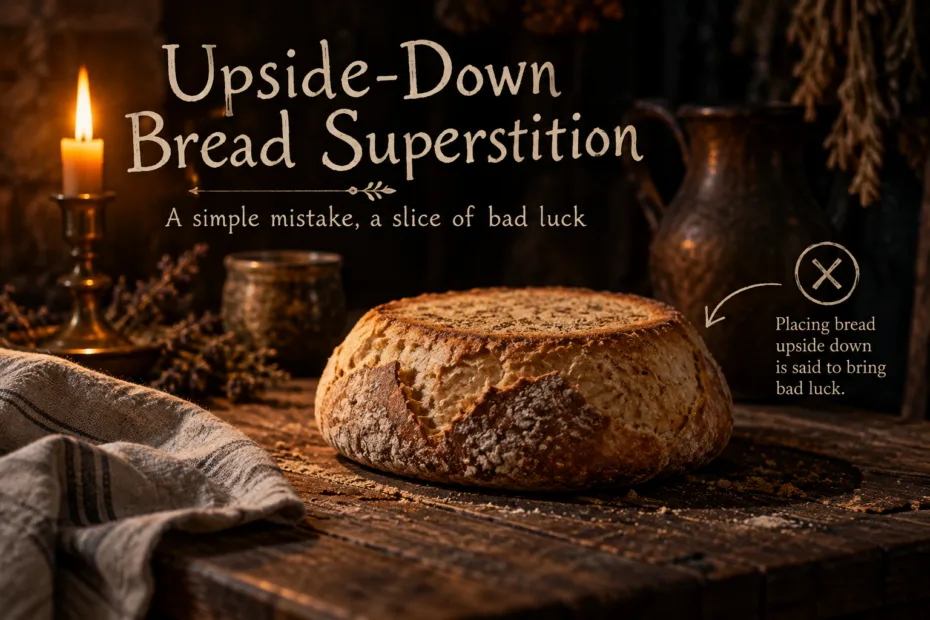
The upside-down bread superstition treats a loaf placed with its usual top against the table as a sign of bad luck or as an improper way to handle bread. The belief is especially associated with French tradition, but older folklore records show that similar warnings also appeared independently in parts of Britain.
What the Upside-Down Bread Superstition Says
The basic rule is simple: a loaf of bread should not be placed upside down. If someone sets it on the table that way, another person may immediately turn it back over.
In its mildest form, the custom is treated as household etiquette. Bread has a proper side, and leaving it inverted feels careless or disrespectful. In more explicitly superstitious versions, an upside-down loaf is said to bring misfortune, attract the evil eye, or carry an association with death.
The exact consequence is not fixed. Folk beliefs change through oral transmission, so one family may simply call the act unlucky while another attaches a more specific warning to it. The stable part of the tradition is the inversion itself: bread that normally rests one way should not deliberately be turned onto its other side.
The belief can be applied to a round loaf, a long loaf, or a baguette. What matters is that the bread is recognized as lying on its “wrong” side. It is a folk rule about the treatment of bread rather than a rule tied to one recipe or shape.
Why Bread Was Treated Differently From Ordinary Food
Bread has long occupied an unusually respected place at the table. It was a basic source of food, the result of agricultural labor, and in Christian settings it also carried religious associations. These meanings encouraged customs in which bread was handled with greater care than many other foods.
That background helps explain why a small physical action could become meaningful. Turning a loaf over does not damage it, yet in folk custom the act can be read as putting something essential into an improper position. Similar traditions surrounding bread warn against wasting it, treating it carelessly, or performing certain actions while cutting and serving it.
The upside-down loaf therefore belongs to a broader pattern of respect expressed through everyday handling. The supernatural explanation may differ from place to place, while the practical gesture remains almost identical.
The French Story of the Executioner’s Bread
The best-known explanation links the superstition to the executioner in France. According to the traditional story, a baker set aside bread intended for the local executioner and placed the loaf upside down so that other customers would recognize it and leave it untouched.
Because the executioner’s occupation was associated with death and social stigma, the inverted loaf supposedly acquired the same uncomfortable associations. A household that later placed its own bread in that position could therefore be said to invite bad luck or symbolically reproduce the position of the executioner’s bread.
This explanation remains part of recorded French folk tradition. An oral-history record collected in Aveyron in 1996 preserves the rule that bread placed on the table should not be turned over because doing so brought misfortune. The accompanying traditional explanation connects the reversed loaf with bread reserved for the executioner.
The executioner story is best treated as a traditional explanation rather than a proven origin. Historical research confirms that executioners could possess special rights involving goods sold at markets, including food, but surviving archival evidence does not firmly establish a general rule that bakers throughout France marked an executioner’s loaf by turning it upside down.
This distinction matters because folk customs often preserve explanations long after the circumstances behind them have become unclear. The story may explain how later generations understood the taboo without proving that every part of the story created the superstition.
Older British Records Show a Different Meaning
The French executioner story cannot explain every recorded form of the belief. Nineteenth-century collections of folklore from northern England describe it as unlucky to turn a loaf upside down after taking bread from it.
Along parts of the coast, the warning became much more specific: an overturned loaf was connected with a ship being wrecked or brought into danger. Cornish folklore also recorded an upside-down loaf on a table among the bad omens recognized by sailors.
These maritime versions are useful because they show how the same household action could acquire a different meaning in another setting. A coastal community could connect the overturned loaf with the overturning, loss, or distress of a vessel rather than with an executioner.
Leaving bread upside down is unlucky, improper, or disrespectful.
An overturned loaf is linked with danger to a ship or a future shipwreck.
Turning the Bread Back Over
Unlike some superstitions that require a spoken formula, charm, or elaborate protective action, this belief usually has a very ordinary response. The loaf is simply turned right-side up again.
That small correction is part of what allows the tradition to survive easily. Someone does not need to accept the supernatural explanation in order to follow the custom. A person may correct the loaf because it was learned as table manners, because an older relative always did so, or simply because seeing bread upside down feels wrong.
For that reason, the same gesture can sit somewhere between superstition and inherited habit. Two people may perform exactly the same action while understanding it differently.
What Is Actually Documented
- The belief that an upside-down loaf brings bad luck has been recorded in European folk tradition.
- A French tradition connects the reversed loaf with bread supposedly reserved for an executioner.
- The executioner explanation is widely repeated, but its status as the original historical cause is uncertain.
- Nineteenth-century British folklore records an independent warning against turning a loaf upside down.
- In some coastal traditions, the action was specifically associated with a ship being wrecked or placed in danger.
- The usual household response is simply to return the loaf to its normal position.
These records make the upside-down bread belief more than a single isolated saying. They also show why its meaning should not be reduced to one universal origin story. The recognizable custom is the same—a loaf is kept upright—while the feared consequence and the explanation attached to it can change with the community preserving the belief.