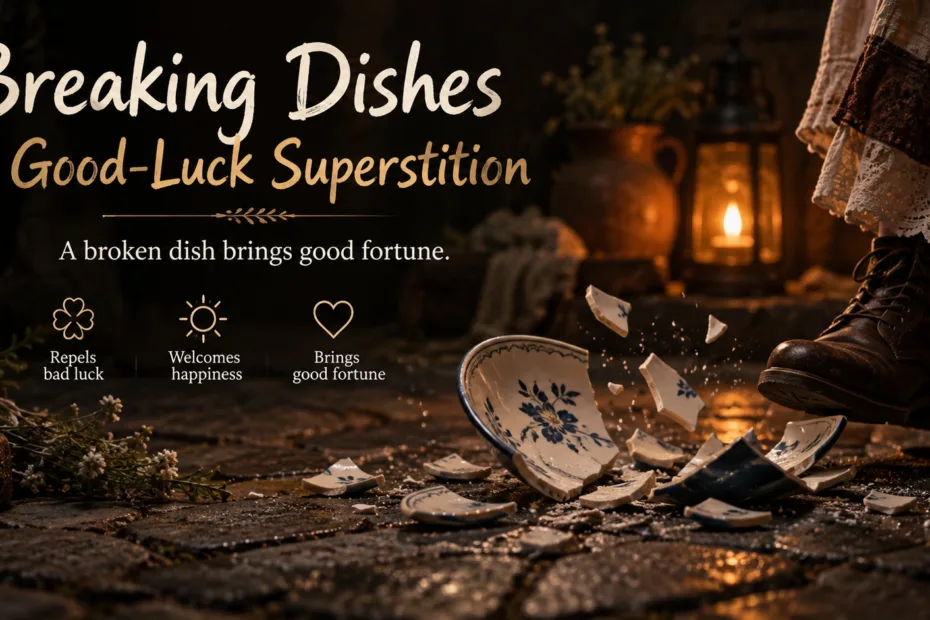
Breaking dishes is associated with good luck in several folk traditions, particularly during weddings and New Year celebrations. The meaning depends on the occasion: deliberately shattered pottery can express wishes for a happy marriage, friendship, or future fortune, while an accidentally broken dish may carry a different interpretation.
Why Are Broken Dishes Considered Lucky?
The superstition gives broken household objects a meaning beyond their ordinary value. A shattered plate usually represents damage or loss, but within certain customs the pieces are associated with good fortune.
One traditional explanation connects the noise of breaking pottery with protection against harmful spirits. This interpretation is especially associated with German wedding customs, where the crash of porcelain is believed to drive away influences that might threaten the marriage.
Other traditions focus on the broken pieces themselves. They may represent good wishes, friendship, or an auspicious beginning. The meanings differ according to the occasion and the community observing the custom.
Not every form requires deliberate breakage. In German-speaking households, the saying Scherben bringen Glück can also be offered when someone accidentally breaks a fragile object, turning an inconvenient mishap into an occasion for reassurance.
Breaking Porcelain Before a German Wedding
One of the clearest ceremonial examples is the German Polterabend, a gathering traditionally held on the evening before a wedding. Friends and relatives bring old porcelain, earthenware, or other suitable ceramics to break as a wish for the couple’s future happiness.
The custom is associated with the expression Scherben bringen Glück, meaning “shards bring luck.” The loud breaking sounds have traditionally been explained as a way of driving away harmful spirits or influences.
The couple then sweeps up the broken pieces together. This shared task is understood as a symbol of cooperation and the ability to face difficulties during married life.
The ceremony has recognizable rules. Porcelain, stoneware, and pottery are traditionally suitable, while glass and mirrors are generally avoided. Breaking glass is regarded as unlucky in accounts of the custom, and mirrors carry their own associations with misfortune.
Although the gathering was traditionally held immediately before the wedding, some couples now arrange it several days or weeks earlier. The celebration also varies between families and regions, and not every German wedding includes a Polterabend.
Denmark’s New Year Dish-Breaking Tradition
A different custom was associated with New Year’s Eve in Denmark. People traditionally broke old dishes at the doors of friends and family members as an expression of friendship and a wish for good luck in the coming year.
The broken crockery was interpreted positively. Rather than expressing hostility toward the household, the action was intended as a friendly gesture.
The practice is less common in Denmark today. VisitDenmark, the country’s official tourism organization, describes breaking old crockery at friends’ and relatives’ doors as a custom that was more usual in earlier times. Its account of Danish New Year traditions notes that the practice has become rarer, although it remains recognized.
The custom is therefore better described as a historical Danish New Year tradition with some continuing recognition, rather than an activity routinely performed by most Danish households today.
Unlike the German Polterabend, the Danish practice was connected with the arrival of a new year and the relationships between friends or relatives. It did not require a wedding, a bride and groom, or the ceremonial cleaning of shards by a couple.
Different Occasions, Different Meanings
| Tradition | Occasion | Customary Action | Associated Meaning |
|---|---|---|---|
| German Polterabend | Before a wedding | Guests break porcelain or pottery, and the couple cleans up the pieces | Good fortune for the marriage, protection, and cooperation |
| Danish New Year custom | New Year’s Eve | Old dishes are broken at the doors of friends or relatives | Friendship and good wishes for the coming year |
| German saying Scherben bringen Glück | Including everyday accidents | A reassuring saying follows the breaking of a fragile object | Luck or consolation after an unfortunate mishap |
These customs share an association between broken objects and favorable outcomes, but their timing, participants, and interpretations are not interchangeable.
Intentional Breaking and Accidental Damage
Breaking a dish as part of a recognized celebration differs from dropping a plate while washing it. In a ceremony, the action is expected and assigned a particular meaning. An accidental break may be treated as bad luck, good luck, or simply an inconvenience, depending on the surrounding belief.
The German proverb shows that a positive interpretation can extend beyond deliberate ceremonies. Duden, the German language dictionary, describes Scherben bringen Glück as a humorous expression of consolation when something fragile breaks.
Other household superstitions similarly assign meaning to unexpected accidents. Beliefs involving accidental breakage and bad-luck remedies can attach warnings to mishaps and prescribe symbolic actions to counter misfortune. Spilling salt over one’s surroundings and breaking crockery are separate events, but both illustrate how an ordinary household accident can acquire a folkloric interpretation.
Broken dishes are not universally regarded as lucky. The occasion, material, intention, and local tradition determine whether the breakage is interpreted as favorable, unfavorable, or without any special meaning.
Why Porcelain and Pottery Appear in the Tradition
Plates, cups, earthenware, and porcelain are familiar household objects that break with a noticeable sound. In the German wedding custom, their material is also part of the traditional distinction between acceptable pottery and glass, which is avoided.
The word Scherben itself has a history connected with broken pieces. German dictionaries trace Scherbe through earlier forms of the language, and the modern word can refer to fragments of glass, porcelain, or clay.
The familiar saying has sometimes been linked with older meanings associated with pottery, although explanations of its origin are not uniform. The expression remains closely connected with the idea that broken pieces can carry a favorable meaning.
It would therefore be inaccurate to assume that every broken material has the same symbolic value. Even in a custom that celebrates shattered porcelain, breaking a glass object may be regarded as undesirable.
Shards as a Symbol of Good Fortune
The German expression Scherben bringen Glück preserves a direct connection between fragments and fortune. The broken pieces can be treated as a visible sign of good wishes, particularly when their creation is part of an established ceremony.
In the Polterabend, the couple’s shared cleaning of the shards adds another layer of meaning. The breaking is associated with protection and luck, while cleaning up together symbolizes the practical cooperation expected in marriage.
The former Danish New Year practice placed more emphasis on friendship and good wishes directed toward another household. Its positive meaning came from the relationship between the people involved and the timing of the celebration.
These interpretations belong to particular customs and sayings. They do not establish that breaking objects causes good fortune, and the historical origins of every explanation cannot be determined with certainty.