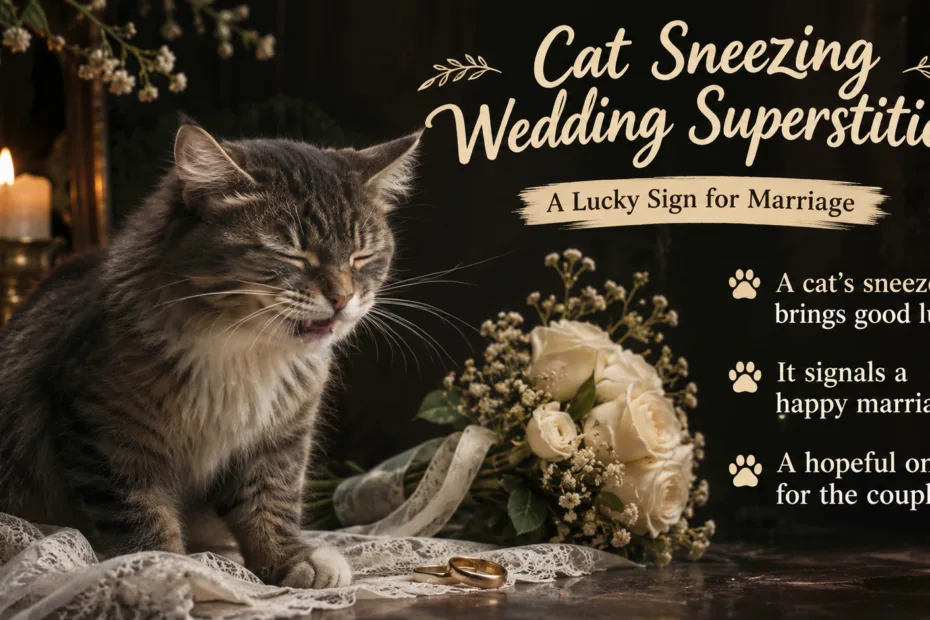
According to an old wedding superstition, a cat sneezing shortly before a marriage is a lucky omen for the bride. The sneeze was believed to foretell good fortune as she entered married life. Historical accounts place the event either on the eve of the wedding or on the wedding day itself.
The belief appears in nineteenth- and early twentieth-century folklore collections, where an ordinary cat’s sneeze is treated as a favorable sign during wedding preparations. The traditional meaning is good luck for the bride, although the accounts do not promise a particular outcome such as wealth, children, or a marriage free from difficulties.
What Does a Cat Sneezing Mean for the Bride?
In the traditional interpretation, the sneeze announces favorable circumstances for a woman about to marry. It is an omen associated with her approaching marriage rather than a prediction that someone will become engaged or receive a proposal.
The wording of older records is notably simple. They describe the sneeze as lucky or auspicious without establishing a detailed set of rewards. Later interpretations sometimes describe it as a promise of marital happiness, but the older expressions of good fortune are broader than that.
The bride is the person specifically named in several historical accounts. The belief does not suggest that the groom receives bad luck or that a wedding without a sneezing cat is unfortunate. It identifies an unexpected event as favorable when it happens at a particular moment in the bride’s life.
Was the Cat Supposed to Sneeze Before or During the Wedding?
Two versions appear in written folklore. Their difference lies chiefly in when the sneeze occurs.
On the Wedding Eve
The cat sneezes on the day before the ceremony. The event is regarded as a fortunate omen for the bride who will marry the following day.
This timing appears in nineteenth-century folklore writing and in later collections of wedding superstitions.
On the Wedding Day
The cat sneezes on the day of the ceremony, bringing good luck to the bride according to the belief.
This version appears in Frances Simpson’s The Book of the Cat and in wedding-omen collections describing events on the wedding morning.
The wedding-eve version is especially precise: the bride is to be married the next day. In the wedding-day version, the fortunate event occurs when the marriage is taking place or being prepared for.
Neither version consistently requires the cat to sneeze during the ceremony. The older descriptions also do not establish a universal rule that the bride must hold the cat, that the animal must stand beside her, or that a particular person must witness the sneeze.
Historical Records of the Sneezing Cat Omen
The superstition appears in several published collections. These records help establish its wording and transmission, although publication dates do not necessarily indicate when the belief first arose.
| Historical Work | Date | Recorded Belief |
|---|---|---|
| Popular Antiquities, associated with John Brand | 1849 edition | A cat sneezing is a lucky omen for a bride marrying the following day. |
| Robert Means Lawrence, The Magic of the Horse-Shoe | 1898 | A cat sneezing on the eve of a wedding is considered auspicious. |
| Frances Simpson, The Book of the Cat | 1903 | A cat sneezing brings luck to a bride on her wedding day. |
| Astra Cielo, Signs, Omens and Superstitions | 1918 | The sneeze of a cat on the wedding eve is a lucky omen. |
An Earlier Latin Reference Preserved by Brand
The 1849 edition of John Brand’s Observations on the Popular Antiquities of Great Britain contains a particularly revealing detail. In its discussion of cats, the editor describes the sneeze as lucky for a bride marrying the next day and includes a Latin verse attributed to Robert Keuchen’s Crepundia.
The verse links a cat’s sneeze with a favorable omen of love and the bride’s approaching wedding. It provides an earlier literary reference behind the nineteenth-century description, although it does not establish where the custom began or how widely people observed it.
How Later Writers Described the Belief
Robert Means Lawrence included the omen in his chapter on sneezing in The Magic of the Horse-Shoe. He associated the wedding-eve sneeze with medieval European belief. That description records his historical interpretation; it does not independently establish that the custom was followed throughout medieval Europe.
Frances Simpson’s 1903 account uses the wedding-day version. Her statement is brief and makes no requirement concerning the cat’s breed, color, or relationship to the bride.
Astra Cielo’s 1918 collection returns to the wedding-eve wording. The repetition of the belief across books shows that it remained a recognizable item in published folklore, but the books may have drawn on earlier compilations rather than separate firsthand observations.
Why Was a Cat’s Sneeze Lucky but Its Meow Unlucky?
One unusual feature of this superstition is that different sounds from the same animal could carry opposite meanings at a wedding.
In Everybody’s Book of Luck, the chapter on weddings describes a cat meowing on the wedding morning as an unfavorable sign associated with disagreements and trouble involving the bride’s new relations. The text suggests feeding the cat in time to prevent its meowing. A sneeze, however, is described as bringing the best of luck.
Two sounds, two traditional meanings: In this particular wedding-omen account, a meow suggests domestic disagreement, while a sneeze signifies good fortune for the bride. The contrast belongs to the recorded superstition and is not a universal rule for interpreting cat behavior.
This distinction also explains why the lucky sneeze should not be confused with every superstition involving cats at weddings. Astra Cielo’s collection, for example, separately reports an older belief that encountering certain animals, including a cat, could be unfavorable for a couple. Encountering a cat and hearing one sneeze were treated as different events.
Did the Cat’s Color or the Number of Sneezes Matter?
The principal historical accounts give remarkably few conditions beyond the sneeze and its connection to the wedding. Several details sometimes associated with other cat superstitions are not established requirements of this particular belief.
- Cat color: The main wedding-sneeze records do not require a black, white, or ginger cat. Color-based cat omens belong to other traditions unless a specific local account connects them to this event.
- Number of sneezes: The wedding belief does not establish that three sneezes are necessary. Some other historical cat superstitions assign meanings to repeated sneezing, but their rules should not be applied to this marriage omen.
- Location: The usual descriptions do not specify that the cat must be inside the bride’s home, beside her wedding dress, or at the ceremony venue.
- Ownership: The recorded wording generally refers to a cat, without consistently distinguishing the household pet from another cat.
- Witnessing the sneeze: Some accounts refer to the bride hearing the cat, while others simply state that the cat sneezes. They do not all impose the same witnessing condition.
There is also no documented requirement in these principal accounts to make the cat sneeze. The event is presented as an omen when it happens, not as a ritual that must be deliberately performed. A missing sneeze has no stated opposite meaning in the basic belief.
Why the Wedding Setting Changed the Meaning of a Cat’s Sneeze
A cat sneezing could carry other meanings outside a wedding. Thomas Firminger Thiselton-Dyer’s Domestic Folk-lore, published in 1881, records a household belief associating a cat’s sneeze with family members catching colds. Robert Means Lawrence also describes weather and illness omens involving sneezing cats.
In the wedding superstition, the animal’s behavior is interpreted through the bride’s approaching marriage. The time and occasion give the sneeze its fortunate meaning. A sneeze at an ordinary moment and one on the eve of a wedding were therefore not necessarily understood in the same way.
This context helps explain why published folklore could preserve a lucky bridal sneeze alongside unfavorable interpretations of other cat behavior. The wedding-eve belief singles out the bride, the approaching ceremony, and the unexpected sneeze as the circumstances that make the event auspicious.