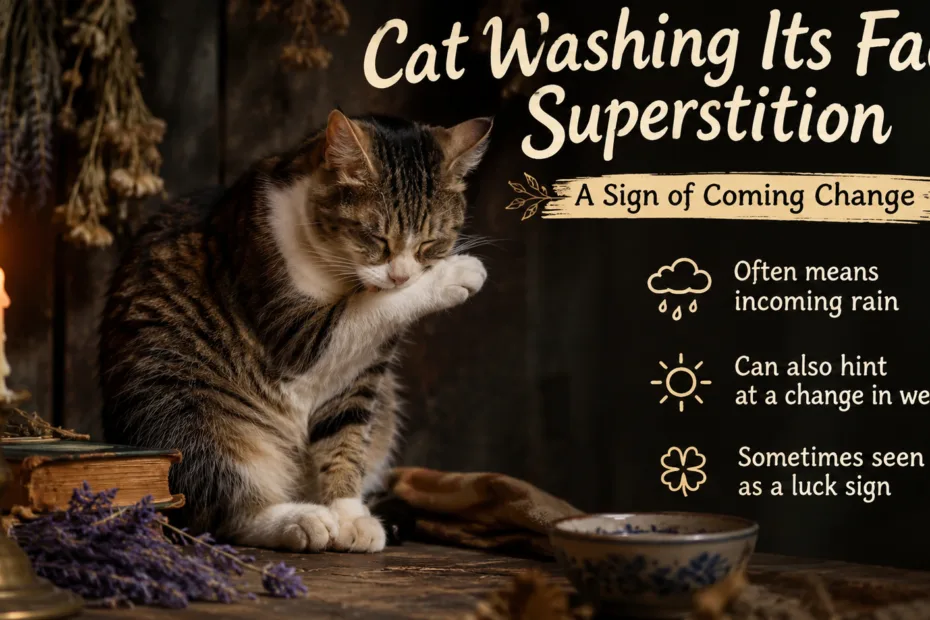
A cat washing its face is traditionally believed to foretell rain, the arrival of visitors, or a change in the weather. The meaning depends on the version of the superstition. Some accounts treat the washing itself as the omen, while others pay attention to whether the cat’s paw passes over its ear or head, where it is sitting, or which direction it faces.
The belief concerns a familiar grooming movement: a cat licks its front paw or foreleg and then rubs it across its face. Folklore collectors have recorded different predictions from this ordinary behavior, including opposite forecasts of rain and clear skies.
When a Cat Washing Its Face Means Rain
One of the oldest documented English versions associates a cat’s face-washing with approaching rain. The important detail is how far the paw travels over the head.
The Paw Passing Over the Head
In his 1643 book Speculum Mundi, John Swan described the way cats moisten their paws with their tongues before washing their faces. He recorded the belief that rain would follow if a cat carried its paws beyond the crown of its head while washing.
This is more specific than the familiar saying that a cat washing its face means rain. In Swan’s account, the paw passing over the top of the head is the particular sign. Folklorist T. F. Thiselton-Dyer later reproduced this account in English Folk-Lore (1880).
Rain the Following Day
Scottish Highland folklore gives the prediction a clearer time frame. John Gregorson Campbell’s Witchcraft & Second Sight in the Highlands & Islands of Scotland, published in 1902, records that a cat washing its face foretells rain the next day.
The Highland account does not require a particular paw movement. Washing the face is enough to carry the meaning, and the expected event is specifically the following day’s rain.
The Japanese Weather Saying
Japanese weather folklore also connects face-washing with rain. The saying neko ga kao o arau to ame ga furu (猫が顔を洗うと雨が降る) means that rain will fall when a cat washes its face.
The Japan Meteorological Agency includes a version referring to a cat washing its face or rubbing its ears among traditional weather sayings collected by its Akita office. This establishes the saying as part of recorded weather lore, although it does not establish face-washing as a dependable forecasting method.
Why Face-Washing Can Also Mean Fair Weather
Not every weather superstition gives the same prediction. In Margaret Cannell’s 1933 collection Signs, Omens, and Portents in Nebraska Folklore, a cat washing its face is listed as a sign of good weather.
The Nebraska version does not specify that the paw must pass over the ear or head. It simply associates the washing action with favorable conditions.
A more detailed exception appears in a 1952 folklore record from Shimane Prefecture, preserved in Japan’s International Research Center for Japanese Studies folklore database. According to this local belief, a cat washing its face while facing north indicates fair weather.
These recorded versions show why the familiar rain interpretation cannot be treated as a universal rule. The same behavior could be read differently, and in some places the direction the cat faced formed part of the prediction.
A Cat Washing Its Face Means Visitors Are Coming
Another established interpretation concerns an approaching guest. Under this belief, seeing a cat wash its face means that someone will visit the household.
Cannell’s Nebraska collection records this visitor omen separately from the fair-weather prediction. The basic form does not identify the visitor or give an exact arrival time.
Washing in Sunshine or Shadow
A more elaborate version in the same collection distinguishes between pleasant and unpleasant company according to where the cat is grooming:
- Washing in sunshine: Pleasant guests are expected.
- Washing in shadow: Unpleasant guests are expected.
In this variation, the location of the cat changes the meaning. The behavior still predicts visitors, but sunlight or shade supposedly indicates whether their arrival will be welcome.
When the Paw Passes the Ear
An early Chinese saying makes a different distinction. The expression 貓洗面過耳,則客至 states that guests will arrive when a cat washes its face past its ears.
The saying appears in the Tang-era work Youyang Zazu, associated with Duan Chengshi. Unlike versions that treat any face-washing as an omen, this one identifies a particular movement: the paw extending beyond the ear.
The raised paw resembles the gesture of the Japanese maneki-neko, or beckoning cat. However, the historical connection between the Chinese face-washing saying and the origin of the Japanese figurine has not been established. A study of Edo-period beckoning-cat traditions published in 2024 questions the proposed direct connection.
Why the Exact Washing Movement Matters
The distinction between washing the face, crossing the ear, and reaching over the crown is part of the recorded folklore. It explains why apparently similar descriptions sometimes carry different meanings.
| Observed Detail | Recorded Interpretation | Historical Context |
|---|---|---|
| Paw passes beyond the crown | Approaching rain | John Swan, England, 1643 |
| Face is washed without a specified movement | Rain the next day | Scottish Highland folklore, published 1902 |
| Face is washed | Good weather | Nebraska folklore, 1933 |
| Face is washed while facing north | Fair weather | Shimane folklore record, 1952 |
| Paw passes beyond the ear | Guests arriving | Early Chinese saying |
| Face is washed in sunshine or shadow | Pleasant or unpleasant guests | Nebraska folklore, 1933 |
The differences are not evidence of a single belief changing according to a fixed set of rules. They are distinct recorded traditions. No consistent rule across these accounts assigns one meaning to the right paw, another to the left, or a prediction to every possible washing direction.
What a Cat Is Actually Doing When It Washes Its Face
Face-washing is a normal part of feline grooming. Cats wet their forepaws and forelegs with saliva and use them to clean parts of the head that are difficult to reach directly with the tongue. The motion may cover the nose, cheeks, ears, and surrounding areas.
A 2026 study by Anna Hock and Manuela Schmidt, published in the Journal of the Experimental Analysis of Behavior, examined grooming behavior recorded from 17 domestic cats. The researchers analyzed 40 grooming sequences from 10 of those cats in greater detail.
They found considerable variation in grooming movements and their order. Face-washing often involved curved strokes over the head, while smaller circular movements were used around the ears and cheeks. The cats did not follow one rigid sequence of grooming actions.
This helps explain why the movements described in old folklore are recognizable everyday behaviors. A paw passing over the head or around an ear is part of normal grooming and does not require an unusual event.
One popular explanation for the rain superstition suggests that changing humidity affects a cat’s whiskers and causes more face-washing. That proposed connection has not been demonstrated as a reliable means of predicting rainfall. Cats groom in many weather conditions, and the 2026 study examined grooming organization rather than weather forecasting.
Other Meanings Attached to Face-Washing
Some historical accounts connect the same grooming behavior to events outside ordinary weather and visitor predictions.
A Friend Arriving or Rain Approaching
G. F. Abbott’s Macedonian Folklore (1903) records a belief that a cat washing its face foretells either the arrival of a friend or approaching rain.
Both interpretations appear together in the same account. The recorded saying does not provide a separate gesture or condition for deciding which event is expected.
The Fish-or-Flesh Omen
George Henderson’s Survivals in Belief Among the Celts (1911) records an unusual belief from Lochbroom, Scotland. A cat washing its face was taken as an indication that it would soon obtain fish or meat.
The account also associates the prediction with fears of misfortune involving livestock. It therefore presents face-washing as a potentially troubling omen rather than a simple promise of food.
The Cat’s First Look After Washing
A darker interpretation appears in Cannell’s Nebraska collection. One recorded superstition claims that the first person a cat looks at after washing its face will die soon.
The important feature of this version is the sequence: the cat first washes its face and then looks toward someone. The supposed omen depends on that subsequent glance, not merely on the washing itself. It is a historical death-omen belief, with no established predictive basis.