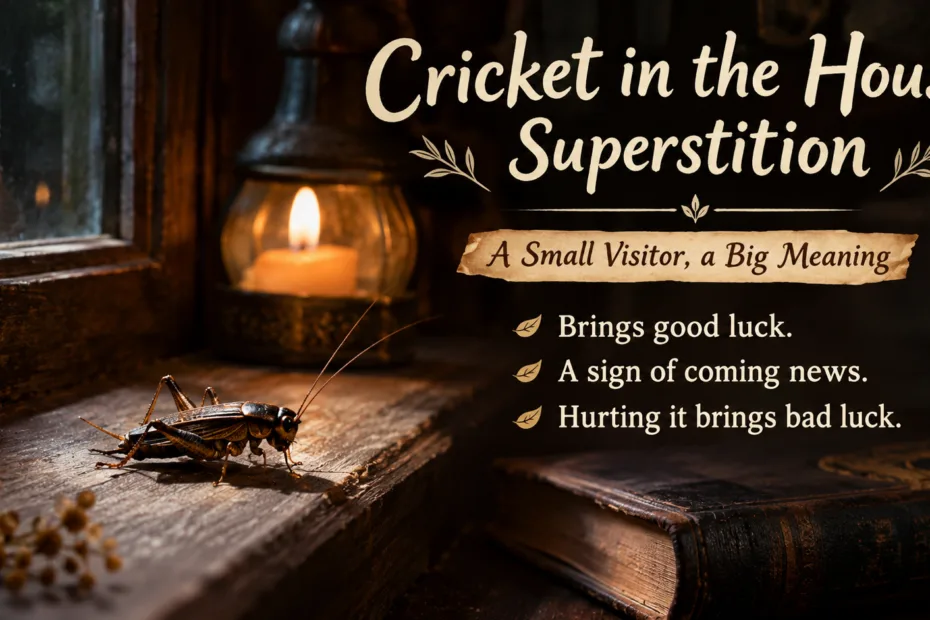
A cricket in the house is traditionally considered a sign of good luck, prosperity, and household happiness. In some recorded folk beliefs, its presence promises that the family will never become poor. Other traditions interpret an unexpected cricket as a warning of sorrow, misfortune, or death. The meaning can change depending on whether the insect has lived in the house for some time, has just arrived, or suddenly disappears.
These contrasting interpretations appear in historical folklore collections, sometimes among communities only a few miles apart. The familiar sound of a cricket near the hearth became associated with the household itself, making its arrival, continued presence, and departure matters of superstition.
The Cricket on the Hearth as a Sign of Good Fortune
In traditional British household folklore, a cricket living near the fireplace was often regarded as a lucky resident. Its regular chirping suggested comfort, domestic happiness, and prosperity. Some families believed that allowing the insect to remain undisturbed would help preserve the household’s good fortune.
Charlotte Sophia Burne’s Shropshire Folk-Lore, published in 1885 from material collected by Georgina F. Jackson and others, records a particularly direct belief from Baschurch and Rodington: a household containing a cricket would never become poor. Other reports from Clun Forest and Longnor simply described crickets as lucky.
The association with the hearth had a practical setting. Traditional fireplaces provided warmth and sheltered spaces where house crickets could live. Their evening chirping became a familiar part of domestic life, especially in homes where the fireplace was the center of family activity.
Charles Dickens drew upon this established association in his 1845 novella The Cricket on the Hearth. Its cricket serves as a protective presence associated with domestic happiness. The literary work reflects an older household belief rather than establishing the superstition itself.
When a Cricket Suddenly Enters the House
A newly arrived cricket was not always welcomed as a lucky visitor. Some traditions distinguished between an insect already living in the home and one that appeared unexpectedly.
In Pulverbatch, Shropshire, a recorded belief held that killing established household crickets was unlucky, while a cricket arriving suddenly and remaining only briefly foretold a death. The distinction depended on the insect’s relationship to the household: a familiar resident could be fortunate, but an unexpected visitor could be ominous.
Other Shropshire accounts were less favorable toward crickets in general. At Worthen, they were described as portents of death. A report from Church Stretton associated their presence with sorrow. At Edgmond, however, the arrival of crickets was considered very lucky.
These records show that the arrival of a cricket did not carry one fixed meaning. Even within a relatively small area, the same event could be interpreted as a welcome sign or a warning of trouble.
Why a Cricket Leaving the House Was Considered Unlucky
In some traditions, an established cricket leaving the house was more worrying than one entering it. The insect’s continued presence represented the household’s good fortune, so its departure suggested that this protection or prosperity might be lost.
A belief recorded at Llandysilio specifically described it as unlucky for crickets to leave after settling in a house. Thomas Firminger Thiselton-Dyer’s English Folk-Lore also describes the departure of crickets from a familiar hearth as an omen of approaching misfortune, sometimes even death.
The following distinctions appear in historical records:
| Cricket’s Behavior | Recorded Interpretation |
|---|---|
| Living in the house | Continued prosperity and freedom from poverty in accounts from Baschurch and Rodington. |
| Arriving unexpectedly for a short stay | A death omen in the Pulverbatch tradition. |
| Leaving after settling in the house | Bad luck in the Llandysilio account. |
| Coming into or leaving the house | A change in household circumstances in a collected tradition from County Cavan, Ireland. |
The Irish account, preserved in the National Folklore Collection’s Schools’ Collection at Drung, County Cavan, describes crickets as arriving and departing when changes occur in a household. The record does not assign every such change a favorable or unfavorable outcome.
Another variation appears in Harry Middleton Hyatt’s Folk-Lore from Adams County, Illinois, published in 1935. One collected saying associates a cricket that stops calling and leaves the house with forthcoming sickness. Here, the loss of both the insect’s presence and its familiar sound forms part of the omen.
What Does a Cricket Chirping Inside the House Mean?
The sound of a cricket often mattered as much as seeing the insect. Some household traditions regarded chirping as a sign of prosperity, while others interpreted particular calls as warnings. The number of chirps and the circumstances in which they were heard could affect the interpretation.
Chirping as a Sign of Happiness and Prosperity
A regularly chirping cricket was sometimes believed to indicate a happy and prosperous home. Its familiar sound suggested that the household’s luck remained undisturbed.
Hyatt’s collection from Adams County, Illinois, includes several variations: hearing crickets sing was considered lucky, hearing them after going to bed promised good fortune, and crickets singing inside the house were associated with prosperity. Another recorded saying connected their chirping with future success.
These are individual collected beliefs, not rules that were necessarily shared by every household in the region.
Three Chirps as a Warning of Death
A more specific superstition was recorded around Wenlock in Shropshire. According to the collected account, a cricket chirping three times was regarded as a sign of death. The same local tradition considered the cricket’s arrival unlucky.
The number three belongs to this particular recorded variation. It should not be treated as a universal rule for interpreting cricket sounds.
Actual cricket songs also consist of repeated sound patterns. A single audible chirp may contain several pulses produced by wing movements, making the traditional act of counting calls different from a biological description of the insect’s song.
Chirping, Rain, and Unexpected Silence
The natural connection between cricket activity and weather helped make its song a subject of household prediction.
Naturalist Gilbert White described the house cricket as a familiar domestic presence whose sound could be interpreted as a forecast of rain or as an omen concerning good luck, death in the family, or the return of an absent loved one. These were beliefs attributed to household observers, rather than established powers of the insect.
Crickets produce sound through a process called stridulation. Adult males of singing species rub specialized parts of their forewings together, mainly to attract females or communicate with other males. Temperature can influence the rate of chirping, while movement or disturbance may cause a cricket to stop calling.
A sudden silence therefore does not necessarily mean that the cricket has left the house. It may have stopped singing while remaining hidden nearby. This distinction matters because some recorded omens refer specifically to a cricket’s departure, not merely a pause in its song.
Why Killing a House Cricket Was Thought to Bring Bad Luck
Where the house cricket was considered fortunate, deliberately killing it could be regarded as an act that invited misfortune. Removing the insect by killing it was believed to destroy or drive away the luck associated with its presence.
The Shropshire records include warnings against killing crickets at Guilsfield and Edgmond. At Edgmond, both the arrival of crickets and the prohibition against destroying them formed part of the same belief. In Pulverbatch, the warning applied specifically to crickets already living in the house.
An older explanation connected the taboo with hospitality. The antiquarian Francis Grose, whose interpretation was discussed by later folklore writers, suggested that killing a cricket might be considered unlucky because it violated the hospitality owed to a small creature that had taken refuge indoors.
A different consequence appears in the County Cavan account preserved in the Schools’ Collection. Some people reportedly believed that if a cricket was killed, other crickets would damage clothing in retaliation. The story gave the killing of a household insect a consequence beyond the loss of ordinary good luck.
These prohibitions were not universal, even in areas where crickets carried supernatural associations. Their meaning depended on whether the insect was regarded as a welcome member of the household or an unwanted omen.