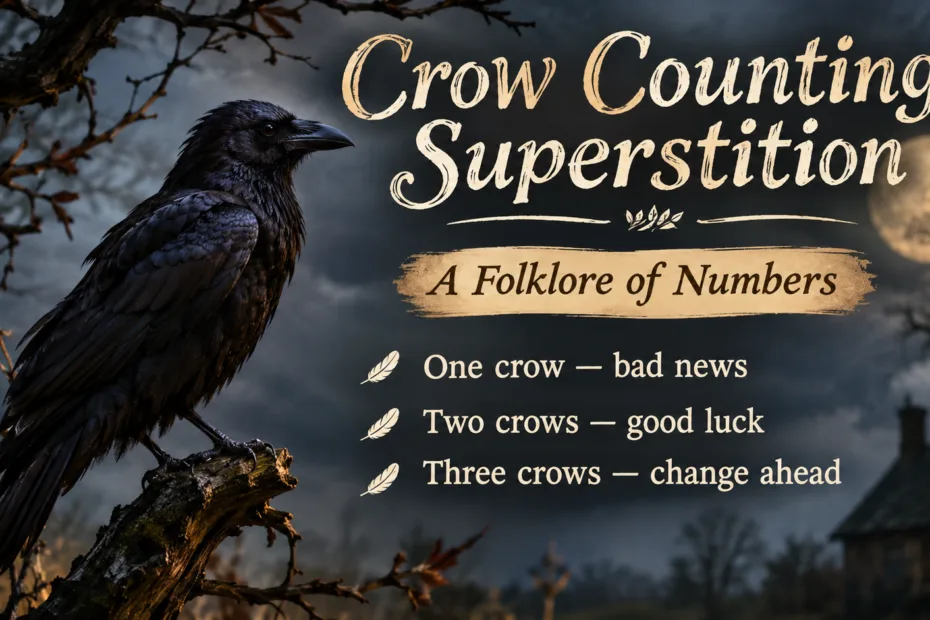
The crow counting superstition interprets the number of crows seen together as an omen of future events. In several recorded traditions, one crow represents sorrow or bad luck, while two crows indicate joy or good fortune. Larger numbers have been associated with weddings, births, messages, wealth, secrets, and sometimes death.
These meanings are preserved in traditional counting rhymes, including versions of “One for sorrow, two for joy.” The rhyme also belongs to magpie folklore, and its wording differs between communities. There is no single historical sequence that assigns the same meaning to every number of crows.
What Does the Number of Crows Mean?
Historical folklore collections preserve several interpretations of crow numbers. The first two are relatively consistent across the records, while the meanings of three or more crows vary considerably.
| Crows Seen | Recorded Folklore Meanings | Traditional Context |
|---|---|---|
| One | Sorrow, misfortune, or bad luck | Recorded in Welsh, English, and Newfoundland crow beliefs. |
| Two | Joy, good fortune, or favorable luck | The fortunate counterpart to seeing a solitary crow. |
| Three | A wedding, a letter, or death | Different meanings appear in Newfoundland traditions, British children’s rhymes, and a nineteenth-century Leeds record. |
| Four | A boy, a birth, or a wedding | Interpretations change between counting-rhyme versions and local records. |
| Five | Silver | Appears in an extended counting rhyme recorded in Newfoundland folklore. |
| Six | Gold | Follows the silver reference in the same extended rhyme tradition. |
| Seven | A secret that must remain untold | Appears in longer versions of the bird-counting rhyme. |
The silver, gold, and secret interpretations are also familiar from magpie-counting verses. Their appearance in a crow rhyme does not establish a separate, universal crow-counting system.
Why One Crow Is Unlucky and Two Are Lucky
The contrast between a solitary crow and a pair is one of the clearest recurring features of this superstition.
Elias Owen’s Welsh Folk-Lore records a Welsh saying that links seeing one black crow with bad luck. A corresponding saying interprets two black crows as fortunate. Owen also describes protective words and gestures associated with the appearance of a lone crow.
The distinction appears in English records as well. Jacqueline Simpson and Steve Roud’s A Dictionary of English Folklore preserves a belief reported in Leeds during the 1860s: one crow represented bad luck, whereas two represented good luck.
Iona and Peter Opie’s 1959 study The Lore and Language of Schoolchildren documents the same contrast among children. In some accounts, seeing a solitary crow was especially unlucky if nobody else witnessed it. The presence of a second crow changed the interpretation to a favorable omen.
The importance of the pair: In these recorded traditions, a second crow changes the meaning of the sighting. The bird itself is not assigned a permanently fortunate or unfortunate character; the number observed determines the omen.
The Traditional Crow Counting Rhyme
One recorded Newfoundland version begins with four predictions:
One for sorrow,
Two for joy,
Three for a wedding,
Four for a boy.
A crow-counting verse recorded in Newfoundland folklore and discussed in Kelly Roubo’s 2002–2003 study of bird omens.
Other collected versions continue with five for silver, six for gold, and seven for a secret that must not be told.
The rhyme translates an ordinary observation into a prediction. The person sees a number of birds and matches that number to a remembered line. Because the words are short and rhythmic, variations can circulate through family tradition, children’s games, and everyday speech.
Why Three or Four Crows Can Have Different Meanings
The historical evidence contains conflicting predictions for the same number of birds.
Three for Death, Four for a Wedding
A recorded local belief assigned death to three crows and a wedding to four. This differs from the better-known rhyme in which three birds predict a wedding.
Three for a Letter, Four for a Boy
The Opies documented a children’s counting verse in which three crows foretold a letter and four indicated a boy.
Three for a Wedding, Four for a Boy
A locally recorded rhyme associated three crows with a wedding and four with a boy. Other Newfoundland crow omens connected groups of three with death instead.
The Newfoundland material is particularly revealing because both favorable and unfavorable interpretations of three crows appear in accounts associated with the region. The rhyme could predict a wedding, while another recorded belief regarded three crows flying together as a death omen.
These differences show why a list of crow numbers should be identified as a particular folklore version rather than presented as an agreed set of predictions.
How Crow Counting Became Connected With Magpie Folklore
The familiar “One for sorrow” family of rhymes is strongly associated with magpies in British and Irish folklore. Early recorded versions of magpie counting appeared by the late eighteenth century, and later collections preserve many different lines and endings.
Both crows and magpies belong to the crow family, Corvidae, although they are different birds. Their related appearance and their presence in bird-omen traditions helped the same numerical verses become attached to more than one species.
The Roud Folk Song Index records the counting-rhyme family under “One for Sorrow,” with versions involving both magpies and crows. Crow versions are documented in places including Maine and Newfoundland, while magpie versions are prominent in British material.
Not every magpie-counting variation should therefore be labeled an original crow superstition. Some familiar lines, particularly those involving a girl, a boy, silver, and gold, are shared between different versions of the rhyme.
Traditional Ways of Responding to an Unlucky Crow Count
Some accounts describe a response intended to prevent the bad luck associated with seeing a single crow.
In the Welsh traditions recorded by Elias Owen, a person could address the crow with protective words or make the sign of a cross on the ground. The spoken response was understood as a way of rejecting the unfavorable omen.
Newfoundland folklore also preserves gestures intended to avert a crow-related warning. These included crossing the fingers, making the sign of the cross, or drawing a cross-shaped sign between the observer and the bird.
Such actions belonged to the belief that an unfavorable omen could be counteracted. They were ritual responses within particular traditions, not evidence that the number of birds could alter future events.
Does Crow Counting Mean Counting Birds or Their Calls?
The traditional numerical rhyme concerns the number of crows seen, usually during a single encounter. One crow calling several times is not equivalent to seeing several separate crows.
Other bird-omen traditions interpret the number or pattern of a bird’s calls, but those beliefs require their own evidence. A rhyme about three visible crows cannot automatically be applied to three calls from one bird.
Historical records also do not establish a standard distance, observation period, or rule for whether a crow that leaves and returns should be counted again. The practice is usually described as an observed sighting rather than a precisely defined counting procedure.
Ordinary crow behavior can produce these encounters. Crows may appear alone, in pairs, or in larger groups while feeding, traveling, or gathering at communal roosts. The counting superstition gives those changing numbers a traditional meaning, but the sightings themselves do not provide reliable predictions of personal fortune.