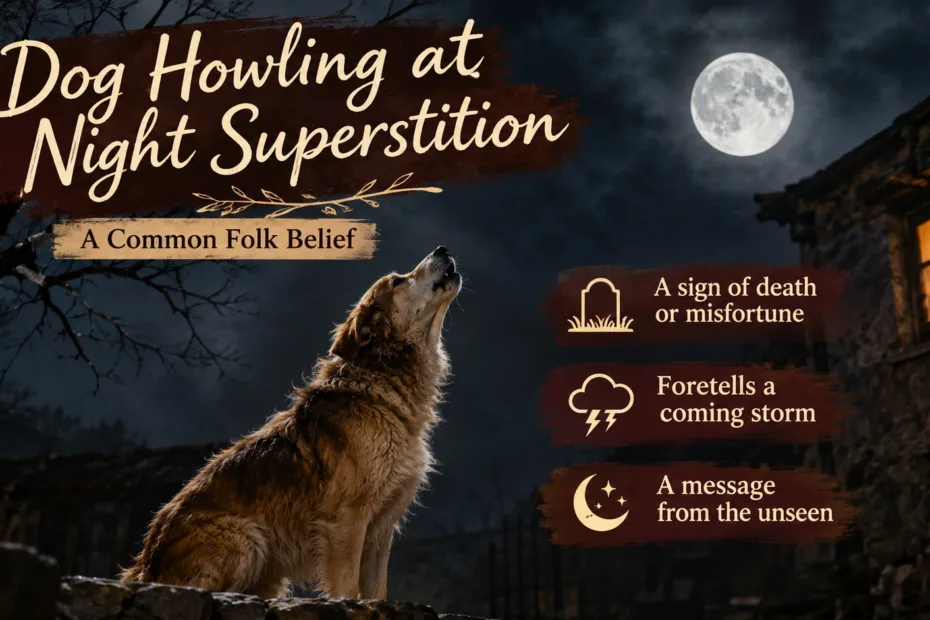
In a widespread folk superstition, a dog howling at night is believed to warn of an approaching death. The sound is considered especially ominous when the dog howls outside a house, near a sick person’s home, or repeatedly without an obvious cause. Some versions predict a death within the household, while others associate the howl with a relative, a neighbor, or a more general misfortune.
The belief has been recorded in historical folklore collections, but its meaning is not identical in every tradition. The dog’s location, the direction of its head, and the circumstances surrounding the sound could all influence the interpretation. These are traditional predictions rather than established abilities of dogs.
Why a Dog Howling at Night Was Considered a Death Omen
The central superstition treats a dog’s howl as a warning that someone may soon die. In older accounts, the animal was sometimes thought to recognize approaching death before the people around it became aware of any danger.
Thomas Firminger Thiselton-Dyer described the belief in his 1881 book Domestic Folk-Lore. In his discussion of death warnings, he identified the nighttime howling of dogs as a familiar omen. He also observed that people facing illness or an expected death might become especially sensitive to unusual sounds.
The interpretation depended partly on the difference between ordinary barking and prolonged howling. A brief bark could indicate a passing person or another animal. A drawn-out, mournful howl, particularly during an otherwise quiet night, was more likely to attract attention and be remembered as a warning.
In some accounts, the dog was believed to announce a death that had not yet occurred. In others, the sound was connected with a death taking place elsewhere. The superstition did not establish a consistent interval between the howl and the event it supposedly foretold.
Why Howling Outside a House Was Especially Ominous
A dog howling near a particular dwelling was often interpreted differently from one heard somewhere in the distance. Its location appeared to identify the people affected by the warning.
A Dog Howling at the Door
In some death-omen traditions, a dog remaining outside a doorway and howling was believed to signal a death among the occupants. The association was particularly strong when the animal appeared reluctant to leave.
The doorway gave the sound a specific setting. Instead of an unidentified dog calling somewhere in the neighborhood, the animal seemed to direct its attention toward one household. This made it easier for observers to connect the howl with the circumstances of the people living inside.
A record from the Irish Schools’ Collection at Mohill, County Leitrim, preserves the belief that a dog howling outside a house signified a death. The record identifies the location of the howl without specifying how soon the supposed death would occur.
Howling Near a Sick Person
The presence of an ill person could give an ordinary sound a more troubling meaning. Some historical interpretations held that a dog could detect approaching death through its senses. Others attributed the behavior to spirits believed to gather near the dying.
These explanations belonged to different understandings of the same omen. One imagined the animal detecting a physical change; the other gave it awareness of unseen beings.
The Howling Dog at Worthing
An unusually detailed example was recorded in nineteenth-century Sussex folklore. A Newfoundland dog was reported howling near a house in Worthing where a young woman who had been ill for some time died. The coincidence caused considerable alarm among people who regarded the dog’s behavior as a warning.
When the circumstances were investigated, the dog was found to have become separated from its owner. It had wandered through places associated with the owner, calling at several locations while searching for him. The owner had also visited the house connected with the death.
The earlier account in Some West Sussex Superstitions Lingering in 1868 further describes how witnesses came to associate the sound with the house where the death occurred, although the dog had been heard elsewhere nearby.
The incident illustrates how a real death and a real animal sound could become linked through their apparent proximity, even when the dog’s behavior had an independent explanation.
Did the Direction of the Dog’s Head Change the Omen?
Some recorded superstitions attached different predictions to the position of a dog’s muzzle while it howled. The distinction could separate a warning of death from a warning of fire.
Howling with the Head Lowered
In examples preserved by the James T. Callow Folklore Archive, a dog howling with its muzzle pointed downward was interpreted as a sign that someone would die.
Howling with the Head Raised
In those same recorded versions, an upward-pointing muzzle was associated with an approaching fire rather than a death.
The archive includes a head-direction belief recorded as having been learned in Hungary and another collected in Detroit. Their similar wording preserves a particular interpretation, not a universal rule.
Other traditions reverse part of this distinction. Accounts of death-related beliefs in Anatolia describe a dog lifting its head toward the sky while howling near a house or doorway as a warning that a relative may die.
Consequently, the meaning of an upward howl cannot be determined from the animal’s posture alone. The reported interpretation depends on the particular tradition being examined.
Could a Howling Dog See Spirits or Sense Death?
One explanation behind the superstition was that dogs possessed senses unavailable to humans. Their ability to notice sounds, scents, and movements that people might overlook helped make unusual behavior appear mysterious.
In Domestic Folk-Lore, Thiselton-Dyer describes two explanations offered for the supposed connection between dogs and approaching death:
- Detecting a change associated with dying: Some people believed that a dog’s sensitive nose allowed it to recognize the approach of death.
- Seeing unseen spirits: Others believed that dogs could perceive spirits gathering near a sick person’s home and responded by howling.
The second explanation places the dog between the ordinary household and a supernatural understanding of death. The animal’s unusual reaction was treated as evidence that something invisible was present.
These beliefs concern supernatural perception, not a demonstrated ability to foretell a person’s death. Dogs can notice environmental changes that humans miss, but noticing a smell or sound does not establish that an animal knows when someone will die.
Why the Omen Was Associated with Nighttime
Night was an important part of the superstition because a howl could be particularly noticeable when other activity had diminished. A distant dog might be heard without its location or reason for calling being clear.
The sound also fitted older associations between darkness, uncertainty, and unseen activity. In this setting, people could interpret a dog’s call as something more than animal communication.
Nighttime was not an absolute requirement in every recorded version. Some folklore entries identify howling as a death omen without specifying an hour. Others explicitly mention a dog crying at night or near a house after dark.
Repeated Howling and the Length of the Cry
Long, repeated, or unusually mournful howling was particularly memorable in accounts of death warnings. The repetition could increase concern because the sound continued after observers had noticed it.
However, there is no single number of howls that defines this superstition. Although individual folk records sometimes mention a particular count, those details cannot be applied to every version of the belief.
Was the Dog Howling at the Moon?
The familiar image of a dog lifting its head toward the moon has sometimes become mixed with nighttime omens. Yet the moon is not a necessary part of the death prediction in the historical accounts.
Dogs commonly raise their muzzles when howling, whether the moon is visible or not. There is no established rule that a dog howling during a full moon is predicting death, and the appearance of the moon does not make an otherwise ordinary howl a reliable warning.
What Might Actually Cause a Dog to Howl at Night?
Howling is a natural form of canine vocal communication. Dogs use it to announce their presence, communicate with other dogs, and respond to sounds in their environment.
A dog may begin howling after hearing another dog, a distant siren, or a high-pitched noise. Some howl when separated from their owners. Others vocalize in response to excitement, attention-seeking, or distress.
According to veterinary behavior guidance, a sudden change in howling can sometimes be associated with pain or illness. A normally quiet dog that begins howling persistently, especially with other signs of discomfort, may need veterinary attention.
Folklore and animal behavior: The historical omen describes the meaning people assigned to a howl. The sound itself does not establish that a death, fire, or supernatural event is approaching. Its immediate cause may be another animal, a sound, separation-related distress, or a health problem.
How People Tried to Prevent the Misfortune
Some communities developed customs intended to stop a dog’s ominous howling or prevent the event it was thought to announce. These practices provide another aspect of the superstition: the belief that an unwanted prediction might be interrupted through a symbolic action.
Turning a Shoe to Stop the Howling
English folklore collected by Thiselton-Dyer includes a custom from Norfolk in which turning the left shoe was said to quiet a howling dog. A more elaborate version from Staffordshire involved placing the shoe upside down and performing additional actions intended to protect the person from harm.
Such customs connected an ordinary household object with an attempt to reverse an ominous sign. Their purpose was symbolic; the recorded belief does not demonstrate that the ritual could influence either the animal’s behavior or future events.
Offering Bread and Reversing a Slipper
Traditional death-related beliefs recorded in Ahlat, eastern Anatolia, include giving bread to a howling dog and turning a slipper over as responses to the feared omen. The customs appear among practices intended to keep death or misfortune away.
The same local record identifies dog howling among behaviors considered possible signs of an approaching death. Offering food and changing the position of a household object were separate responses to that interpretation.
These historical practices differed in their details, but both show how people attempted to act upon a warning that could not otherwise be explained or controlled.