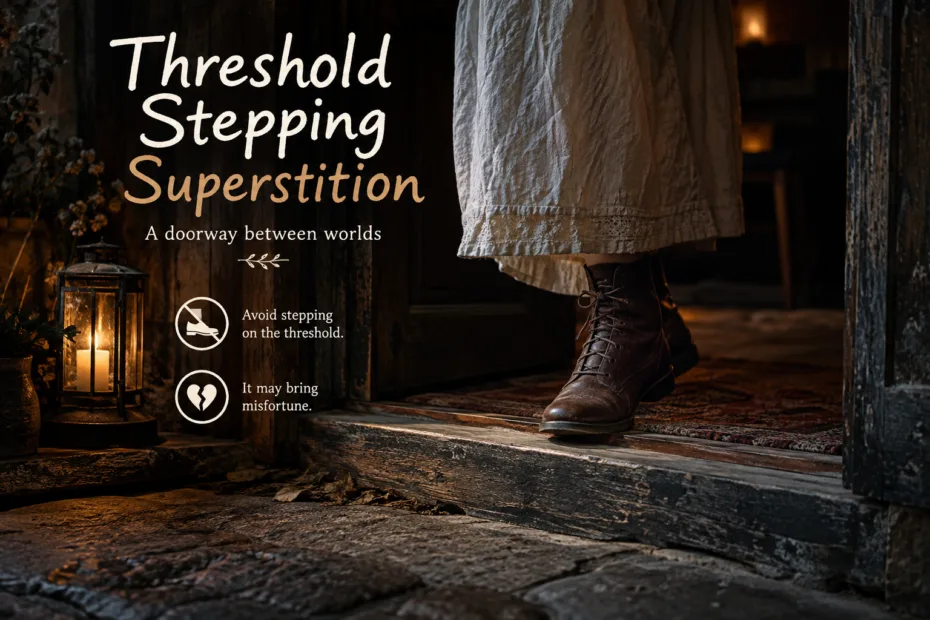
The threshold stepping superstition holds that a person should step over a doorway threshold rather than place a foot directly on it. The avoided act and its predicted consequence vary by tradition, but the threshold itself is commonly treated as a meaningful boundary between the household and the space beyond it.
Why Stepping on the Threshold Is Avoided
A threshold is the sill at the bottom of a doorway. In ordinary architecture it marks the point where one space ends and another begins. Folk traditions can give that physical boundary an added social or protective meaning.
Under the superstition, placing a foot directly on this boundary may be treated as disrespectful, unlucky, or disruptive. The customary response is simple: cross the threshold without standing or stepping on it.
Crossing cleanly into the house or room while leaving the sill untouched.
Placing the foot directly on the sill, which some traditions associate with bad luck or disturbance of the household boundary.
The Consequence Is Not the Same Everywhere
There is no single worldwide prediction attached to stepping on a threshold. Recorded versions give different reasons for avoiding it.
Some Chinese folklore records connect the act with shortened life or death within the family. Korean accounts may describe stepping on the sill as driving away good fortune or inviting bad luck. Turkish folk-belief records also warn against stepping on a doorway threshold, although the consequence recorded there can differ from the East Asian explanations.
These are local interpretations of the same basic avoidance rule, not interchangeable versions of one universal belief. A warning learned in one household may simply say that stepping on the sill is unlucky, while another tradition may attach a much more specific outcome to it.
The most stable part of the superstition is the action itself: avoid putting the foot on the threshold. The explanation for doing so is much more variable.
Why the Doorway Becomes a Special Boundary
Folklore concerning doors often treats the entrance of a home differently from ordinary floor space. The doorway controls movement between inside and outside, so beliefs about protection, welcome, danger, luck, and household order can gather around it.
Research on door and threshold traditions has documented protective practices performed at entrances and objects placed beneath thresholds. Such customs reflect the idea that the doorway is not merely part of the building. In some belief systems it also marks the point where the protected household meets what lies outside.
This helps explain why touching the threshold with the foot can carry more meaning than stepping on another piece of wood or stone. The action occurs directly on the line that separates two spaces.
Respect for the Threshold Has a Long Record
Historical folklore collections describe communities in which thresholds were crossed carefully and were not supposed to be trodden upon. Some records associate the sill with household protection or sacred space, while others simply preserve a rule that people should step over it.
Older records should not be read as evidence that every community understood the custom in the same way. Threshold beliefs developed in different religious, domestic, and regional settings. Similar behavior can therefore survive with very different explanations.
The rule may also function as etiquette rather than as a strongly held supernatural belief. Raised thresholds in traditional buildings naturally require a deliberate step, and avoiding the sill can remain customary even when the older reason for the practice is no longer known or accepted.
Which Threshold Does the Belief Apply To?
The main entrance of a home often receives the most attention because it forms the clearest boundary between the household and the outside. Some recorded versions, however, extend the prohibition to thresholds between rooms as well.
This difference matters when describing the superstition. Avoiding the front-door sill, avoiding every raised interior threshold, and avoiding standing in a doorway are related practices, but they are not always treated as exactly the same rule.
For the threshold stepping superstition itself, the defining action remains crossing the sill without putting a foot directly on it.