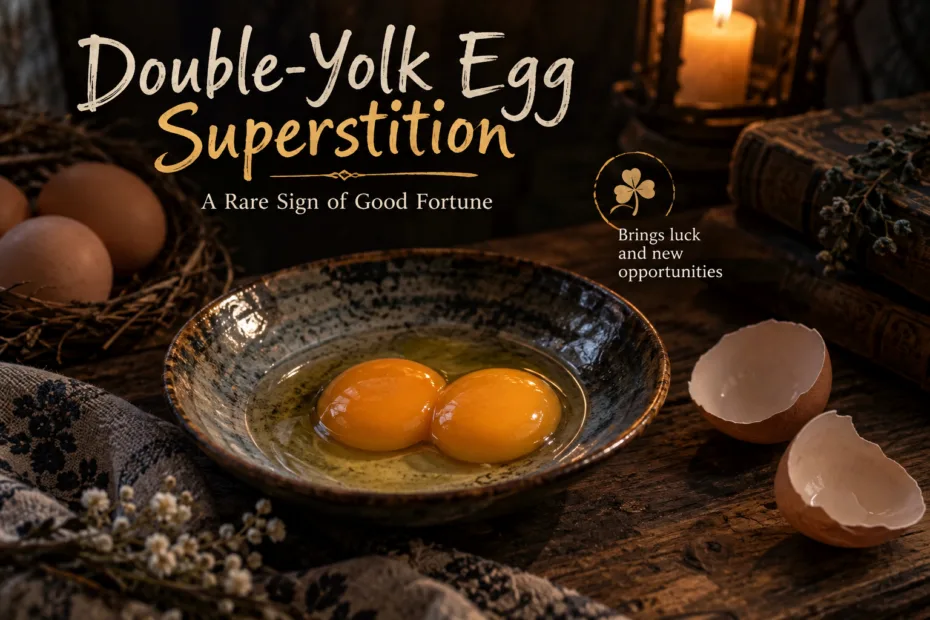
Finding two yolks inside a single egg has been interpreted as an omen in several folk traditions. Recorded meanings connect the doubled yolk with twins, pregnancy, marriage, fertility, or good fortune, while other traditions regard the same discovery as a warning of delayed marriage, infertility, or death.
What a Double-Yolk Egg Is Believed to Mean
The superstition begins with an unexpected sight: one shell contains two yolks where only one is normally expected. Folk explanations sometimes turn that visible doubling into a prediction that something else will also come in pairs.
This is why pregnancy and twins appear in double-yolk beliefs. In one recorded form, discovering the egg is taken as a sign that someone in the family is pregnant. If a pregnancy is already known, the two yolks may be interpreted as a prediction of twins.
Marriage is another documented interpretation. In parts of British folklore, finding a double-yolked egg was associated with an approaching wedding. Other traditions warned that eating such an egg could delay marriage.
Some accounts give the egg a broader positive meaning. Rather than predicting a particular event, the unusual egg may simply be regarded as a lucky find associated with prosperity or approaching good fortune.
A double yolk does not carry one fixed meaning across folklore. Recorded interpretations range from birth, marriage, and luck to warnings, taboos, and death omens. The same natural occurrence can therefore be favorable in one tradition and troubling in another.
The Link Between Double Yolks and Twins
The connection with twins appears in several documented traditions and is easy to understand through folk symbolism: one egg unexpectedly contains two yolks. This visible duplication was associated with the idea of two children developing during one pregnancy.
Bulgarian folklore, for example, preserved a belief that a pregnant woman could bear twins after violating a prohibition against eating an egg with a double yolk. The same unusual egg also appeared in customs involving twins themselves, showing that its doubled structure carried meaning beyond a simple prediction.
An ethnographic account of Mapuche (Araucanian) communities in Chile’s Alepue area records a similar prohibition. A pregnant woman and her husband were expected to avoid eating the double yolk of an egg because doing so was believed to result in twins. The account also records that informants from another community did not share this belief.
In these examples, the egg does not merely announce the future. Eating it is treated as an act that could influence the pregnancy. The association belongs to traditional belief rather than a biological relationship between double-yolk eggs and human multiple births.
Double-Yolk Eggs as Marriage Omens
Marriage predictions involving double-yolk eggs are documented in British folklore. The meaning depends on the particular tradition, including whether the egg is simply discovered or eaten.
A Wedding Omen in Somerset, England
In Somerset, a county in southwestern England, a double-yolked egg was traditionally interpreted as a warning of an approaching wedding. The version described in British superstition collections specifically associated the discovery with a hurried marriage following an unexpected pregnancy.
The prediction was not necessarily regarded as good news. The concern attached to the omen came from the circumstances believed to bring about the wedding, rather than from marriage itself.
This regional interpretation is described in accounts of British household superstitions, including Ellen Castelow’s 2015 account of British superstitions published by Historic UK. The tradition is also recorded in later collections discussing the different meanings assigned to eggs.
The Somerset belief concerns an approaching marriage, but does not establish that the person who discovers the egg will be the one getting married. The surviving descriptions also do not provide a fixed interval between finding the egg and the predicted event.
A Lithuanian Belief About Delayed Marriage
A contrasting marriage belief appears in Lithuanian folklore. According to a tradition preserved in Meilės magija: Lietuvių vedybiniai ir meilės burtai (2000), a young unmarried woman was warned against eating an egg with two yolks because doing so was believed to delay her marriage for a long time.
Ethnologists Rimantas Balsys and Maryna Ponomarenko discuss this belief in their 2025 study of Lithuanian and Ukrainian egg traditions, citing the Lithuanian marriage-magic collection.
The distinction between the two marriage beliefs is important. In the Somerset account, encountering the unusual egg foretells a wedding. In the Lithuanian account, eating the egg is the prohibited action, and delayed marriage is the feared consequence.
Neither account establishes a universal connection between double yolks and marriage. They preserve different interpretations of the same unusual feature within particular folkloric settings.
When the Double Yolk Becomes a Warning
Not every interpretation treats duplication as abundance. British superstition records include a darker reading in which a double-yolked egg could foretell a death. A poultry folklore column published in New Zealand’s Otago Witness on December 25, 1918, likewise described the laying of a double-yolked egg as an unlucky event associated with the death of a relative.
Another recorded belief moves in a different direction. A German-American custom collected in Detroit, Michigan, and associated with approximately 1930 warned women against eating double-yolked eggs because they were believed to cause infertility. The belief is preserved in the University of Detroit Mercy’s James T. Callow Folklore Archive.
This directly conflicts with beliefs that make the same egg a symbol of pregnancy or increased fertility. The Lithuanian marriage taboo also shows how eating a double-yolk egg could be considered undesirable even where finding one was not necessarily interpreted as a bad omen.
Such contradictions occur in folk traditions because an unusual object can acquire different meanings in different communities. A particular interpretation should therefore be connected to its recorded context rather than presented as the meaning of every double-yolk egg.
Why the Egg Looks Unusual
A double-yolk egg forms when a hen releases two yolks close together and both travel through the reproductive tract before the shell is completed. They then become enclosed within the same egg.
Double yolks are especially associated with young hens whose laying cycles are still becoming regular, although other hens can produce them as well. The egg is therefore a natural variation in egg formation rather than a biological sign of events in the household.
Two yolks also do not necessarily mean that an egg contains two developing chicks. Fertilization and successful embryo development are separate processes, and double-yolk eggs rarely produce viable twin chicks.
The unusual appearance still matters to the folklore. Breaking an ordinary-looking shell and unexpectedly finding two yolks creates a memorable household event that can be associated with birth, marriage, luck, or misfortune.
Why the Superstition Has Several Opposite Meanings
The two yolks can support more than one symbolic reading. In birth-related beliefs, they suggest twins or an increase in fertility. In marriage folklore, the association may involve an approaching wedding or a prohibition intended to avoid delaying marriage.
The difference also depends on what happens to the egg. Discovering a double yolk can be interpreted as an omen, while eating it may be treated as an action capable of influencing an expected event.
For the twin-related superstition, the symbolism is especially direct: one shell contains two yolks, resembling the idea of one pregnancy producing two children. Marriage interpretations are less uniform and have to be understood through their individual recorded forms.
These beliefs do not establish that a double-yolk egg can predict pregnancy, twins, marriage, or misfortune. They document the different meanings people have attached to an unusual but naturally occurring feature of an egg.