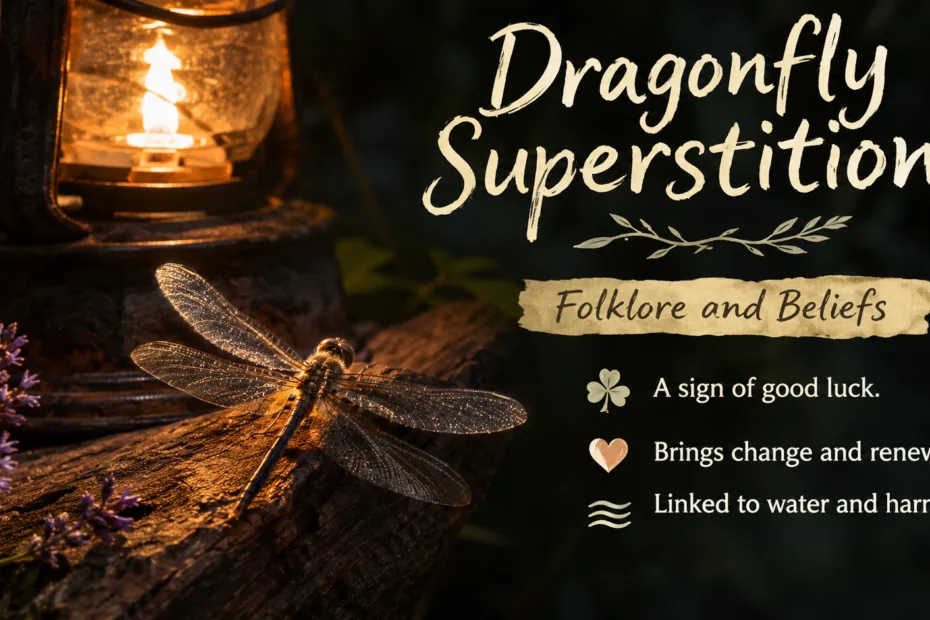
A dragonfly appearing nearby has been treated as a sign of good luck, an opportunity to make a wish, or a warning of danger. Some traditional beliefs give the insect unusual powers, including the ability to sew a person’s eyes shut, restore an injured snake, or foretell rain through its flight.
Dragonfly superstitions differ in what gives the encounter meaning. Some depend on simply seeing the insect. Others concern its movements, its contact with a person, or the consequences of harming it. These distinctions appear in recorded folklore, traditional names, and customs associated with dragonflies and their close relatives.
Seeing a Dragonfly: Good Luck and Making a Wish
In a recorded Cambridgeshire tradition, seeing a dragonfly was considered lucky. The person who spotted it could cross their fingers and make a wish. The gesture was part of the custom, rather than a separate belief that every dragonfly automatically granted wishes.
The tradition also included a warning against harming or killing dragonflies, which was regarded as unlucky. This gave the insect a protected place in local belief: its appearance could bring good fortune, while deliberately injuring it could bring the opposite.
These customs show how a chance encounter became a moment for a particular action. The person had to notice the dragonfly and, in the wish-making version, respond by crossing their fingers.
A dragonfly landing on someone’s hand, shoulder, or clothing is sometimes interpreted today as a particularly lucky encounter. However, a fixed traditional rule assigning a distinct meaning to each landing place is not established by the Cambridgeshire account. The recorded custom concerns seeing the insect, not where it lands.
The Devil’s Darning Needle: The Belief That Dragonflies Could Sew Eyes Shut
One of the best-known frightening beliefs associated with dragonflies and damselflies appears in the name Devil’s Darning Needle.
According to an old British account, a person who fell asleep beside a stream on a summer day risked having their eyelids sewn together by the insects. Their long, narrow bodies were imagined as needles capable of stitching human skin.
Related versions extended the threat to lips, ears, and other body parts. In some accounts, children who lied, used bad language, or behaved badly were warned that the insects might sew their mouths or eyes shut.
The threatened injury often depended on a specific action, such as falling asleep near water or breaking an expected rule of behavior. This made the tale suitable for warnings passed between adults and children.
Why Dragonflies Were Called Horse-Stingers
Another British folk name, Horse-Stinger, reflects the belief that dragonflies could sting horses.
Large dragonflies were sometimes seen flying around horses in fields. These insects were often hunting the flies attracted to the animals. When a biting fly caused a horse to twitch or move suddenly, an observer might blame the larger, more visible dragonfly.
A dragonfly held in the hand may also curl its abdomen in a way that resembles an attempt to sting. Such movements could strengthen the impression that the insect carried a hidden weapon.
Dragonflies have no stinging apparatus. Their mouthparts can bite, especially when a large insect is handled, but the feared sting described in the old name does not exist.
The Dragonfly That Could Steal Hair or Cause Blindness
Swedish folk traditions preserved other fears about dragonflies approaching the human body.
A record collected in 1907 from Resele parish in Ångermanland describes an insect called hårsnäla, associated with taking people’s hair. According to the belief, if it caught even a single strand, the person who lost that hair would become bald.
A related account recorded in Ragunda parish, Jämtland, in 1963 describes dragonflies as pulling hair from people’s heads. These records preserve particular local beliefs rather than a rule shared throughout Sweden.
Other traditional names carried fears about eyesight. The Swedish dialect name blindsticka, associated with eye-stinging and blindness, reflects the idea that the insect could injure a person’s eyes.
The Swedish Institute for Language and Folklore preserves these accounts alongside older regional names. Their wording shows how the imagined danger could become part of the insect’s everyday name.
Snake Doctor: The Dragonfly That Could Heal an Injured Snake
The folk name Snake Doctor comes from a different kind of belief. Instead of threatening people, the dragonfly was imagined as an assistant or healer to snakes.
In folklore recorded in the southern United States, a dragonfly could supposedly repair an injured snake. One Texas belief held that a snake could be cured by a snake doctor provided its head had not been cut off.
Other accounts describe dragonflies accompanying snakes, warning them of approaching danger, or helping them find food. The insect’s appearance could therefore be interpreted as an indication that a snake was somewhere nearby.
The association also produced warnings against harming dragonflies. In some versions, a snake might retaliate if someone injured or killed its supposed helper.
The expression Snake Doctor is closely related to names such as Snake Servant and Snake Pilot. The Welsh name gwas-y-neidr, meaning “adder’s servant,” also preserves an association between these insects and snakes.
No actual healing relationship between dragonflies and snakes is known. The supposed medical skill, assistance, and retaliation belong to the traditional account.
The Dragonfly as a Sign of Victory and Good Fortune
In Japanese tradition, the dragonfly became an emblem of determination and success. The name kachi-mushi, commonly translated as “victorious insect,” expresses this favorable meaning.
The association was connected with the dragonfly’s manner of hunting. Its direct, purposeful movements toward prey were admired as signs of courage and resolve.
Dragonfly designs appeared on samurai equipment, especially helmet crests. An eighteenth-century Japanese helmet preserved in the Metropolitan Museum of Art carries a large dragonfly figure above its bowl, demonstrating the insect’s place in historical warrior imagery.
This use differs from a superstition about unexpectedly seeing a dragonfly. The Japanese example concerns a deliberately chosen emblem whose meaning was carried through its design and use.
Dragonflies as Messengers Between People and the Spirit World
In Zuni tradition, the dragonfly has a specific spiritual association with water and the carrying of prayers.
The Zuni name Shumak’olo:wa refers to the dragonfly, which is described by the Zuni Artist Resource Team as a messenger carrying prayers to the spirit world. Its double-winged shape is sometimes called the Pueblo Cross.
Water is part of this meaning. Dragonflies lay their eggs in aquatic habitats, and their presence is associated with the water on which life depends.
The spiritual role of the dragonfly is also reflected in Zuni carvings and other artistic representations.
This tradition has a more precise meaning than the general claim that every dragonfly represents a deceased person’s spirit. Modern interpretations sometimes describe a dragonfly appearing after a death as a message from a loved one. Such a personal reading should not be treated as an established rule of the Zuni tradition, which specifically describes the carrying of prayers.
Can a Dragonfly’s Flight Predict Rain?
Dragonfly flight has also been used as a traditional weather sign. A Vietnamese proverb associates the height of a dragonfly’s flight with the weather expected to follow:
Chuồn chuồn bay thấp thì mưa, bay cao thì nắng, bay vừa thì râm.
The proverb describes three different conditions:
| Dragonfly Behavior | Traditional Weather Prediction |
|---|---|
| Flying low | Rain is expected. |
| Flying high | Sunny weather is expected. |
| Flying at a middle height | Cloudy or overcast weather is expected. |
The saying belongs to a tradition of observing animals and natural conditions to anticipate changes in the weather. Unlike beliefs about wishes or supernatural injury, it concerns a visible behavior that people could compare with later conditions.
Dragonfly activity can vary with temperature, wind, light, and the availability of flying insects that serve as prey. These factors may influence where and how dragonflies hunt.
The proverb does not provide a fixed flight height or a defined period before rain should arrive. Its three-part pattern expresses a traditional weather expectation, not a guaranteed forecasting method.