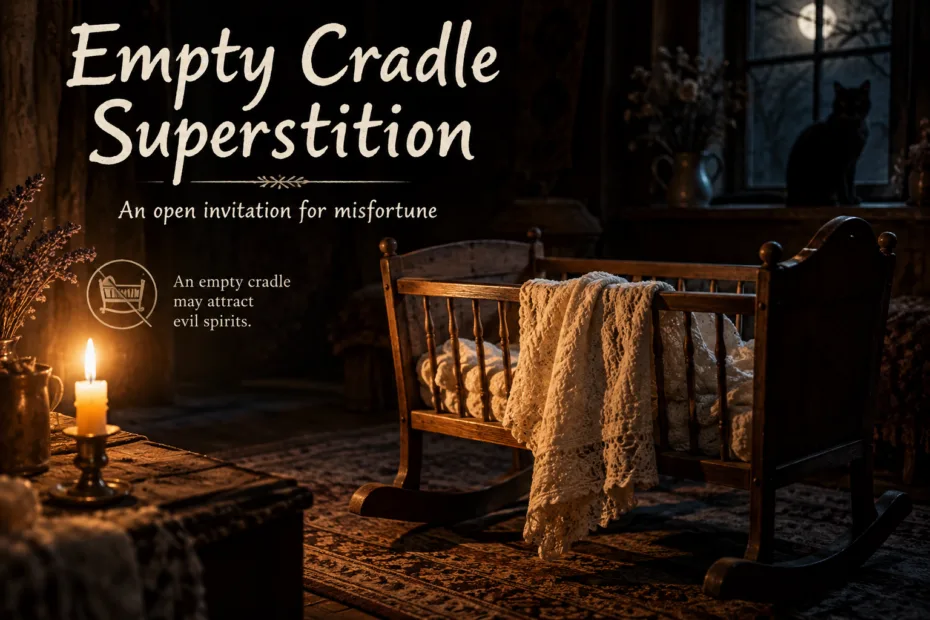
The empty cradle superstition is a traditional warning against rocking a cradle when no baby is inside it. The predicted consequence is not the same in every record. Some traditions treat the action as harmful to a child, while others say it foretells another baby entering the household.
What the Empty Cradle Superstition Forbids
The best-recorded form concerns the movement of an unoccupied cradle. A person, often a child playing with the cradle, rocks it even though the infant is elsewhere or no baby has yet used it. The movement itself becomes the forbidden act.
Older accounts attach several possible outcomes to it. Rocking the empty cradle may be described as bringing bad luck to the baby, predicting illness, disturbing the child’s sleep, or foreshadowing loss. In another well-recorded form, the same action predicts that the cradle will soon be occupied by another baby.
Do not rock the empty cradle because doing so is thought to bring misfortune, illness, restlessness, or danger to a child.
Rocking the empty cradle is said to predict another pregnancy or a new baby who will later occupy it.
These meanings should not be merged into a single universal rule. Folklore records show that the same household action could carry opposite predictions depending on the family, locality, and period in which it was recorded.
The Older “Toom Cradle” Tradition
Nineteenth-century collections from Britain contain repeated warnings about the “toom cradle.” Toom is a Scots and Northern English word meaning empty or vacant, so a “toom cradle” simply means an empty cradle.
Some records describe rocking it as dangerous for the baby associated with the cradle. The feared result could be sickness or death. Other nearby traditions gave the act a very different meaning: an empty cradle set in motion was taken as a sign that another child would soon arrive.
Folk beliefs are often preserved as short household rules rather than fixed doctrines. A warning can survive in one family while a reversed version survives elsewhere. For the empty cradle belief, the contradiction is part of the recorded tradition rather than an error that needs to be resolved.
The birth-prediction version was sometimes expressed through short rhymes linking an empty rocking cradle with having more babies. Such sayings made the belief easy to remember and gave adults a ready explanation for stopping children from playing with nursery equipment.
Why Rocking Matters More Than Emptiness
An unused cradle is not automatically the subject of the superstition. In many records, the important detail is that someone rocks, swings, or moves it as if a baby were present.
A cradle normally moves for a reason: someone is soothing an infant. Folk interpretation could therefore treat movement without an occupant as an action performed before its proper circumstance existed. In the birth-prediction version, the empty motion anticipates the future presence of a child. In the warning version, performing the action at the wrong time is treated as inviting an unwanted outcome.
Early folklore writers sometimes interpreted the first pattern as a form of imitative belief: acting out an expected event was thought to encourage or predict that event. That interpretation fits the version in which rocking produces the expectation of another baby, but it does not explain every form of the superstition.
Related Cradle Rules Are Not the Same Belief
The empty cradle warning sits beside several other nursery customs, and they can easily become mixed together in retellings. They are better treated as related but separate traditions.
- Rocking an empty cradle: the cradle is present and deliberately set in motion without a baby inside.
- Bringing a cradle home before the birth: the concern is preparing baby equipment too early rather than rocking it.
- Moving an empty pram or stroller: a later form that transfers the older cradle rule to newer nursery equipment.
- Using a particular cradle: some traditions attach separate rules to inherited cradles, borrowed cradles, or cradles previously used by another child.
The distinction matters because the feared result may change with the act. A family might allow an empty cradle to stand in a room but object immediately if someone begins rocking it. Another tradition may focus instead on whether nursery equipment should enter the home before a baby is born.
From the Cradle to the Empty Pram
As cradles became less central to everyday infant care, the belief did not always disappear with the object. Folklore collections also record warnings against pushing or wheeling an empty pram.
This is a clear example of a household belief adapting to a new object while preserving the same basic action: moving baby equipment as though an infant were inside it. The pram version may be stated simply as “bad luck,” without the detailed prediction attached to older cradle accounts.
Advice about an empty pram can also overlap with another belief that a pram or cradle should not be brought into the house before the birth. Although the two ideas are closely associated, one concerns movement while empty and the other concerns preparing too early.
A Household Rule Passed Through Families
The superstition has not survived only in nineteenth-century collections. Later folklore archives contain personal accounts in which people recall relatives warning them not to rock an empty cradle because it could bring bad luck to an expected baby.
Such records should be read as evidence of family-level transmission, not proof that every member of a wider culture follows the rule. Folk beliefs often persist through grandparents, parents, caregivers, and children without requiring a formal explanation or a shared community-wide interpretation.
A person may repeat the rule without firmly believing that rocking an empty cradle can cause an event. Following the custom can instead be a habit, a family expectation, or a way of avoiding an action traditionally regarded as inappropriate around pregnancy and infancy.
This helps explain why very short warnings can remain recognizable long after the older reasoning behind them has faded. Someone may still stop an empty cradle from being rocked while knowing only that it is “not supposed to be done.”
What the Omen Is Supposed to Predict
There is no single fixed outcome attached to the empty cradle. Recorded versions fall into a small set of recurring interpretations.
The variation is one of the clearest features of the belief. The forbidden action is more stable than the explanation. Across many records, what remains recognizable is the instruction to leave an unoccupied cradle still.