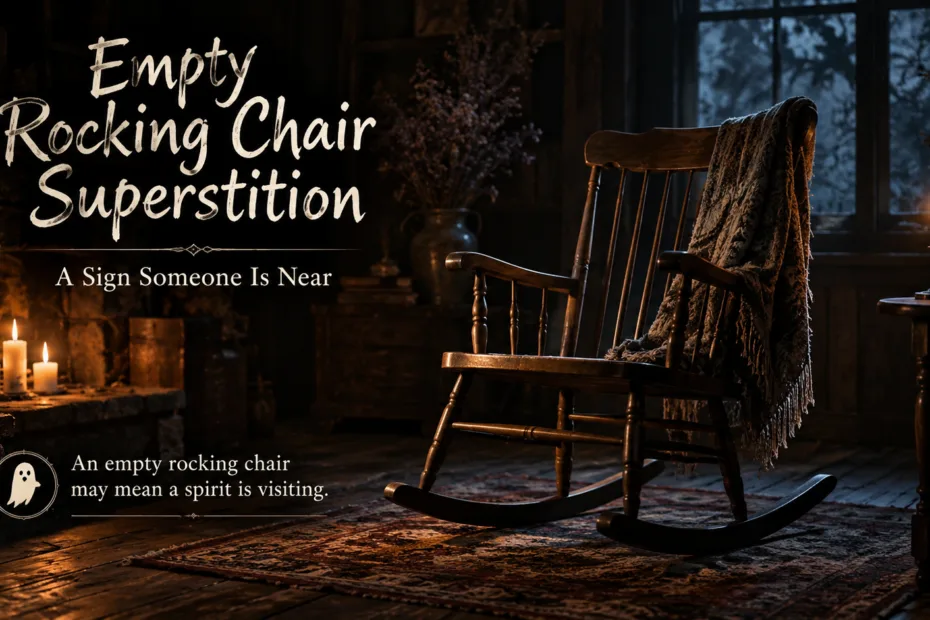
The empty rocking chair superstition is not one fixed belief. In recorded North American folklore, an unoccupied rocker may be treated as unlucky when someone deliberately sets it moving, while a chair that appears to rock by itself may be read as an omen or as a seat occupied by an unseen presence. Older records also attach more specific outcomes to the same act, including illness or a death in the family.
What the Empty Rocking Chair Superstition Says
The basic warning is simple: do not set an empty rocking chair in motion. What is supposed to happen afterward varies from one telling to another.
| Situation | Recorded Folk Interpretation |
|---|---|
| Someone deliberately rocks an empty chair | Bad luck may follow. |
| An empty rocker continues moving after the sitter leaves | Leaving it in motion may be treated as unlucky. |
| An empty chair appears to rock by itself | It may be interpreted as an omen of death or as evidence of an unseen occupant. |
| An empty chair is deliberately rocked in some family traditions | The act may be said to bring illness or a death within the family. |
| An empty rocker is set moving in a spirit-related version | The motion may be described as inviting a spirit to take the vacant seat. |
These meanings belong to folk belief. They should not be treated as verified cause-and-effect claims. The value of the records lies in showing how families and communities interpreted an ordinary household action.
A Recorded Death-Omen Version from 1896
One of the older printed records appears in Current Superstitions: Collected from the Oral Tradition of English Speaking Folk, edited by Fanny D. Bergen and published for the American Folk-Lore Society in 1896.
A Michigan belief in that collection describes an empty rocking chair swaying while apparently unoccupied. The movement was understood as the work of a deceased family member returning to choose another person who would soon follow the dead.
What This Early Record Shows
The 1896 version concerns a chair that seems to move without a visible sitter. It is therefore more specific than the broader warning that simply rocking an empty chair brings bad luck.
The record also places the belief among death omens rather than presenting it as a general rule about furniture. That distinction matters because later oral versions widened the meaning of the empty rocker.
When a Person Starts the Rocking
Twentieth-century folklore records preserve many versions in which the danger comes not from unexplained movement but from deliberately rocking a vacant chair. The action itself becomes taboo.
Bad Luck
The James T. Callow Folklore Archive at the University of Detroit Mercy contains several examples of the bad-luck form. Records associated with Pennsylvania and Michigan warn against rocking a chair when nobody is sitting in it. Similar material collected in Tennessee also treats the act as a way of bringing bad luck.
This version does not always say what the misfortune will be. The warning may stop at a broad rule: an empty rocker should be left still.
Death or Illness
Other records give the warning a more precise consequence. Examples collected in Illinois, Michigan, Tennessee, Georgia, New York and California connect an empty rocking chair with death. Some say that someone in the family will die; another recorded Georgia version names the person’s mother. A Michigan record instead associates rocking an empty chair with sickness.
These differences show why the superstition cannot be reduced to a single sentence that applies everywhere. Even closely related versions may disagree about whether the expected result is ordinary bad luck, illness or death.
Inviting a Spirit
A different form shifts attention away from predicting misfortune and toward the idea of vacant furniture becoming available to an unseen occupant. An Alabama record from the Callow archive warns that rocking an empty rocking chair invites an evil spirit into it.
Modern retellings often emphasize this spirit-invitation interpretation, but it is only one strand of the tradition. Older and archived versions also describe the empty rocker simply as unlucky or as a death omen without explaining the chair as an invitation.
Rocking by Itself and Rocking It Empty Are Different Signs
The Chair Moves by Itself
The unexplained movement is the omen. In recorded versions, an unseen sitter, a deceased relative or an approaching death may be inferred from the motion.
Someone Rocks the Empty Chair
The person’s action breaks a household taboo. Depending on the tradition, that act may be said to invite bad luck, illness, death or a spirit.
The two forms often merge in casual retellings, yet historical folklore records preserve both. A family might object to someone idly pushing an empty rocker even if nobody believed the chair had begun moving on its own. Elsewhere, the unexplained movement itself was the disturbing part.
A third form falls between them: someone gets out of a rocking chair and leaves it swaying. In this version, no mysterious force starts the movement, but allowing the now-empty chair to continue rocking may still be considered unlucky.
Why the Rocking Chair Fits This Kind of Folklore
A rocking chair can continue moving after a person stands up. It can also respond visibly to a push, an uneven floor or other small physical disturbances. Unlike a fixed chair, it can therefore appear active while remaining empty.
That makes the object well suited to a belief centered on absence and apparent occupancy. The motion normally associated with a seated person continues even though the person is gone. Folklore can then supply an unseen occupant or interpret the unexpected movement as a sign.
This offers a useful way to understand the form of the superstition, but it does not establish a single historical origin. Folk beliefs often circulate orally for years before anyone records them, and the same short warning can acquire different explanations as it moves between families and places.
No Single Origin Is Firmly Established
The empty rocking chair warning is sometimes presented as though it came from one named country or one regional tradition. The surviving records do not support such a tidy origin story.
The 1896 Michigan example already shows the belief in American oral tradition in the nineteenth century. Later archive records appear across several parts of the United States, including the Midwest, Northeast and South. Some twentieth-century examples were explicitly learned from a parent or preserved as a family rule, which points to ordinary household transmission rather than a single known founder, event or text.
The safest historical description is therefore broad: the superstition is a documented folk belief with multiple North American forms, including bad-luck warnings, death omens and spirit-related interpretations. A precise place or moment of origin remains uncertain.
A Counter-Charm in One Family Version
Most records simply warn against rocking the empty chair, but one Michigan family tradition collected around 1970 includes a way to cancel an accidental violation.
In that version, rocking an empty rocking chair invites bad luck. If it happens accidentally, the person is supposed to say “bread an’ butter” immediately to break the effect.
The phrase should not be treated as a universal part of the rocking-chair superstition. It belongs to a particular recorded family version. “Bread and butter” also appears elsewhere in English-speaking folk practice as a spoken formula used after an unwanted separation or unlucky act, which helps explain how a short verbal counter-charm could become attached to an empty-chair warning.