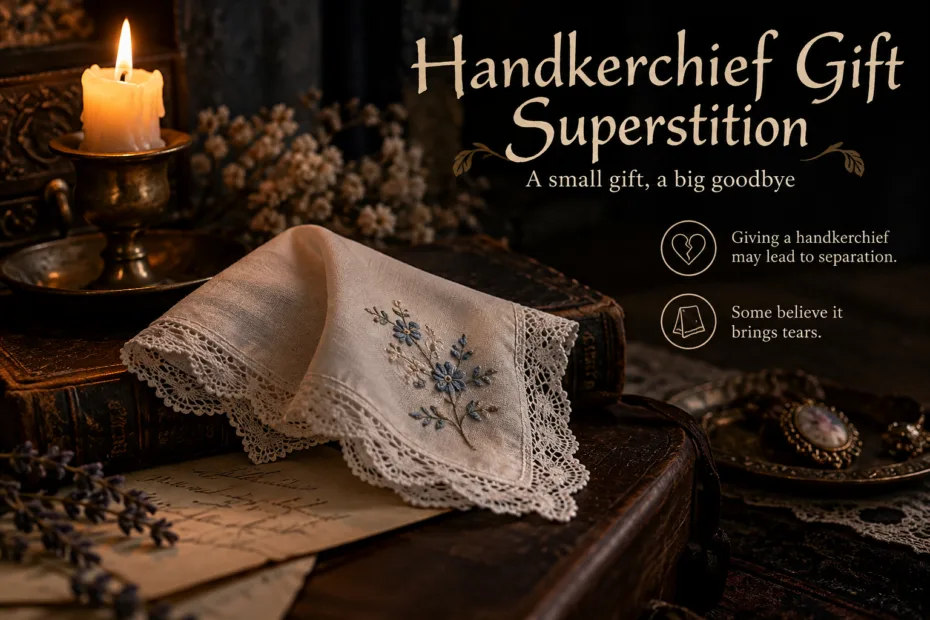
The handkerchief gift superstition says that giving someone a handkerchief may bring tears, sadness, parting, or trouble in a relationship. The belief comes from symbolic associations with what a handkerchief traditionally does: it wipes away tears and has often appeared in scenes of mourning and farewell.
What Does Giving a Handkerchief Mean in Superstition?
In its most common form, the superstition treats a handkerchief as an unlucky present because the recipient will supposedly have tears to wipe away. The gift does not merely represent an ordinary piece of cloth. Folk interpretation turns its practical use into a prediction: giving something used for tears may invite a reason for those tears.
A handkerchief given as a present may be interpreted as a symbol of future tears or sorrow. Some variants narrow the meaning further and connect the gift with separation between the giver and recipient.
The belief is therefore an example of associative folk symbolism. The feared outcome resembles the object’s familiar use rather than depending on any physical property of the handkerchief.
Why the Handkerchief Became Linked With Tears
Handkerchiefs have long been used to wipe tears during grief, emotional farewells, and mourning. That ordinary function provides the clearest basis for the gift superstition. In folk logic, an object closely connected with crying can become a symbolic carrier of sadness when deliberately presented to another person.
The same principle appears in older gift beliefs involving objects whose everyday actions are given symbolic consequences. A cutting object may represent a relationship being cut, for example, while the handkerchief’s connection is to crying and parting.
There is no need to assume that every version of the belief came from one historical event. The connection between a handkerchief and tears is simple enough to develop in more than one place without a single shared origin.
From Tears to Separation
Some versions of the superstition move beyond sadness and treat the handkerchief as a sign that two people will eventually part. Farewell imagery helps explain this variation. Handkerchiefs have been associated not only with wiping tears but also with departures, including the familiar gesture of waving a cloth as someone leaves.
Romantic versions can be more specific. One recorded Swedish gift belief warns against a man giving his lover a silk handkerchief, with the traditional explanation that she may use it to wipe away her affection for him. This is a localized form of the broader idea rather than a rule attached to every handkerchief gift.
The handkerchief predicts crying, sorrow, or an unhappy event because it is used to wipe tears.
The gift represents emotional distance, farewell, or the eventual end of a relationship.
The Belief Is Not Universal
A handkerchief is not treated as an unlucky gift everywhere. Folklore records also show it functioning as a token of love, remembrance, good luck, hospitality, marriage, and ceremonial exchange. Its meaning can change according to the occasion, the relationship between the people involved, and the tradition in which the exchange takes place.
In Turkish folk culture, for example, academic studies record handkerchiefs in a wide range of social and ceremonial roles. They may be exchanged with newly married couples, young men leaving for military service, guests, or loved ones, while embroidered handkerchiefs can communicate emotions such as affection, longing, or separation. The same object can therefore carry positive or negative meanings depending on context.
Wedding folklore provides another contrast. Some family traditions preserve a handkerchief as a good-luck object carried by successive brides. Such examples show why the general claim that a handkerchief is always an unlucky present is too broad.
When the Superstition Applies
The belief concerns the act of giving a handkerchief as a gift, not simply owning, carrying, buying, or using one. Even within traditions that recognize the superstition, the interpretation may depend on the circumstances.
- Ordinary gift: may be associated with tears or coming sadness.
- Gift between lovers: may be interpreted as a warning of separation or fading affection.
- Farewell gift: the association with departure can make the symbolism especially noticeable.
- Ceremonial or inherited handkerchief: may carry an entirely different meaning, including affection, memory, or good luck.
These meanings belong to folklore and customary interpretation. A person may know the superstition without observing it, while another may see a handkerchief simply as a useful or personal present.
Why Different Meanings Can Coexist
Handkerchiefs have served many social purposes beyond their practical use. They have been embroidered as personal tokens, exchanged between loved ones, carried at weddings, used during mourning, and associated with farewell gestures. Because the object appears in both joyful and sorrowful situations, folk traditions have not assigned it one fixed meaning.
The handkerchief gift superstition is best understood as one branch of that wider symbolism. Its central idea is simple: a cloth used to catch tears can symbolically promise tears. Traditions that emphasize romance or farewell may turn the same association into a prediction of separation, while other customs preserve the handkerchief as a valued gift rather than an unlucky one.