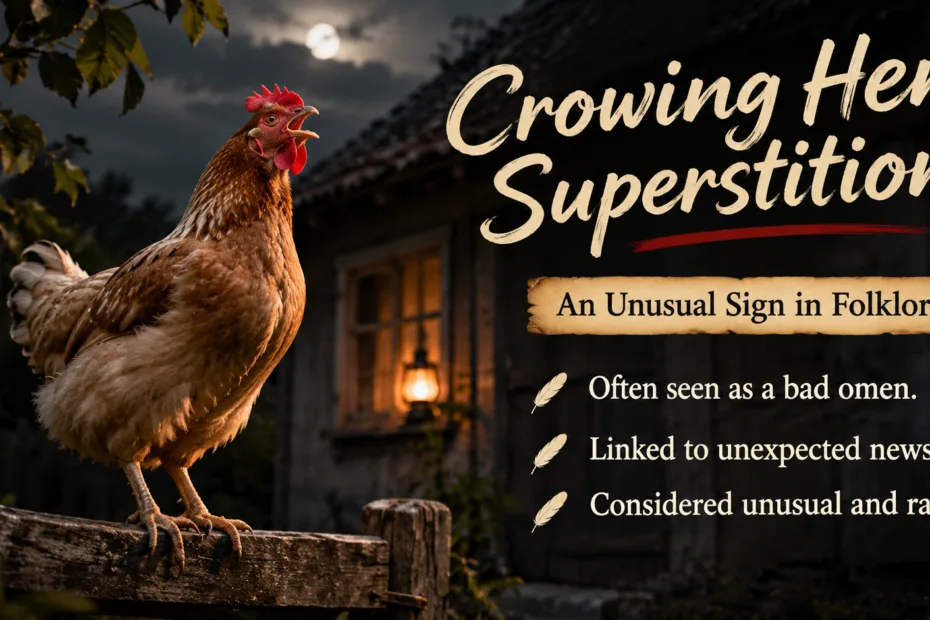
A hen crowing like a rooster was traditionally regarded as an unusual omen in several folk traditions. The most common interpretation was bad luck or approaching trouble in the household, although some accounts connected the sound specifically with death. Other traditions allowed favorable meanings depending on the direction the hen faced while crowing.
The belief arose around a recognizable difference in poultry behavior: roosters were expected to crow, while hens were associated mainly with clucking and laying eggs. When a hen made a rooster-like call, people sometimes treated this unexpected behavior as a warning rather than an ordinary animal sound.
What Was a Crowing Hen Believed to Predict?
Historical accounts describe several interpretations of a hen crowing. The precise prediction depended on the tradition and the circumstances surrounding the bird.
- Household misfortune: A crowing hen could suggest that trouble or an unlucky period was approaching for the family keeping it.
- Death or bereavement: Some British and Irish traditions treated the call as a warning that someone in the household might die.
- An unexpected family event: Certain accounts interpreted the sound as a sign that an unusual change was coming, without necessarily identifying it as harmful.
- Good fortune under particular conditions: Some recorded beliefs assigned a favorable meaning to the direction in which the hen was facing.
These were separate interpretations rather than parts of a single prediction. A hen crowing did not always mean death, and a general warning of bad luck should not be confused with a specific death omen.
Why the Direction of the Crowing Hen Mattered
An unusual version of the superstition appears in N. B. Dennys’s 1876 book The Folk-Lore of China. The account describes a belief in which the direction of a hen’s head determined whether its crowing foretold prosperity or misfortune.
Facing the Front of the Property
If the hen faced outward or toward the front of the premises while crowing, the sound was interpreted as an unfavorable omen. It could indicate poverty or other household misfortune.
Facing the Rear of the Property
If the hen faced toward the back of the premises, the same behavior was interpreted favorably. It was associated with improved family prosperity.
The account also states that a crowing hen could remain unwelcome even when its direction suggested good fortune. The unusual behavior itself was considered unsettling.
This directional interpretation belongs to the historical account in which it was recorded. It should not be assumed to represent a uniform Chinese belief.
The Saying About a Whistling Woman and a Crowing Hen
The crowing hen became closely associated with an English-language proverb that paired it with a woman who whistles. One familiar version reads:
“A whistling woman and a crowing hen are neither fit for God nor men.”
Traditional proverb, recorded in several related forms.
The pairing reflects older expectations about male and female behavior. Crowing was considered characteristic of a rooster, while whistling by women was treated as improper in some communities. The proverb linked both departures from expected behavior with misfortune.
Its wording varied. Some versions warned that such behavior brought no luck to a household, while others suggested that the individuals involved would come to an unfortunate end.
The saying also carried a social judgment about women who behaved outside traditional expectations. Its meaning therefore extended beyond a belief about poultry. As an inherited expression, it could be repeated without the speaker necessarily believing that a crowing hen predicted disaster.
The Crowing Hen as a Death Omen
In nineteenth-century collections of folklore from northern England and the Scottish Borders, a crowing hen was sometimes described as a forerunner of death.
William Henderson’s Notes on the Folk-Lore of the Northern Counties of England and the Borders records a story from East Kilbride in which a woman heard her hen crow on several occasions and later associated the calls with deaths among her relatives.
Such accounts illustrate how the superstition operated through remembered sequences of events. A strange animal sound became meaningful when a later misfortune seemed to confirm the warning.
The association with death was not universal. Other records describe an unlucky household without predicting that anyone would die.
How Households Responded to a Crowing Hen
People who considered the sound ominous sometimes believed that the bird should be removed from the household. Historical folklore records mention selling or otherwise disposing of crowing hens in attempts to prevent the feared misfortune.
These responses were not consistent. An Irish folklore account recorded on November 11, 1940, includes the belief that if one crowing hen was killed, another would begin to crow. This suggests that some storytellers considered the unwanted sign capable of recurring regardless of what happened to the original bird.
Other recorded customs attempted to transfer the supposed bad luck away from the home. Such practices reflected the belief that the omen could be managed through symbolic action, rather than the idea that the bird was physically responsible for later events.
Why a Hen Can Actually Crow
Although crowing is more characteristic of roosters, hens are physically capable of producing similar vocalizations. The behavior can occur without any connection to an unusual event outside the flock.
A dominant hen may produce rooster-like calls, particularly in a flock without a rooster. Hormonal changes can also lead to crowing and the development of other male-typical characteristics. In some cases, changes involving the reproductive system affect the bird’s hormone balance.
These biological explanations help distinguish the behavior that inspired the superstition from the predictions attached to it. The sound is a real feature of chicken behavior; its interpretation as a warning of death, bad luck, or prosperity belongs to folk belief.