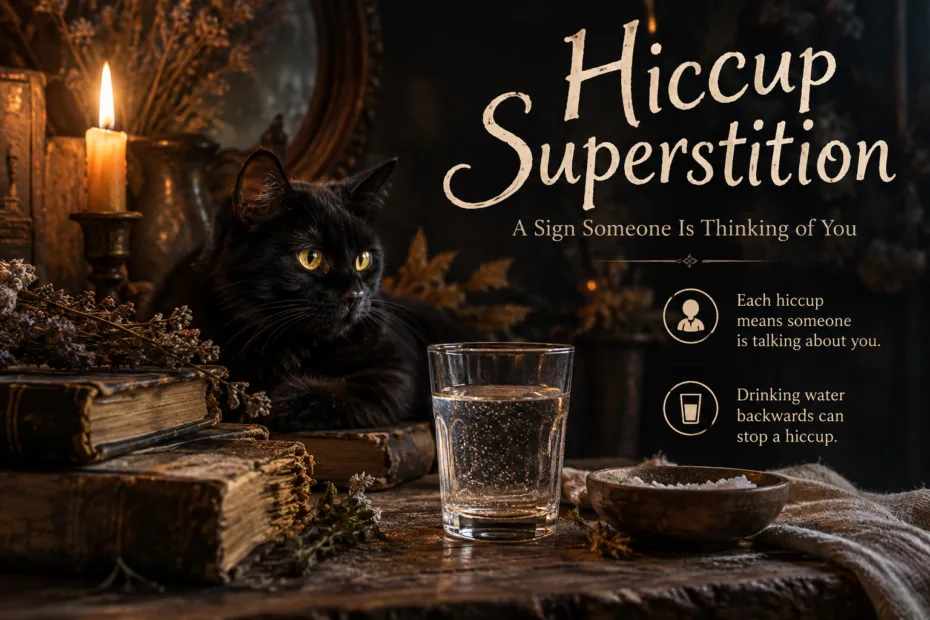
In hiccup superstition, an unexplained bout of hiccups is often interpreted as a sign that an absent person is thinking about, remembering, or talking about the person who has them. The meaning changes between recorded traditions, and some versions turn the moment into a name-guessing ritual.
What Hiccups Are Said to Mean
The best-documented pattern links hiccups with another person’s attention. In one form, someone is simply thinking of you. In another, a loved one is remembering you. Other records give the same bodily sign a less friendly meaning and connect it with gossip or negative thoughts.
These versions belong to the same broad type of folk belief: an involuntary change in the body is treated as a signal of something happening elsewhere. The surviving records do not support one universal meaning, one place of origin, or one rule followed by every community in which a hiccup belief has been reported.
The Core Folklore Pattern
A sudden hiccup may be read as a social sign rather than a prediction about the future. The absent person is imagined to be thinking, remembering, speaking, or speaking badly about the person who hiccups.
The Name-Guessing Version
Some forms of the superstition do more than explain the hiccup. They offer a way to identify the person supposedly responsible for it.
A record in the James T. Callow Folklore Archive, marked as learned in Hungary and dated 1897, says that hiccups mean someone is thinking of you. The person with the hiccups tries to guess who it is; if the hiccups stop, the successful name is taken as the answer.
This creates a small test inside the belief. Hiccups commonly stop by themselves after a short time, so the end of a bout can easily coincide with one of the names being tried. In folklore, that coincidence gives the guessing ritual a clear stopping point.
Affection, Remembrance, and Gossip
Historical and modern folklore records preserve several emotional readings of the same basic sign.
Thinking
Someone Has You in Mind
Biren Bonnerjea’s 1927 A Dictionary of Superstitions and Mythology records the belief that hiccups mean someone is thinking of the sufferer and associates that version with material from Great Britain, Bohemia, and India.
Affection
Someone Who Loves You Is Thinking of You
A 2012 USC Digital Folklore Archives entry records an informant being told by an Indian friend that hiccups mean somebody who loves you is thinking of you. The friend said he had learned the belief from his mother, making this a documented family-transmitted version rather than evidence for every Indian community.
Negative Attention
Someone Is Speaking or Thinking Badly of You
Bonnerjea also records a Macedonian form in which hiccuping or choking while eating or drinking was linked with a backbiter, with guessing the person’s name forming part of the response. A Dartmouth folklore interview collected in 2018 preserves a family version in which hiccups meant that someone close was thinking about the person negatively.
Why One Hiccup Superstition Can Have Opposite Meanings
Folklore does not require a bodily sign to keep the same emotional value everywhere. Hiccups can be interpreted as affectionate remembrance in one account and hostile attention in another. What remains stable is the connection between the unexpected physical interruption and an absent person’s supposed thoughts or words.
This is why statements such as “hiccups always mean someone misses you” are too narrow. Missing, loving, remembering, thinking, and gossiping are separate recorded interpretations. A local or family version may favor one of them without representing the whole tradition.
The Physical Hiccup and the Folk Meaning
A hiccup is an involuntary movement of the diaphragm followed by a rapid closing of the vocal cords, which produces the familiar sound. Hiccups may appear with no obvious trigger and usually pass within a few minutes.
The superstition gives that ordinary reflex a social meaning; it is not a physical explanation for why the diaphragm contracts. This distinction matters because the folklore record describes what people have said a hiccup means, while medicine describes how the hiccup itself occurs.
Folk Ways of Ending Hiccups
Beliefs about the meaning of hiccups often sit beside traditional ways of trying to stop them. Historical collections record methods involving water, breath-holding, sudden fright, counting, spoken formulas, and small charms.
The National Folklore Collection of Ireland preserves several examples in the Schools’ Collection. One record gives fright as a hiccup cure; another records nine sips of water; another describes drinking from the opposite side of a cup. Bonnerjea’s 1927 dictionary also notes a paper cross placed on the forehead in a hiccup remedy.
These practices are not all parts of the “someone is thinking of you” belief. They show a second strand of hiccup folklore: people not only interpreted the reflex, but also attached customary actions to making it stop.