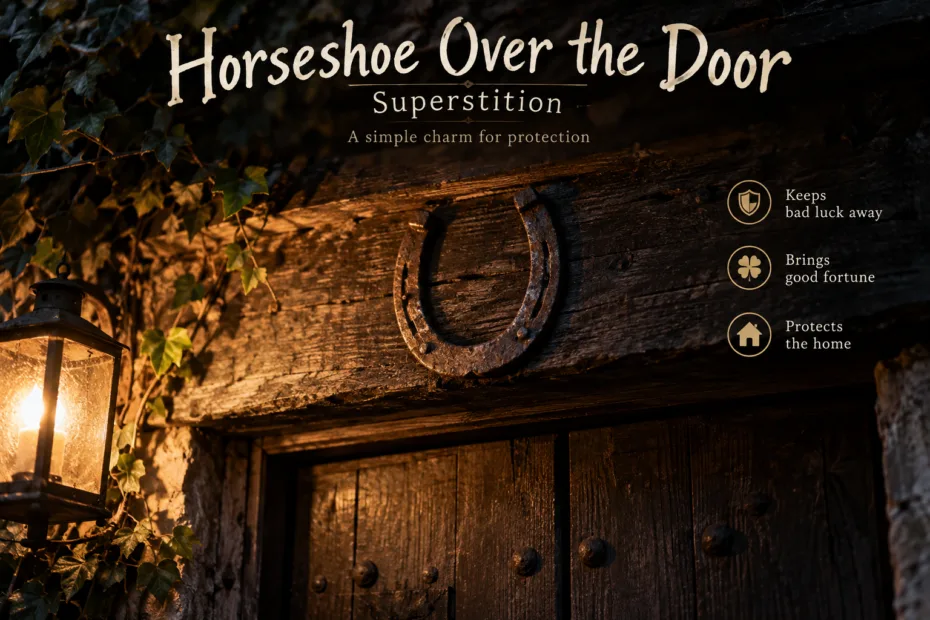
A horseshoe fixed above a door is traditionally treated as a charm for good luck or protection. Historical records show that the meaning has never been completely uniform: the shoe might guard the entrance, preserve luck inside the household, or combine both ideas.
Why the Horseshoe Is Placed at the Door
The doorway is central to this superstition. It marks the point where people and, in traditional belief, unwanted influences could enter a house. Putting the horseshoe at the entrance turned it into a form of protective threshold charm rather than simply a lucky object kept somewhere indoors.
One unusually clear early English record comes from John Aubrey’s Miscellanies, published in 1696. Aubrey described horseshoes being nailed at the thresholds of doors because they were believed to hinder witches from entering. He also recorded the idea that the preferred horseshoe was one that had been found rather than deliberately obtained.
A late nineteenth-century study in the Journal of American Folk-Lore described the horseshoe’s protective use against witches and troublesome spirits as older than its familiar interpretation as a general emblem of good luck. The two meanings later became closely intertwined.
Why a Horseshoe Was Thought to Protect a House
The belief drew strength from several properties of the object itself. A traditional horseshoe was made of iron, and iron appears in many European folk traditions as a material associated with protection from harmful supernatural beings. A horseshoe was also an ordinary object that could be fixed directly to a door, lintel, or threshold.
Its connection with the horse added another possible layer of meaning. Older folklore writers proposed several explanations for the horseshoe’s reputation, including its iron, its curved shape, its pointed ends, and its association with the animal. These theories do not establish one original cause. Instead, they show that people interpreted the same charm in different ways.
The practical history of the object mattered too. A worn shoe had already been attached to a working horse and could later be found on a road or near a stable. In traditions that valued found objects, this made an old horseshoe different from a decorative horseshoe made specifically to be hung on a wall.
Should the Horseshoe Point Up or Down?
There is no single traditional orientation shared by every version of the superstition. Folklore records preserve conflicting rules, and later explanations often give each position its own logic.
In one widespread interpretation, the open horseshoe acts like a container. Keeping the two ends upward is said to hold the luck, while turning them downward would allow the luck to fall out.
Other traditions accept or prefer the open end facing downward. Later explanations describe the luck or protective influence as passing over people who walk beneath the horseshoe.
Recorded American folklore provides a clear example of the first interpretation: twentieth-century collections from Michigan include the rule that the prongs should face upward so that the luck does not fall out. Other historical records focus on where the shoe is positioned or which direction its points face relative to the entrance rather than describing a simple up-versus-down rule.
The disagreement is part of the tradition itself. Turning the shoe one way or the other does not represent a universally accepted version of the belief.
Finding the Horseshoe Could Be Part of the Luck
Some versions of the superstition do not treat every horseshoe as equal. The circumstances in which the object was obtained could matter as much as its placement.
- A horseshoe found by chance could be preferred to one bought intentionally.
- A shoe that had already been used could carry more traditional value than a purpose-made ornament.
- Some recorded beliefs attached extra importance to nails remaining in the shoe.
- Other traditions required a particular position when the found shoe was fixed at the entrance.
Irish folklore collections from the twentieth century preserve several beliefs in the luck of finding horseshoes as well as records of horseshoes being placed over household doors. These records also show why it is misleading to reduce the custom to one fixed ritual: details changed between communities and individual informants.
The Saint Dunstan Story
A well-known English explanation connects the horseshoe charm with Saint Dunstan, the tenth-century churchman who was traditionally associated with metalworking.
In the familiar horseshoe version of the legend, the Devil approaches Dunstan to be shod. Dunstan fastens a horseshoe painfully to him and removes it only after receiving a promise that the Devil will not enter a place displaying a horseshoe at its entrance. The story therefore gives the doorway horseshoe a direct protective meaning.
The legend should not be treated as proven evidence for how the custom began. Medieval stories about Dunstan confronting the Devil existed long before the best-known horseshoe narrative, while the elaborate horseshoe version became especially visible through Edward G. Flight’s nineteenth-century The Horse Shoe: The True Legend of St. Dunstan and the Devil. It is better understood as a folkloric explanation attached to an already established protective symbol.
From Protective Charm to Household Good-Luck Symbol
Historical material shows a gradual overlap between two ideas. In one, the horseshoe guards the entrance against witches, spirits, or other unwanted supernatural influences. In the other, it brings or preserves good fortune for the household.
By the nineteenth and twentieth centuries, folklore collections regularly recorded the shorter belief that a horseshoe over the door brings good luck, sometimes without any reference to supernatural protection. The older doorway function remained visible, but the explanation had become simpler.
This helps explain why decorative horseshoes can retain the language of luck even when the older rules about iron, finding the shoe, remaining nails, or exact placement are no longer followed. The recognizable custom survived while many of its local instructions changed or disappeared.
What the Traditional Belief Actually Requires
The broadest form of the superstition requires only a horseshoe associated with the entrance of a home. Beyond that, the historical record is variable. Some versions care about the material, some about whether the shoe was found, some about its orientation, and others simply state that having one above the door is lucky.
For that reason, rules such as “points up is lucky and points down is unlucky” describe particular strands of the tradition rather than the entire superstition. The stable element is the horseshoe itself and its placement at the boundary of the household; the exact instructions surrounding it belong to local and family versions of the belief.