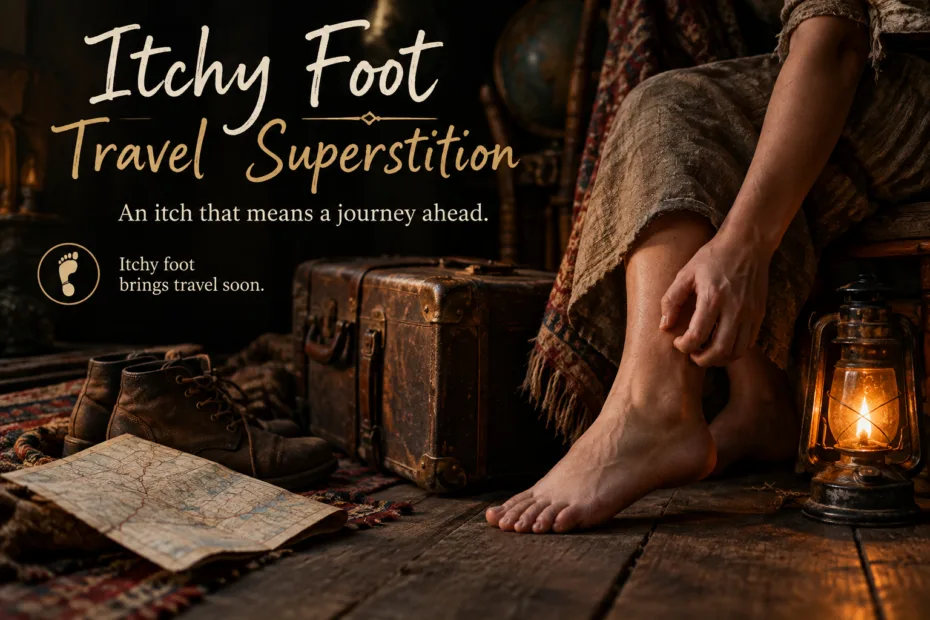
In recorded folk belief, an itching foot can be interpreted as a sign that a journey, visit, or walk on unfamiliar ground lies ahead. Some traditions treat either foot the same way, while others give the right and left foot different meanings.
Why an Itchy Foot Became a Travel Sign
The travel meaning appears clearly in older folklore records. Feet physically carry a person from one place to another, so an unexplained itch could be turned into an omen of movement. Historical collectors often recorded the prediction as walking on “strange ground” or beginning a “strange journey.”
Here, “strange” generally means unfamiliar rather than mysterious or supernatural. The belief points toward leaving familiar surroundings, visiting another place, or walking somewhere not normally encountered.
James Napier’s 1879 collection of West Scottish folklore records an itching foot as a sign that its owner was about to undertake a strange journey. An American example collected in Boston and published by Fanny D. Bergen in 1896 says that an itching sole meant the person would walk on strange ground. That version applies to either foot and does not divide the omen into lucky and unlucky sides.
Does the Right or Left Foot Change the Meaning?
Sometimes, but not consistently. Historical records show several local versions rather than one fixed rule.
Right Foot
One American record from Baldwinsville, New York, associates an itching right foot with going somewhere the person will be welcome. Other recorded versions connect the right sole with unfamiliar travel or a pleasant journey.
Left Foot
The matching Baldwinsville tradition says an itching left foot means going somewhere the person will be unwelcome. Other historical versions connect the left sole with an unpleasant or disadvantageous trip.
These differences should not be turned into a universal formula in which the right foot always predicts good travel and the left always predicts bad travel. Some documented traditions make no distinction between the two feet at all.
The Sole Appears Often in Older Records
Several collected versions refer specifically to an itching sole rather than an itch anywhere on the foot. Bergen’s Boston record, for example, concerns the sole of either foot. Other collections preserve similar sayings about the bottom of the foot and unfamiliar ground.
This does not establish a traditional map in which the heel, arch, toes, and top of the foot each carry separate predictions. The older material supports the foot or sole as the main sign much more clearly than highly detailed modern interpretations of individual parts of the foot.
The most stable theme is movement toward unfamiliar ground. Predictions about welcome, discomfort, pleasure, or disadvantage appear as added local variations.
A Folk Omen Could Be Very Simple
Not every version tried to describe the destination or outcome of the journey. Twentieth-century folklore records from Michigan preserve the belief in a particularly direct form: itchy feet meant that a person would take a trip. Another collected version described itching on the bottom of the feet as a sign that the person would soon walk somewhere unfamiliar.
This simpler form helps separate the core travel superstition from later layers of interpretation. The itch announces movement; extra details depend on the particular community, family tradition, or printed collection in which the belief appears.
Travel, Visiting, and Being Welcomed
Some variants narrow the prediction from general travel to a social visit. The Baldwinsville version links each foot with how the traveler will be received. An Alabama record goes further, treating an itching left foot while someone is already going to visit another person as a sign that the visitor is not welcome.
These examples show how the same bodily sign could acquire different layers of meaning. One tradition focuses only on going somewhere new; another adds the expected reception at the destination.
The recurring idea remains closely tied to the ordinary purpose of the feet: walking, leaving, arriving, and crossing into unfamiliar surroundings.