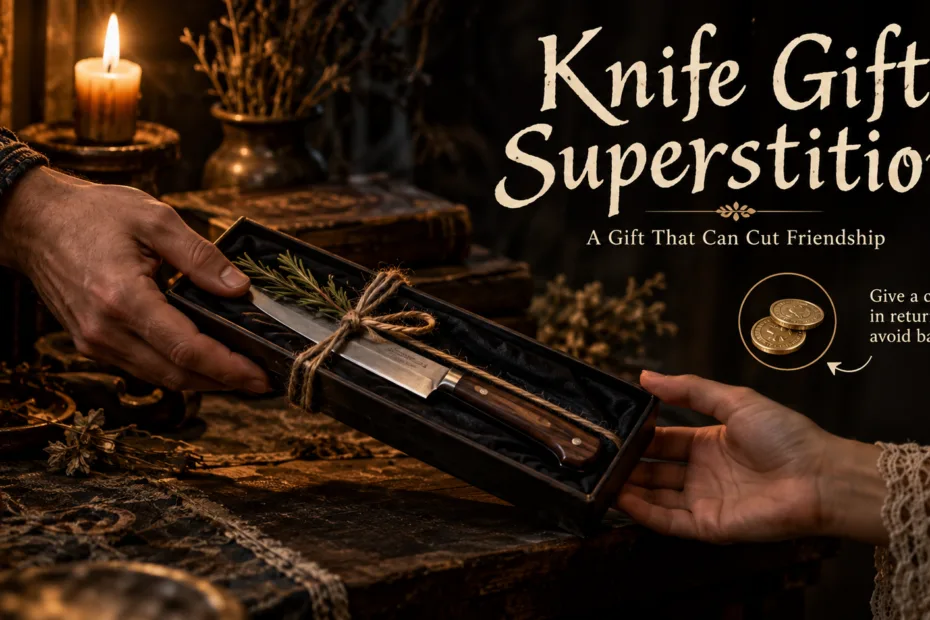
The knife gift superstition holds that giving someone a knife can symbolically cut or sever the relationship between the giver and recipient. A small payment, often a coin, is traditionally used in many versions of the belief to prevent the knife from being treated as a true gift.
What the Knife Gift Superstition Says
The central idea follows the ordinary function of the object. A knife cuts things apart, so folk belief transfers that action to the social relationship surrounding the gift. The blade is therefore said to risk cutting the friendship, affection, or personal bond between two people.
Recorded versions do not always predict exactly the same outcome. Some say the friendship will end. Others warn of a quarrel, separation, bad luck, or a damaged relationship. The common element is the symbolic connection between a cutting edge and a severed bond.
American folklore collections from the 1960s and early 1970s preserve several versions of the belief. They include warnings that a gifted knife will “cut” a friendship unless some form of payment or a penny accompanies the exchange. These records show that the custom was circulating through families and personal networks rather than existing only as later gift-shop advice.
Why a Coin Is Exchanged for the Knife
The best-known response to the superstition is a token payment. The recipient gives the person who offered the knife a small coin. Once money changes hands, the knife can symbolically be treated as something purchased rather than something freely given.
The amount is normally unimportant. A penny or another low-value coin is enough in versions where the purpose is simply to create an exchange. The gesture is symbolic rather than an attempt to pay the actual value of the knife.
The Coin Custom Has More Than One Form
Folk traditions rarely remain identical as they pass between families and communities. Records of knife-gifting beliefs show this clearly. The coin does not always move in the same direction.
The recipient returns a penny or another small coin. This version explicitly turns the knife into a symbolic purchase rather than a gift.
Some recorded traditions instead place a penny with the sharp object. In these versions, the coin itself accompanies the gift as the element intended to prevent the friendship from being cut.
Because both forms occur in collected folklore, there is no reason to treat one exact coin procedure as the only authentic version. The stable part of the tradition is the pairing of a sharp gift with a small monetary exchange or token.
Why the Belief Focuses on Relationships
The superstition is built around resemblance between an object’s physical action and an imagined social result. The knife divides material; the gifted knife is therefore imagined as dividing people.
This type of reasoning also explains why the warning is often worded specifically around friendship. Folklore records repeatedly describe the feared result as losing a friend, breaking up a friendship, or creating a fight between giver and recipient. Other tellings apply the same idea more broadly to family or romantic relationships.
The folk rule concerns what the blade represents during the exchange. A kitchen knife, pocket knife, or other ordinary cutting tool can carry the same symbolism even when it is given for a practical purpose.
Does the Superstition Apply Only to Knives?
Not always. Some documented versions extend the rule to any sharp or pointed gift. Folklore records mention sharp-edged objects, pins, and letter openers alongside knives. Scissors are also associated with the same cutting-ties interpretation in some gift traditions.
The broader form therefore treats the knife as the clearest example of a larger principle: an object capable of cutting or piercing may symbolically damage the relationship in which it is given.
- Knife: the most familiar form of the belief.
- Scissors: sometimes interpreted through the same idea of cutting ties.
- Pins or other pointed objects: included in some collected family traditions.
- Other sharp-edged gifts: may fall under the broader rule when a family follows it.
This wider interpretation is a variant of the belief rather than a rule followed everywhere the knife superstition appears.
Knife Gifts Can Carry Opposite Meanings
The negative interpretation is not universal. A knife can also represent usefulness, craftsmanship, protection, a new beginning, or the ability to clear a path. This is one reason a knife may be regarded as an unsuitable gift in one setting and a valued present in another.
Japanese gift etiquette illustrates this ambiguity particularly well. Knives and scissors may be avoided for occasions such as weddings because they can suggest cutting ties. Yet blades have also carried favorable associations, including the idea of cutting a path forward, and historical Japanese gift practices have not treated knives as inherently unlucky objects.
The knife gift superstition is therefore better understood as a folk interpretation attached to the act of giving, not as a universal rule about knives themselves.
The Meaning of “Buying” a Gift for a Penny
The token purchase preserves an unusual distinction within the belief. The feared outcome belongs to a knife that is given; a knife that is bought does not occupy the same symbolic category. Even a tiny payment can therefore change how the exchange is understood.
This does not require the coin to represent the knife’s real price. Its purpose is to mark reciprocity. Instead of one person simply transferring a blade to another, both people contribute something to the transaction.
Some families insist that the recipient personally hand back the coin. Others put a penny in the knife box, attach one to the gift, or use whatever small coin is available. These details can vary while preserving the same underlying belief about preventing a sharp gift from cutting the relationship.