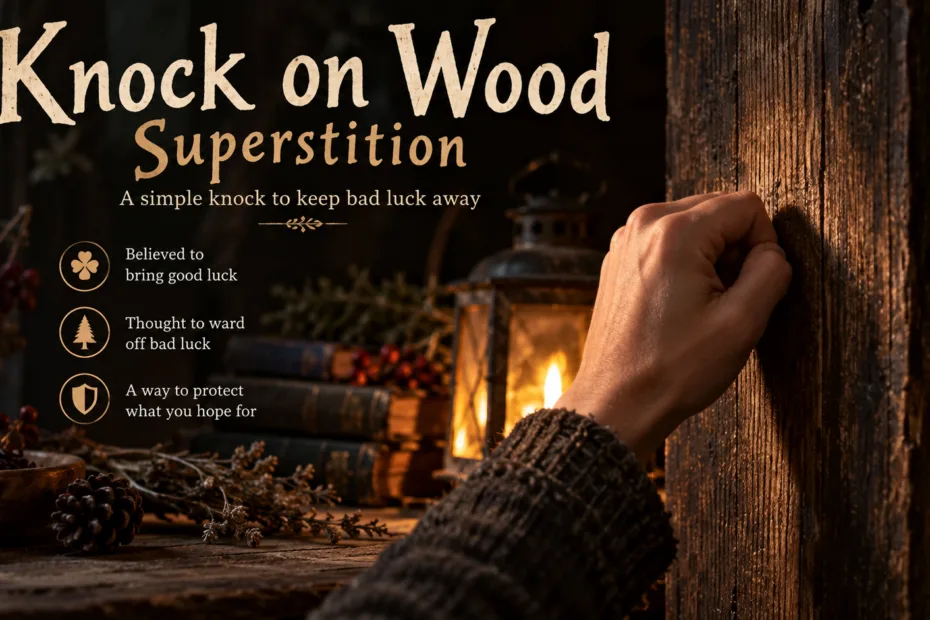
Knocking on wood is a folk practice used after a hopeful, confident, or fortunate statement to avoid tempting fate. The spoken phrase “knock on wood” can accompany an actual tap on wood, but it is also commonly used on its own.
Why People Knock on Wood After Saying Something Fortunate
The superstition usually appears at a very specific moment: someone has just said that things are going well, that a problem has never happened, or that a hoped-for event is likely to happen.
A person might say that a car has never broken down, then add “knock on wood”. The phrase acts as a small protective response to the favorable statement. Within the belief, speaking too confidently about good fortune may risk reversing it or attracting the very problem that has just been ruled out.
The action does not normally create a specific new piece of good luck. Its more characteristic role is protecting an already favorable situation or hopeful prediction from being spoiled after it has been mentioned aloud.
This is why the expression is closely associated with the idea of a jinx. Saying something fortunate can feel premature, while knocking on wood symbolically cancels the risk created by saying it.
The Gesture and the Spoken Phrase
The physical form is simple. A person touches or taps a wooden object, often with the knuckles, shortly after making the statement they want to protect. A table, door, desk, tree, or other nearby wooden surface may serve the purpose.
The words and the action do not always occur together. “Knock on wood” can function as an idiom even when no wood is touched. Someone may say the phrase in ordinary conversation simply to show that they do not want a confident statement to become unlucky.
The timing matters more to the belief than the object itself. The phrase usually follows the statement that might be interpreted as tempting fate:
- mentioning that something bad has never happened;
- saying that a favorable situation has continued without problems;
- predicting that something will go well;
- expressing hope while acknowledging that the outcome is not guaranteed.
“Knock on Wood” and “Touch Wood”
The two expressions represent essentially the same superstition. “Knock on wood” is the familiar American English form, while “touch wood” is the established British English form.
Usually describes tapping or knocking on a wooden surface and is strongly associated with American English.
Usually describes making contact with wood and is the common equivalent in British English.
Despite the difference in wording, both expressions are used to avoid bad luck after discussing good fortune or a desired future outcome. In casual speech, either expression may survive even when the physical gesture is omitted.
The Origin Is Less Certain Than the Popular Stories Suggest
Several explanations are repeatedly offered for the origin of knocking on wood, but there is no securely documented line connecting the present-day superstition to a single ancient ritual.
One familiar explanation links the custom with beliefs about sacred trees or spirits associated with trees. In versions of this story, touching or striking the wood either asks for protection, acknowledges good fortune, or keeps hostile forces from interfering with it.
Another explanation connects the protective quality of wood with Christian traditions surrounding the wood of the cross. These interpretations may explain why later generations found wood especially suitable for a protective gesture, but they should not be treated as established origins of the English expression.
The familiar stories about ancient tree worship, protective spirits, or the Christian cross are possible cultural interpretations rather than a proven historical chain leading directly to the current superstition.
A Children’s Game Offers Another Historical Trail
Folklorist Steve Roud has argued for a much more recent connection with British children’s chasing games in which touching wood created a place of safety. One such game became known as Tiggy Touchwood. A player who reached and touched wood could be temporarily protected from being caught.
This interpretation fits an important feature of the superstition: wood functions as a protective boundary. In the game, touching wood protects a player from capture. In the later folk practice, touching or knocking on wood is supposed to protect a favorable statement from bad luck.
The connection is notable because documentary evidence for the English superstition is relatively recent. References to touch wood appear in the nineteenth-century record, while the American wording knock on wood is documented around the beginning of the twentieth century. That late written record makes confident claims of an unbroken ancient origin difficult to support.
What the Superstition Is Supposed to Prevent
The feared event is usually not caused by the wood itself. The concern is that speaking confidently about good fortune may invite its opposite. The knock then serves as a protective counter-action.
For example, saying that someone has never missed a flight creates a statement about continued good fortune. Adding “knock on wood” marks the speaker’s wish that mentioning the pattern will not cause it to end. The same structure appears when people discuss health, travel, work, weather, relationships, possessions, or other uncertain parts of ordinary life.
The practice therefore belongs to a wider family of folk responses to premature certainty. It gives the speaker a small ritual action immediately after saying something that now feels exposed to chance.
Why the Phrase Can Survive Without the Belief
People do not have to accept the superstition literally to use the expression. “Knock on wood” has also become a conversational way of softening confidence. It can signal something close to “I hope this continues” or “I do not want to jinx it.”
This allows the phrase to operate at several levels. One person may deliberately search for real wood and perform the gesture. Another may say the words jokingly. Someone else may use the expression simply because it is a familiar idiom attached to uncertain good fortune.
Those different uses preserve the same underlying pattern: a favorable statement is followed by a brief act or phrase intended to keep that favorable situation from changing for the worse.