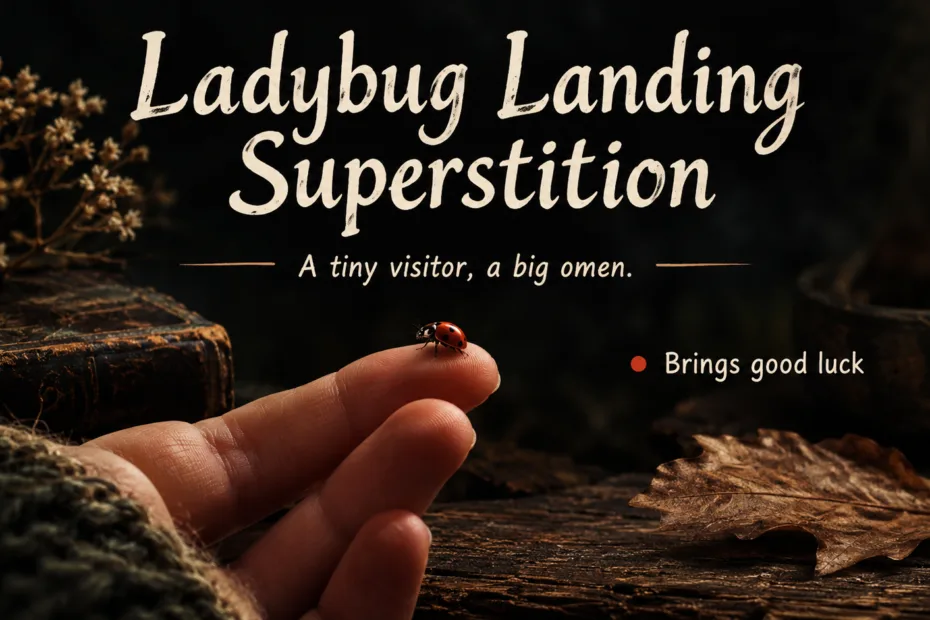
When a ladybug lands on a person, it is traditionally regarded as a sign of good luck. The belief treats an unexpected visit from the small beetle as a favorable omen, even though it does not specify exactly what good fortune will follow. Some related customs attach additional meaning to what the ladybug does next: crawling across a hand, opening its wings, or flying in a particular direction.
The superstition appears in recorded American folklore as well as older European traditions. Its simplest form concerns the landing itself. More elaborate versions use the ladybug’s movements to predict marriage, identify the direction of a future sweetheart, or accompany a wish.
A Ladybug Landing on You as a Sign of Good Luck
The James T. Callow Folklore Archive at the University of Detroit Mercy preserves a 1977 record from Taylor, Michigan, stating that a ladybug landing on someone brings good luck. Other records collected in Detroit describe the same belief.
These examples are unusually direct. They do not require the person to catch the beetle, count its spots, or perform a particular action. The ladybug’s arrival is itself the favorable sign.
The distinction between seeing a ladybug and having one land on the body matters. A person might notice several ladybugs in a garden, but the landing superstition concerns an encounter in which the insect settles on the person. The unexpected contact is what gives the event its special meaning.
The recorded good-luck belief does not assign separate predictions to the head, shoulder, arm, or clothing. Nor does it establish how long the good fortune should last. These details should not be assumed from the general statement that a landing is lucky.
The Ladybug That Measures a Hand for Wedding Gloves
One of the more unusual customs associated with a ladybug on the hand concerns marriage. Frank Cowan described it in his 1865 book Curious Facts in the History of Insects.
According to his account, a young woman in northern Europe who encountered a ladybug in spring could allow it to crawl across her hand while imagining that the insect was measuring her for wedding gloves.
The little beetle’s movements became a symbolic preparation for marriage. Its journey across the hand represented the taking of measurements for an accessory associated with a wedding.
This custom involved more than the insect simply landing. The woman deliberately allowed it to walk over her hand, and the interpretation depended on that action. The reference to spring was also part of the tradition Cowan recorded, rather than a rule governing every ladybug encounter.
The wedding-glove belief connected an ordinary movement of the beetle with the expectation of a future marriage. Once the ladybug had finished crawling and began to fly, another part of the fortune-telling custom could begin.
What the Ladybug’s Flight Revealed About Love
The Direction of a Future Sweetheart
In the marriage tradition described by Cowan, the direction taken by the ladybug after leaving the hand was believed to indicate where a future sweetheart would come from.
The young woman watched whether the insect flew north, south, east, or west. The direction was interpreted geographically, as a clue to the location from which a future partner might arrive.
English and Scottish rhymes also connected a ladybug’s flight with the search for a beloved person. In these customs, the insect’s departure supplied the answer to a question about love.
No fixed meaning was required for each compass direction. Flying west, for example, did not automatically predict disappointment or the return of a former lover. The particular direction was important because it supposedly pointed toward the person the observer hoped to meet or marry.
Bishop Barnabee and the Timing of Marriage
Another English tradition addressed the timing of marriage rather than the location of a sweetheart.
In Norfolk, the ladybug was known in some traditional rhymes as Bishop Barnabee or by related names. A person placed the beetle on the palm and recited a verse asking when a wedding would occur. The insect was then expected to take flight.
One recorded form of the rhyme asked:
“Bishop, Bishop Barnabee, Tell me when my wedding be.”
The following lines invited the beetle to open its wings and fly if the wedding was near. An immediate departure could therefore be interpreted as a prediction of an approaching marriage.
Folklore collections preserve different versions of the verse, including forms associated with Norfolk and Sussex. Some emphasize when the wedding will take place, while others ask the insect to fly toward the person the speaker loves.
Both versions rely on the same observable event: a ladybug resting on a hand eventually leaves it. The meaning assigned to that departure depends on the words and expectations of the particular custom.
Making a Wish When a Ladybug Flies Away
Wishing on a ladybug is another practice associated with the moment when the insect leaves a person’s hand.
In one family tradition documented by the USC Digital Folklore Archives, a Chicago informant recalled learning from their mother that ladybugs were lucky and that a wish could be made as one was released and flew away.
The wish was connected to the insect’s departure. Instead of watching its direction for news of a future partner, the participant attached a personal hope to the moment of release.
Such an account documents a particular family practice. It does not establish that every community regarded a ladybug landing as an invitation to make a wish, or that a wish would necessarily come true if the beetle flew away.
It also shows how the same small encounter can support different forms of folklore. A ladybug may be treated as a general good-luck sign in one tradition and as part of a wishing custom in another.
Letting the Ladybug Go Without Harming It
Some ladybug superstitions concern how a person treats the insect after encountering it.
The James T. Callow Folklore Archive contains a Detroit record from 1969 stating that killing a ladybug brings bad luck. A separate record from Toledo, Ohio, preserves the same prohibition.
This belief gives the insect a protected status in everyday custom. A creature associated with good fortune becomes one that people are reluctant to harm.
Other recorded traditions attach a positive result to releasing a ladybug alive. One account in the Detroit Mercy collection states that a person who catches a ladybug and releases it unharmed will soon receive money.
The distinction between these beliefs is worth preserving:
- A ladybug landing on someone: interpreted as a favorable omen without requiring another action.
- Releasing a captured ladybug alive: associated with receiving money in a separately recorded belief.
- Killing a ladybug: regarded as unlucky in other recorded traditions.
These are related beliefs, but they do not form a single set of rules. In particular, the money prediction concerns releasing a captured insect, not every instance in which a ladybug lands on someone and later flies away.
The Fly-Away Rhyme After a Ladybug Lands
A different use of a ladybug landing appears in a childhood recollection preserved by the James T. Callow Folklore Archive. The account describes a practice learned in Roseville, Michigan, during the 1950s.
When a ladybug landed on someone, the child would recite a version of the familiar Ladybug, Ladybug, Fly Away Home rhyme and blow the insect from the hand.
The recorded version referred to the ladybug’s house being on fire and its children being in danger. If the insect flew out of sight without landing again, the children were considered safe.
This interpretation differs from both the simple good-luck omen and the marriage predictions. The insect’s flight was treated as the outcome of a small spoken ritual, with attention given to whether it continued flying or settled again.
The familiar fly-away rhyme has many recorded forms, and not all of them involve a ladybug first landing on a person. The Roseville account is distinctive because it explicitly begins with that encounter and gives a particular meaning to what happens after the beetle leaves the hand.