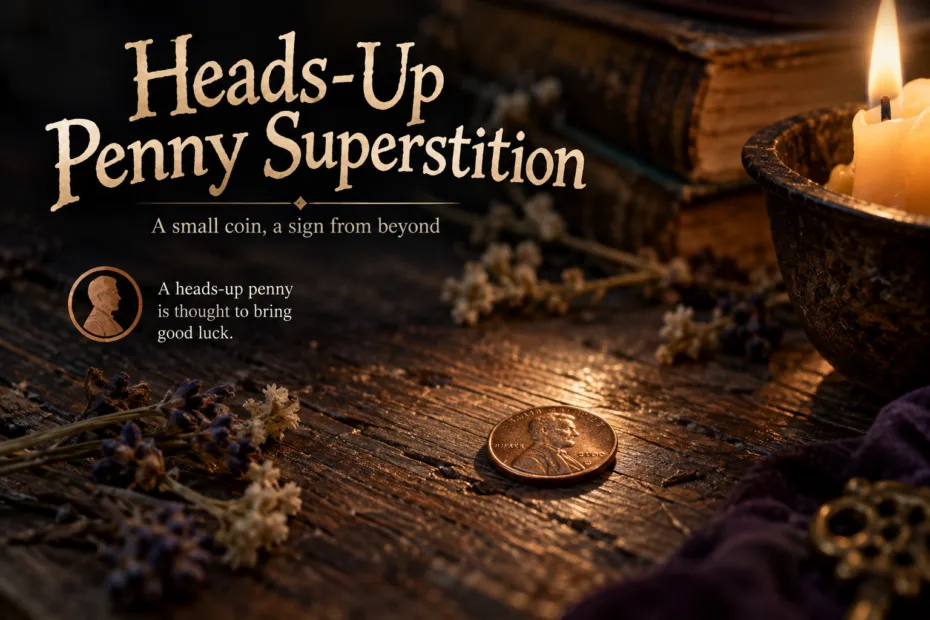
A penny lying heads-up is traditionally treated as a small piece of good luck. In the best-known form of the belief, the finder picks up the coin and keeps it, while a penny showing its reverse side may be left where it is or turned over for another person to find.
What Makes a Penny “Heads-Up”?
A penny is heads-up when its obverse, or portrait side, faces upward. On a Lincoln cent, this is the side bearing Abraham Lincoln’s portrait. The opposite face is commonly called the tails side.
The orientation matters because the superstition does not always treat every found penny in the same way. In versions that use the heads-up rule, seeing the portrait side first is what marks the discovery as lucky.
Heads-Up
Usually treated as the lucky position. The penny may be picked up and kept, sometimes with the luck understood to last for the rest of the day.
Tails-Up
Traditions differ. The coin may be left alone, regarded as unlucky, treated as having no effect, or turned heads-up for the next finder.
The Familiar Lucky-Penny Rule
The belief is closely associated with the familiar children’s rhyme about finding a penny, picking it up, and having good luck for the day. Folklore records show that the rhyme and the heads-up rule often overlap, but they are not exactly the same tradition.
Some recorded versions of the rhyme say simply that finding and picking up a penny brings luck. They make no distinction between the two sides of the coin. Other accounts add a second condition: the penny must already be lying heads-up before it should be taken.
This difference is useful because there is no single fixed set of rules. The superstition has circulated through families, childhood sayings, and informal advice, allowing small details to change while the basic connection between a found penny and luck remains recognizable.
What Happens After the Penny Is Picked Up?
In a simple version, nothing more is required. Finding the heads-up penny and taking it is enough to receive the supposed good luck.
Other recorded forms add a small action after the discovery. A person may keep the penny in a pocket or carry it for the day. One folklore account even records carrying the coin in a shoe. These details belong to individual versions rather than to a universal rule.
The Duration of the Luck Also Varies
The rhyme commonly connects the penny with luck for the rest of the day. Some personal traditions simply describe the penny as lucky without giving the effect a fixed duration.
Why a Tails-Up Penny Is Often Left Behind
The tails-up side produces the greatest variation in the belief. In some accounts, picking up a tails-up penny is avoided because that position is associated with bad luck. In others, a tails-up penny is merely considered not lucky, with no harmful meaning attached to it.
Another practice is to turn the penny over and leave it on the ground. The coin is then heads-up for whoever encounters it next. This turns the superstition into a small act of passing the lucky opportunity to another finder rather than taking the coin oneself.
- Leave it: the tails-up penny is passed by.
- Turn it over: the penny is left heads-up for someone else.
- Treat it as neutral: some versions attach no bad luck to the reverse side; it simply does not count as a lucky find.
Because all three forms appear in recorded folklore, claims that a tails-up penny always means bad luck make the tradition more uniform than it really is.
The Penny Rhyme Has an Older Relative
The well-known penny saying resembles an older English-language rhyme about finding a pin rather than a penny. Versions of the pin rhyme associate picking up the small object with good luck and leaving it behind with bad luck.
Later penny versions preserve much of that simple pattern: notice a small object, pick it up, and receive good fortune. The exact path from the older pin wording to the penny rhyme is not clear enough to assign the heads-up penny belief to one person, date, or event.
More importantly, the older rhyme does not by itself explain the heads-versus-tails rule. The coin’s orientation appears as an additional folk condition in many later accounts. It is therefore more accurate to distinguish the broader found penny brings luck tradition from the more specific only a heads-up penny is lucky version.
How the Belief Works in Everyday Use
The heads-up penny superstition depends on an ordinary chance encounter. The finder does not arrange the coin or choose which side appears. A penny already lying portrait-side up becomes the lucky find.
That makes the practice easy to pass on informally. Someone notices a penny, another person says to pick it up because it is heads-up, and the rule is learned through the moment itself. Folklore collections contain exactly this kind of variation: people often remember learning the rule from relatives or during childhood without knowing where the belief originally began.
The stable part of the tradition is small: a found penny lying heads-up is treated as good luck. What to do with a tails-up coin, how long the luck lasts, and whether the penny must be carried afterward depend on the version being followed.