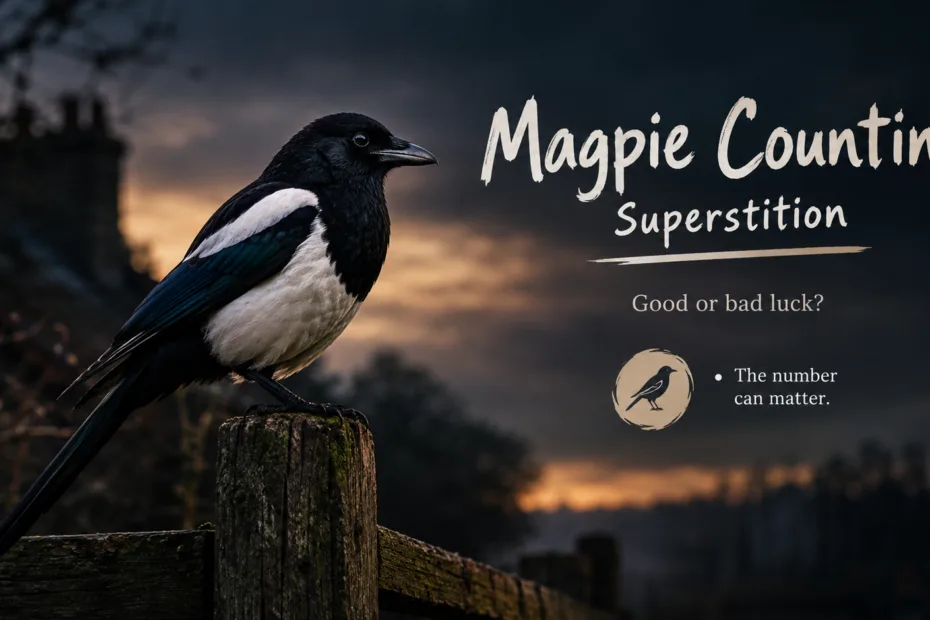
The magpie counting superstition is a traditional belief that the number of magpies seen together can foretell good or bad fortune. Best known through the rhyme “One for sorrow, two for joy,” it associates a lone magpie with sadness, a pair with happiness, and larger groups with events such as births, weddings, wealth, or secrets.
The custom is particularly associated with British and Irish folklore. Its meanings have changed across regions and generations, and no single version of the counting rhyme has always been accepted everywhere.
What Does the Number of Magpies Mean?
The familiar seven-number rhyme gives each sighting a different interpretation. The first two numbers express the main contrast: one magpie is considered unlucky, while two are welcomed as a favorable sign.
| Magpies Seen | Traditional Rhyme | Folklore Meaning |
|---|---|---|
| 1 | One for sorrow | Sadness, disappointment, or misfortune |
| 2 | Two for joy | Happiness or good fortune |
| 3 | Three for a girl | A girl, often interpreted in connection with a birth |
| 4 | Four for a boy | A boy, often interpreted in connection with a birth |
| 5 | Five for silver | Money or material good fortune |
| 6 | Six for gold | Wealth or prosperity |
| 7 | Seven for a secret never to be told | A hidden matter or undisclosed information |
These are the meanings associated with a familiar modern form of the rhyme, rather than a fixed historical system. Older versions gave three magpies the meaning of a wedding and four the meaning of death or birth, depending on the tradition.
What About Eight, Nine, or Ten Magpies?
Some extended versions continue beyond seven birds. A version associated with the British children’s television programme Magpie includes eight for a wish, nine for a kiss, and ten for a bird not to be missed.
Older recorded rhymes assign different outcomes to these higher numbers. There is no universally established meaning for eight, nine, ten, or larger groups of magpies.
Why Is One Magpie Unlucky but Two Lucky?
In the best-known tradition, a solitary magpie represents sorrow. Seeing two together removes that unfavorable meaning and replaces it with joy or good fortune.
The contrast reflects an older tradition of interpreting birds as omens. People attached meaning to their numbers, calls, movements, and appearances. Magpies were especially noticeable because of their black-and-white plumage, loud calls, and habit of appearing near human settlements.
Traditional beliefs sometimes associated the solitary bird with isolation or misfortune, while a pair was treated more favorably. However, these symbolic explanations should not be mistaken for a proven origin of the rhyme.
What counts as a sighting? The historical counting tradition generally refers to magpies seen together on one occasion. There is no established folkloric rule requiring birds seen at different places or times to be added into a single total.
How Old Is the Magpie Counting Rhyme?
One of the earliest known printed records appears in a note by Samuel Henley published in 1780. It describes a practice in the west of England in which the number of magpies determined the meaning of the omen.
“One for sorrow, two for mirth, three for a wedding, four for death.”
An eighteenth-century recorded form of the magpie counting rhyme
This early wording differs from the commonly remembered version. In particular, it associates three birds with a wedding and four with death, rather than a girl and a boy.
During the nineteenth century, folklore collectors documented longer sequences and alternative meanings. Some included money, marriage, births, and secrets. The familiar combination of a girl, a boy, silver, gold, and a secret was also recorded in the early twentieth century.
When One Magpie Meant Joy Instead
Not every regional tradition treated a single magpie as unlucky. Robert Chambers recorded a Scottish rhyme in 1826 that reversed the first two meanings:
“Ane’s joy; twa’s grief; Three’s a marriage; four’s death.”
A Scottish counting rhyme recorded in the nineteenth century
In this version, one magpie indicates joy and two indicate grief. The difference shows why the modern seven-number sequence cannot be treated as the original interpretation in every community.
Saluting a Single Magpie to Avoid Bad Luck
A separate custom developed around the supposedly unlucky sighting of one magpie. Instead of simply accepting the omen, some people greeted the bird to prevent the predicted misfortune.
A familiar greeting is “Good morning, Mr Magpie.” A longer form asks about the magpie’s wife or family. Within the custom, referring to a companion can symbolically turn the encounter with one bird into an imagined pair.
Other recorded responses include raising a hat, bowing, or turning around. Nineteenth-century folklore accounts document these gestures as ways of counteracting an unfavorable sighting, although the exact actions differed by locality.
The greeting is a ritual response to the belief. It is not a required part of counting magpies, and its supposed ability to change luck belongs to folklore rather than an observable cause-and-effect relationship.
Why Magpies May Be Seen Alone, in Pairs, or in Groups
The bird most closely connected with the British counting tradition is the Eurasian magpie (Pica pica), a member of the crow family.
Eurasian magpies often form long-lasting pair bonds. A pair may remain associated throughout the year, while family parties and larger gatherings can also occur. Birds may be observed alone while feeding, moving between locations, or remaining temporarily out of sight of their companions.
These ordinary differences in bird behavior provide the changing numbers that the rhyme interprets symbolically. The number visible at one moment does not establish that other magpies are absent from the surrounding area.
The counting tradition therefore depends on the observer’s encounter with the birds, not on a special behavior by the magpies themselves.