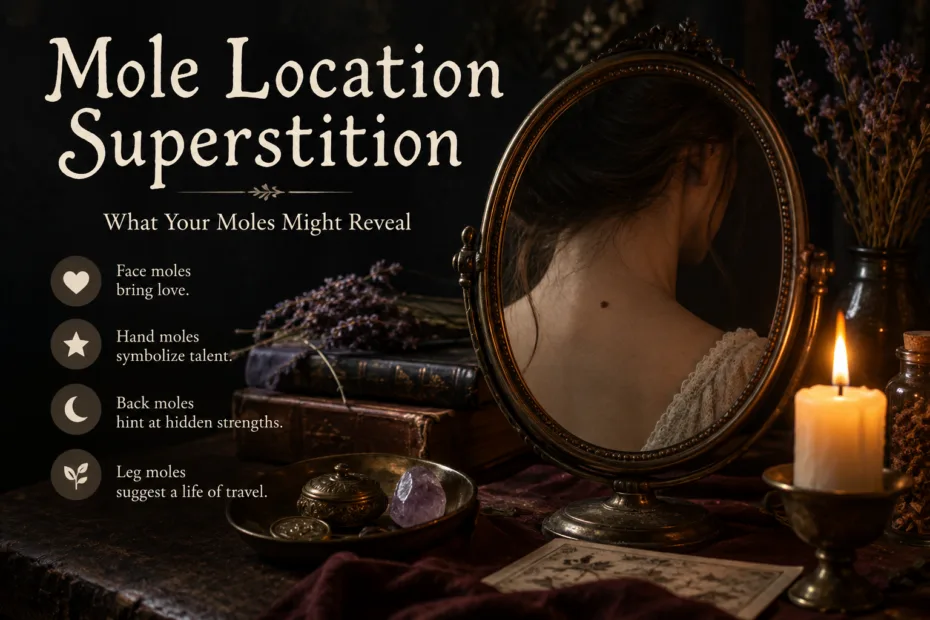
Mole location superstition treats the body as a map of omens. A mark on the forehead, cheek, neck, chest, hand, knee, or another part of the body may be assigned a different meaning, while the right or left side can change the reading entirely.
Why the Location of a Mole Matters in Folk Belief
The central idea is not simply that having a mole is lucky or unlucky. The exact position of the mark is what gives it meaning. Older systems connected different parts of the body with wealth, marriage, children, travel, temperament, social standing, hardship, or good fortune.
This produced detailed body maps in which a mole only a short distance from another could receive a different interpretation. A mark on the forehead might be read differently from one near an eyebrow, while a mole on the right side might carry an opposite omen from the same mark on the left.
Recorded interpretations do not form one worldwide system. Ancient divinatory texts, later European fortune books, local oral traditions, and modern popular belief can assign different meanings to the same location.
An Ancient Tradition of Reading the Body
One of the clearest surviving examples comes from a Greek divinatory text transmitted under the name of Pseudo-Melampus. The work examines natural marks on the body and assigns predictions according to their position.
The Greek term used for these marks is elaia, literally “olive.” In this setting it refers to an olive-like mark on the skin. The category may not correspond perfectly with the modern dermatological meaning of a mole, and some descriptions appear broad enough to include other persistent natural marks.
The text moves through the body from the head downward. Forehead, eyebrows, nose, cheeks, lips, chin, ears, neck, shoulders, hands, chest, abdomen, thighs, knees, ankles, and feet can all receive separate readings.
The pattern shows that mole divination was more than a collection of isolated sayings. The body’s geography itself supplied the organizing principle.
Right and Left Can Change the Omen
Side is one of the most persistent features of mole-location lore. In the Pseudo-Melampus material, the right side is often treated more favorably and the left less favorably. The text even gives a broad rule connecting marks on the right with prosperity and marks on the left with poorer fortune.
That rule is not perfectly consistent. Individual entries can introduce their own meanings, and later traditions do not always follow the same pattern. It is safer to understand right versus left as a recurring method of classification, rather than a fixed law shared by every tradition.
The body part determines the basic category of the omen.
Right and left may alter, reverse, or refine the prediction.
Some older systems give different readings for men and women.
Mole Meanings in English Folk Tradition
Mole-location beliefs also appear repeatedly in British folk collections and fortune-telling literature. Thomas Thiselton Dyer recorded the idea that moles could indicate good or bad luck according to where they appeared on the body.
In one nineteenth-century collection, a mole on the throat is described as lucky, while a mole on the left side of the forehead near the hair receives an unfavorable reading. Marks on the chin, ear, or neck are connected with riches, while a mole on the breast is linked with poverty.
Some of these interpretations resemble the much older Pseudo-Melampus material. Others differ. This does not show that every version descended unchanged from a single source. Instead, it illustrates how the same basic practice—reading destiny from the position of a natural mark—could be reshaped in different periods.
The Mole Above the Right Eye
A particularly well-recorded English example concerns a mole near the right eye. Dyer’s nineteenth-century account describes a Nottinghamshire belief that a woman with a mole above the right eye could expect favorable fortune through marriage.
The belief became associated with a local rhyme from Bunny, Nottinghamshire, in which a girl treats the mark above her eye as a prediction that she will one day become a lady. The example is useful because it shows how a general body-location omen could become part of local oral folklore rather than remaining only in fortune books.
Printed Fortune Books Expanded the Body Map
Early modern and later popular publications turned mole interpretation into elaborate lists. Works such as the Greenwich Fortune-Teller and other inexpensive fortune books assigned predictions to many precise locations.
Forehead marks might concern prosperity. A mark near the nose could relate to travel or marriage in some versions. Arms, hips, knees, legs, feet, chest, and other areas received their own readings. Some texts also changed the interpretation according to whether the mole appeared on the right or left.
These printed lists were not fully consistent with one another. A location described as favorable in one source could receive a less favorable interpretation elsewhere. Even closely related English-language traditions could disagree.
Why the Same Mole Can Have Different Meanings
Mole-location superstition developed through several channels: divinatory manuals, physiognomic traditions, chapbooks, household lore, local sayings, and oral transmission. Each could preserve an older interpretation, modify it, or combine it with another system.
Some readings appear to follow symbolic association. A mark near the mouth may be linked with eating. A mark on a part of the body associated with movement may be connected with travel. Other interpretations have no obvious connection between body part and prediction and simply survive as inherited rules.
This variation is part of the tradition itself. Asking what a mole “means” without knowing the particular belief system, location, side, and historical setting can produce several conflicting answers.
Moles, Birthmarks, and Natural Marks Are Not Always Separated
Historical terminology requires care. Older texts do not always divide moles, birthmarks, blemishes, and other natural marks in the same way modern readers might. A translated reference to a “mole” may therefore describe a broader class of visible skin marks.
This is especially relevant when comparing traditions separated by language and time. The folklore concerns the meaning assigned to a visible bodily mark, while the exact type of mark intended by the original source may vary.
What Defines the Mole Location Superstition
The defining feature is the belief that where a mole appears can reveal something about a person’s fortune, character, relationships, or future. The mole functions as a sign because of its position on the body, not merely because it exists.
That principle can support very simple sayings or highly detailed systems. Some traditions recognize only a few memorable locations. Others divide the body into many zones and add rules for right and left sides, sex, color, shape, or other features of the mark.
For that reason, historical mole lore is best understood as a family of location-based body omens rather than one fixed list of meanings shared across cultures.