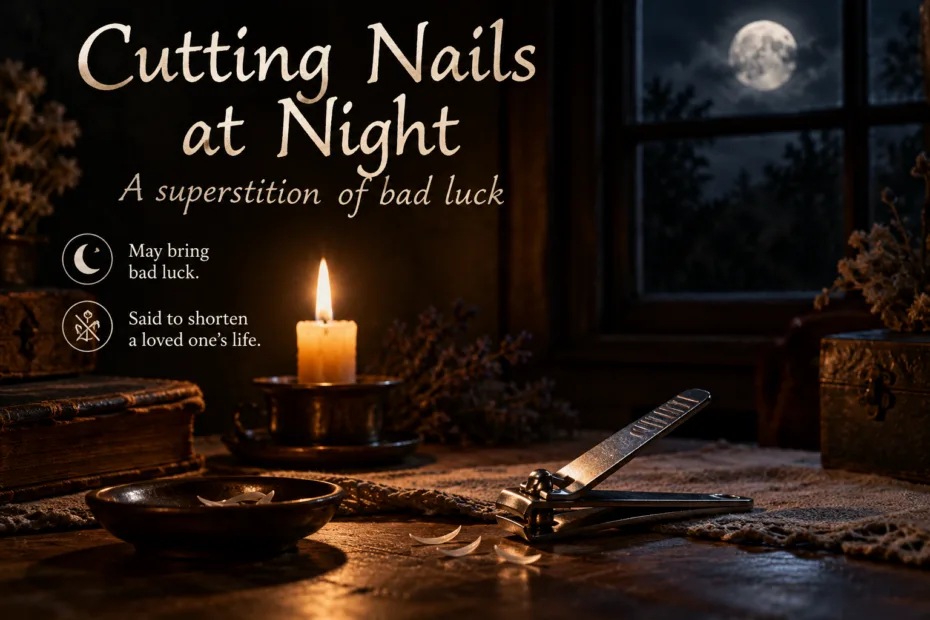
The superstition against cutting nails at night treats an ordinary grooming task as something better left until daylight. Depending on the tradition, breaking the rule may be linked with bad luck, illness, shortened life, family misfortune, or danger connected with discarded nail clippings.
What the Superstition Says
The basic rule is simple: do not cut fingernails or toenails after dark. There is no single consequence attached to it everywhere. The warning changes between families, regions, and cultural traditions.
Some recorded forms say that nighttime nail cutting brings bad luck or sickness. Others connect it with death or separation from one’s parents. In a well-documented Japanese form, a person who cuts nails at night is warned that they may not be present at a parent’s deathbed.
This belief usually works as an action taboo. Nothing has to happen first as a warning. The act itself—cutting the nails at night—is the behavior that should be avoided.
Why Night Is Treated Differently
A practical explanation appears often in family accounts: before bright household lighting, trimming nails after sunset could be awkward. Nails were not always cut with the compact clippers used today. Working with a blade or another sharp tool in poor light could make injury more likely, while dropped nail fragments were harder to find and clean up.
This explanation fits the rule well, but it should not be treated as the proven origin of every version. Folklore rarely develops from one traceable event. A useful household warning can exist beside religious ideas, wordplay, family teaching, and beliefs about the body.
That helps explain why the custom can continue even where electric lighting has removed the original practical concern. Once a rule becomes part of family behavior, it may be repeated simply because parents and grandparents taught it that way.
Nail Clippings Can Carry Their Own Meaning
Human hair and nails have often received special treatment in folk belief because they were once part of the body. In traditions built around this idea, cutting them is not always viewed as the end of their relationship with the person.
Folklorists have used the term contagious magic for beliefs in which something that once belonged to a person remains symbolically connected to that person after separation. Hair, nail clippings, clothing, and other personal remains frequently appear in such traditions.
This wider idea helps make sense of some versions of the nighttime taboo. The concern is not always the cutting alone. What happens to the clippings afterward may matter just as much.
One recorded Korean family tradition warned that nail clippings left on the floor at night could be eaten by rats, which were then said to gain a connection with the person. This is a specific collected folklore account rather than a rule that should be assumed for all Korean households.
The Japanese “Night Nails” Tradition
Japan has a particularly well-recorded form of the belief known through the idea of yozume, or cutting nails at night. Japanese dictionaries and folklore references record the warning that doing so can prevent a person from being present when a parent dies.
The explanation is not uniform. Japanese folklore collections preserve several regional consequences for nighttime nail cutting, including injury, illness, early death, unfulfilled wishes, and other forms of misfortune.
There is also a traditional play on words connecting the expression for nighttime nail cutting with wording that can suggest shortening one’s life. This linguistic explanation is one interpretation among several, not a settled historical origin.
Folklore reference collections preserve several explanations for the taboo, including poor lighting, fear of injury, ideas about harming the body received from one’s parents, supernatural danger, and verbal associations. The surviving evidence does not reduce the custom to one confirmed starting point.
Bad Luck and Sickness Versions
South Asian family traditions also provide clear records of the prohibition. In collected Indian folklore accounts, cutting fingernails after dark has been described as bringing bad luck or sickness.
Some people who learned the rule from parents or grandparents explain it through older living conditions: without strong lighting, nail cutting was safer during the day. The explanation may be practical, while the form in which the lesson survives is a superstition.
This distinction matters. Saying that an older safety concern may help explain the custom is different from claiming that every community invented the belief for exactly that reason.
What “Night” Usually Means
The rule is generally tied to darkness or the period after sunset, not to a universal clock time. A household may interpret it as “after dark,” while another may simply avoid nail cutting once evening begins.
That flexibility is typical of an orally transmitted household taboo. Its boundaries are learned through family practice rather than through a fixed written rule. One generation may repeat the warning literally, another may treat it as an old custom, and another may continue avoiding nighttime nail cutting out of habit without expecting any particular misfortune.