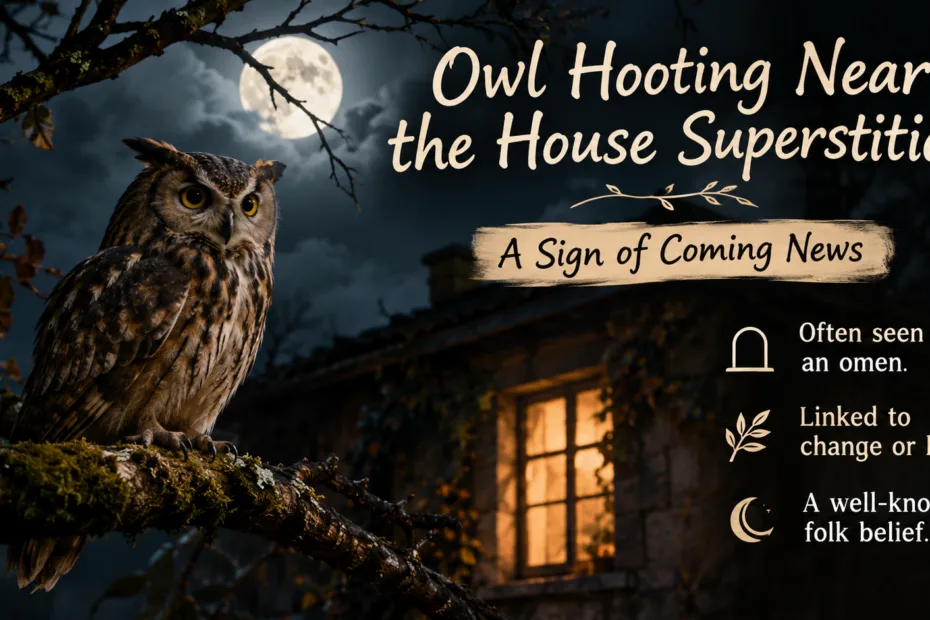
An owl hooting near a house was traditionally regarded in some communities as a warning of death, bad news, or an approaching event affecting the household. The sound carried particular meaning when it came from the roof, a tree in the yard, or elsewhere on the property. Certain versions of the superstition also depended on how many times the owl called or whether it returned on successive nights. These interpretations are recorded folk beliefs, not reliable predictions of future events.
Why an Owl Hooting Near a House Was Considered a Death Omen
The central belief connects an owl’s call with the people living in the nearest house. Rather than predicting misfortune for anyone who happened to hear it, the bird was sometimes understood to be announcing an event within a particular family.
Margaret Cannell’s 1933 collection Signs, Omens, and Portents in Nebraska Folklore records a belief that an owl hooting near a house meant someone inside would die within a short time. Another entry associates hearing an owl at night with receiving news of a friend’s death. The distinction matters: one version concerns the occupants of the house, while the other concerns news reaching the listener.
In these beliefs, the owl generally acts as a messenger or warning sign. Its call is interpreted as announcing an approaching death, without necessarily suggesting that the bird causes it.
When an Owl Hooted Near a House Where Someone Was Sick
The superstition could take on a narrower meaning when a household member was already seriously ill.
A folklore record associated with Columbia, Tennessee, describes owls calling from the roof of a house where someone was sick. The sound was interpreted as a warning that the sick person would die. The belief identified a particular person rather than leaving the expected death unspecified.
The James T. Callow Folklore Archive preserves a personal account in which an owl hooted close to a house during the final night of the narrator’s father’s life. The sound seemed to come from the roof, and neighbors interpreted it as a warning that the father would not survive the night.
The narrator acknowledged that the father died but rejected the idea that the owl had caused his death. This account preserves both the neighbors’ interpretation and the narrator’s disagreement with it.
Three Hoots, Three Nights, and Other Conditions
Some recorded versions of the belief assigned particular importance to the repetition or timing of an owl’s call. The details were not consistent across traditions.
Three Hoots on the Property
One Nebraska belief recorded by Cannell states that an owl hooting three times on someone’s property foretold a death in the landowner’s family.
Here, the number of calls and the location were both part of the omen. The record does not establish three hoots as a universal warning or specify that the predicted event would occur after three days.
Calling for Three Consecutive Nights
A separate belief learned in Nashville, Tennessee, and recorded in 1968 concerned a screech owl whistling near a house for three nights in a row. According to that version, the repeated calling predicted a death in the house.
Three nights of calling is a different condition from three individual hoots. The distinction also shows why historical descriptions such as hooting, whistling, and screeching should not automatically be treated as identical sounds.
An Owl Calling During a Full Moon
A belief recorded in Wartrace, Tennessee, in 1972 added a lunar condition: an owl coming to the house and hooting during a full moon was interpreted as a warning of death in the family.
The full moon belonged to that particular recorded version. It was not a necessary feature of the broader house-hooting superstition.
Does It Matter Where the Owl Is Hooting?
Descriptions of the bird’s position often identify which household the omen supposedly concerns. A roof, a yard, and a tree beside the house appear in different records, although no single interpretation applies to every location.
Hooting From the Roof
The roof places the bird directly above the home. In some accounts, this made the call especially relevant to the residents.
Traditional Persian beliefs documented by Henri Massé, and discussed in the Encyclopaedia Iranica, include the interpretation that an owl crying on a housetop announces bad news for the occupants. Another account associates a wailing owl perched on a roof or tree with death.
Hooting From a Tree in the Yard
The bird did not always have to perch on the building. A tree standing within the household’s immediate surroundings could carry the same association.
In a November 1936 interview collected through the Federal Writers’ Project, Camilla Jackson of Georgia described a belief that an owl settling in a tree in the yard or near the house and beginning to hoot meant someone in the family would die.
This version identifies both the position of the bird and the act of calling. Merely having a tree near the house was not the omen.
When an Owl’s Call Meant a Visitor Instead of Death
Not every traditional interpretation of an owl calling near a home predicted misfortune.
In Persian folklore recorded by Massé, an owl that cried once and then departed was believed to announce the arrival of a traveler. The outcome depended on the brief call followed by the bird’s departure.
That interpretation differs from the account of an owl remaining in a nearby tree and continuing to call, which could be treated as ominous. It also differs from the belief about bad news announced from a housetop.
The duration and pattern of the encounter therefore mattered in some traditions. A single call followed by departure could represent an expected arrival, while persistent calling could carry an unwelcome meaning.
Why an Owl May Hoot Near the Same House Repeatedly
Owls call for ordinary biological reasons, including territorial communication and contact between mates. The same location may provide a suitable calling perch over several nights.
The Cornell Lab of Ornithology describes Great Horned Owls using deep, rhythmic hoots to advertise their territories. Mated pairs may exchange calls, with the female’s voice generally higher in pitch. These birds can also roost on human-made structures.
Barred Owls produce a different, recognizable sequence of hoots and defend their territories throughout the year. During courtship, pairs may exchange several kinds of vocalizations.
Consequently, repeated sounds near a house may come from a resident bird maintaining its territory or from two birds communicating. The calls can be especially noticeable around dusk and during the night, when many owl species are active.
Not every sound attributed to an owl is a deep hoot. Different species produce whistles, shrieks, screams, and other calls. A historical description of a screech owl whistling cannot establish that the bird made the same sound as a Great Horned Owl.
No scientific evidence establishes that the number, timing, or location of an owl’s calls can predict a person’s death or illness.
Traditional Attempts to Turn Away the Owl’s Warning
Some folklore records describe actions intended to drive away the bird or change the meaning of its call.
An account printed in the Journal of American Folk-Lore in 1899 states that putting iron into a fire when an owl hooted around the house was believed to make the bird leave immediately. The account adds an unusual qualification: the bird’s departure might not prevent the calamity it supposedly announced.
The distinction suggests that silencing the messenger and preventing the predicted event were not always considered the same thing.
Other traditional responses attempted to transform the warning into a favorable message. Persian folklore records describe the presentation of a mirror and salt to an ominously calling owl, accompanied by words asking it to bring good news. A related account concerning an owl that continued calling from a tree included bread, salt, and a mirror.
These were customary responses to a feared omen rather than methods known to influence future events. Their specific details also reveal a difference within the superstition: some people sought to make the owl leave, while others sought to change the message they believed it carried.