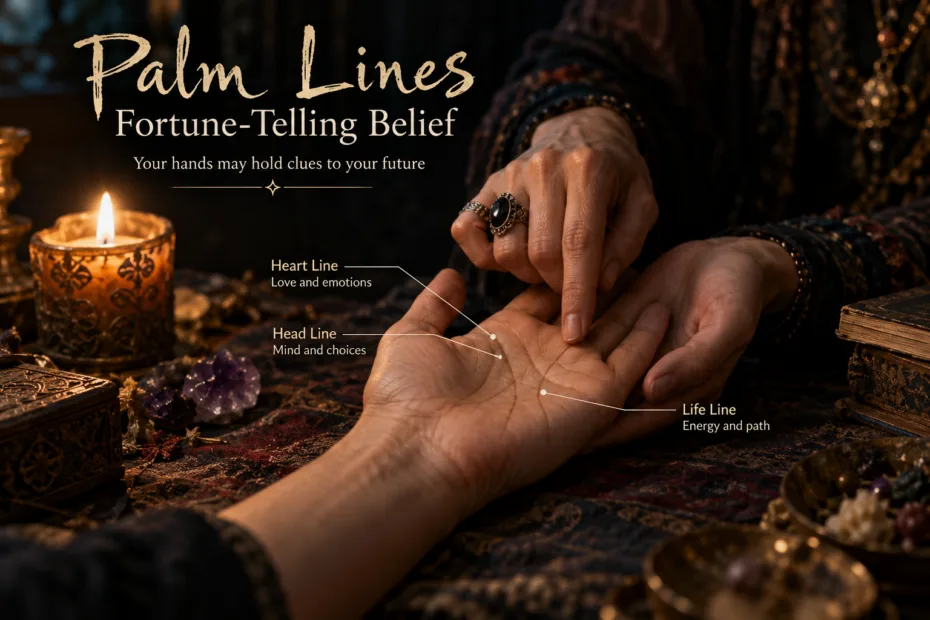
Palm-line fortune telling is the belief that the creases of the hand can be read as signs of personality, relationships, vitality, life direction, and future events. The practice is commonly associated with palmistry or chiromancy, although systems of interpretation have differed across periods and traditions.
How Palm Lines Become Signs of Fortune
The belief does not usually treat every crease as equally meaningful. A reader identifies selected lines and interprets their length, depth, direction, breaks, branches, crossings, and relationship to other lines. A feature that appears favorable in one position may be read differently when it intersects another line.
This creates a symbolic map rather than a simple one-line prediction system. Two people may have a crease in roughly the same place while receiving different readings because its shape, clarity, beginning point, ending point, or surrounding marks differ.
Palmistry can also examine hand shape, fingers, fleshy areas of the palm, marks, and proportions. The fortune-telling belief centered specifically on palm lines is therefore one part of a broader hand-reading tradition.
The Lines Most Often Given Symbolic Meanings
Modern Western palmistry commonly gives special attention to three prominent creases and, when visible, a fourth vertical line. Their familiar names are symbolic labels rather than anatomical names.
Why Breaks, Forks, and Crossings Matter
Fortune-telling systems rarely rely only on whether a named line exists. The form of a line often carries much of the interpretation.
- A deep or clearly marked line may be treated as a stronger expression of the quality assigned to that line.
- A faint or uneven line may be interpreted as uncertainty, fluctuation, or weaker expression.
- A break may be read as a change, interruption, transition, or difficult period.
- A fork or branch can represent divergence, movement in more than one direction, or the development of another influence.
- Crossing lines may be interpreted as interference, encounters, obstacles, or events affecting the meaning of a larger line.
These meanings are conventions within fortune-telling traditions. There is no single interpretation shared by every school of palmistry.
The Life Line and the Idea of Lifespan
The life line has produced one of the best-known palm-reading beliefs: that a long line promises a long life and a short line predicts an early death. Historical palmistry literature does contain associations between this crease and longevity, but the interpretation has never been completely uniform.
Other systems place more emphasis on vitality, health, changes in living conditions, or the general course of life rather than treating physical line length as a direct count of years. This is an example of how a popular version of a superstition can become simpler and more definite than the traditions from which it developed.
A palm line should not be used to estimate lifespan, health outcomes, or future medical events. Palm-reading meanings belong to systems of divination and folk interpretation, not medical prognosis.
Historical Hand Diagrams Turned the Palm Into a Map
European records show that line-based hand reading was already being organized visually in the late medieval period. A German Chiromantia preserved by the Library of Congress, dating to around the late fifteenth century, contains dozens of illustrated hand plates with lines and marks explained directly on the images.
Later manuals continued this diagrammatic approach. A French manuscript from the late seventeenth century in the Wellcome Collection contains hand diagrams alongside instructions for chiromancy and physiognomy. Printed and manuscript charts helped turn variable natural creases into named locations that readers could compare from one hand to another.
The same basic idea appears in many later popular manuals: the palm is treated as a readable surface, with named lines acting like routes through different areas of human experience.
The Names and Meanings Have Not Always Matched
The familiar set of life, head, heart, and fate lines can make palmistry appear more standardized than its history actually is. Earlier texts sometimes divided the palm differently, used other names, or combined meanings that later writers separated.
Even the purpose of hand reading could vary. Some traditions emphasized character and temperament. Others included fortune, prosperity, relationships, health, longevity, or particular events. In some historical settings, palm reading overlapped with physiognomy, the practice of interpreting bodily features as signs of character or destiny.
This variation matters when describing the belief. A meaning found in one manual or community should not automatically be treated as the universal meaning of a palm line.
What the Physical Lines Actually Are
The prominent lines used by palm readers are palmar flexion creases. Anatomical research shows that major creases develop during fetal development, with recognizable palm and finger creases appearing before birth.
Modern anatomical terminology describes the three familiar major creases as the distal transverse crease, proximal transverse crease, and radial longitudinal crease. These correspond broadly to what palmistry commonly calls the heart, head, and life lines.
The lines are physical creases formed as part of normal hand development, with natural variation between individuals.
The same visible creases are assigned symbolic meanings concerning character, relationships, vitality, fortune, or future experience.
The presence of real anatomical variation does not establish the predictive meanings assigned to those variations in palmistry. The fortune-telling element comes from the cultural interpretation placed on the lines.
Reading a Pattern Rather Than a Single Line
Within palm-reading belief, one mark is often interpreted in relation to the rest of the hand. A break in a line, for example, may be judged differently depending on whether another branch continues beside it. A line may also receive a different reading depending on where it begins, where it ends, and which other lines it touches.
This pattern-based approach helps explain why palm-line fortune telling developed so many competing interpretations. The natural variety of human palms provides many possible combinations, while different traditions supply different symbolic rules for reading them.