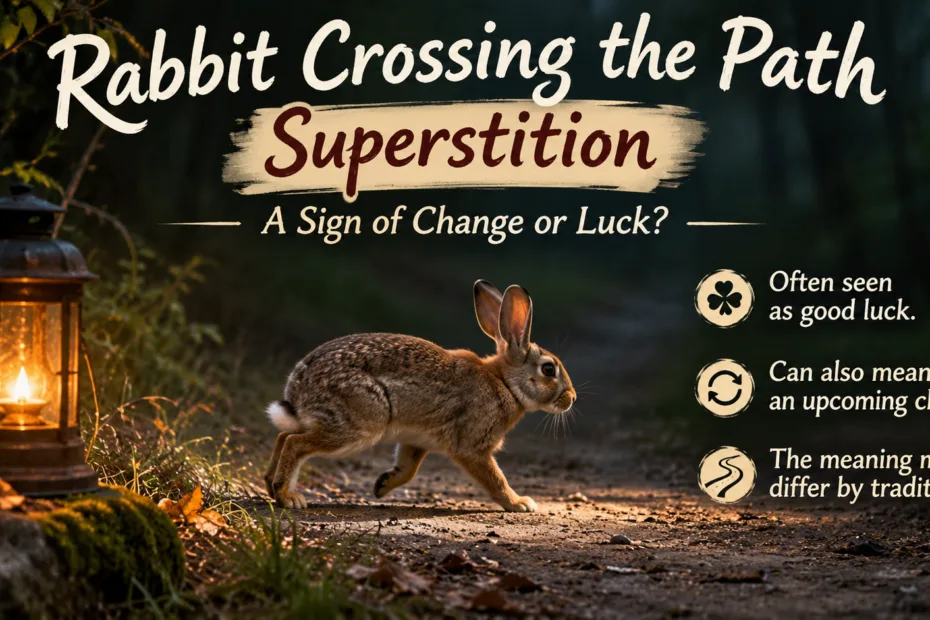
A rabbit crossing someone’s path is a traditional omen whose meaning changes between recorded folk beliefs. In some accounts, the encounter warns of bad luck, an unsuccessful journey, or disappointment later that day. Other versions associate it with good fortune, particularly when the rabbit moves in a certain direction or appears at a particular time.
The superstition concerns an unexpected animal passing directly across a person’s route. The crossing itself is treated as a sign, although there is no single interpretation shared by all traditions.
When a Rabbit Crossing the Path Means Bad Luck
One well-documented interpretation treats the crossing as a warning that something may go wrong. This meaning appears in older British and Irish folklore, especially in beliefs concerning hares.
An account preserved in the Irish Schools’ Collection from the Cobh area of County Cork states that someone who saw a rabbit or hare cross the path expected a disappointment before the day ended. The prediction concerned an unpleasant experience rather than a particular disaster.
The encounter could carry greater importance when someone was beginning a journey. William George Black’s 1883 study, The Hare in Folk-Lore, describes people who regarded meeting a hare on the way to work as unlucky enough to return home and delay their departure.
These accounts place particular emphasis on having the intended route interrupted by the animal. The crossing was understood as a warning about proceeding, rather than an omen attached to every sighting of a rabbit.
Does the Direction of the Rabbit Change Its Meaning?
Some recorded versions distinguish between a rabbit crossing from right to left and one crossing from left to right. The interpretation is not consistent, even within American folklore.
| Recorded Tradition | Rabbit’s Movement | Believed Meaning |
|---|---|---|
| Warren, Michigan | Right to left | Good luck |
| Warren, Michigan | Left to right | Bad luck |
| Adams County, Illinois | Right to left | Bad luck |
| Adams County, Illinois | Running parallel to the person’s route | Good luck |
| Adams County, Illinois | Suddenly darting across the route | Bad luck |
The Michigan version appears in the James T. Callow Folklore Archive at the University of Detroit Mercy. The Illinois examples were published in Harry Middleton Hyatt’s Folk-Lore from Adams County, Illinois in 1935.
These differing interpretations show why the direction cannot be assigned a universal meaning. A movement considered fortunate in one collected belief could be unfortunate in another.
The Sunday Morning Exception
Although many historical accounts describe an unfavorable omen, some connect the same encounter with prosperity.
Hyatt’s Adams County collection records a belief that a rabbit crossing someone’s path on Sunday morning brought wealth and pleasure. This interpretation differs from other entries in the same collection that regard a rabbit running across the path as unlucky.
The example illustrates how timing could change the prediction. The Sunday morning belief is a specific recorded variation, not evidence that every Sunday rabbit crossing was universally considered fortunate.
What People Traditionally Did After an Unlucky Crossing
In some traditions, people responded to an unfavorable crossing by attempting to avoid the predicted misfortune. The response formed part of the superstition itself.
- Returning home: An Illinois belief held that someone whose path was crossed by a rabbit should return home and begin the journey again.
- Spitting: Another Illinois account recorded spitting as a customary way of averting the supposed bad luck.
- Removing a hair: A further Illinois variation described pulling a hair from the head after a rabbit crossed from right to left.
- Changing the route: Older Scottish accounts describe people making detours to avoid an encounter with a hare crossing their path.
These were traditional protective customs. Their purpose within the belief was to cancel or escape the omen, rather than to change anything about the animal’s behavior.
Why Rabbits and Hares Appear in the Same Superstition
Historical descriptions frequently refer to a hare rather than a rabbit. Rabbits and hares are different animals, but their appearances in related folk beliefs sometimes overlap. The County Cork account explicitly includes both.
Hares had a long-standing association with omens in British folklore. Older stories also described witches taking the form of hares, which contributed to the animal’s unsettling reputation in certain traditions.
In Ancient Legends, Mystic Charms, and Superstitions of Ireland (1888), Lady Jane Wilde recorded a belief that a hare crossing the path three times was a warning to turn back because danger lay ahead. The number of crossings was therefore part of that particular prediction.
Such stories help explain the negative meanings attached to certain encounters with hares, but they do not establish a common origin for every rabbit-crossing belief.
The Difference Between a Crossing Omen and a Lucky Rabbit’s Foot
The rabbit’s association with good luck also appears in the separate custom of carrying a rabbit’s foot as a charm. That tradition concerns possessing an object believed to attract or preserve good fortune.
A rabbit crossing the path belongs to a different kind of superstition: an unexpected encounter interpreted as a prediction about what might happen next. Its meaning could be unfavorable, favorable, or dependent on the circumstances.
Consequently, the familiar association between rabbits and lucky charms does not establish that seeing a live rabbit cross the road was always considered a good omen.