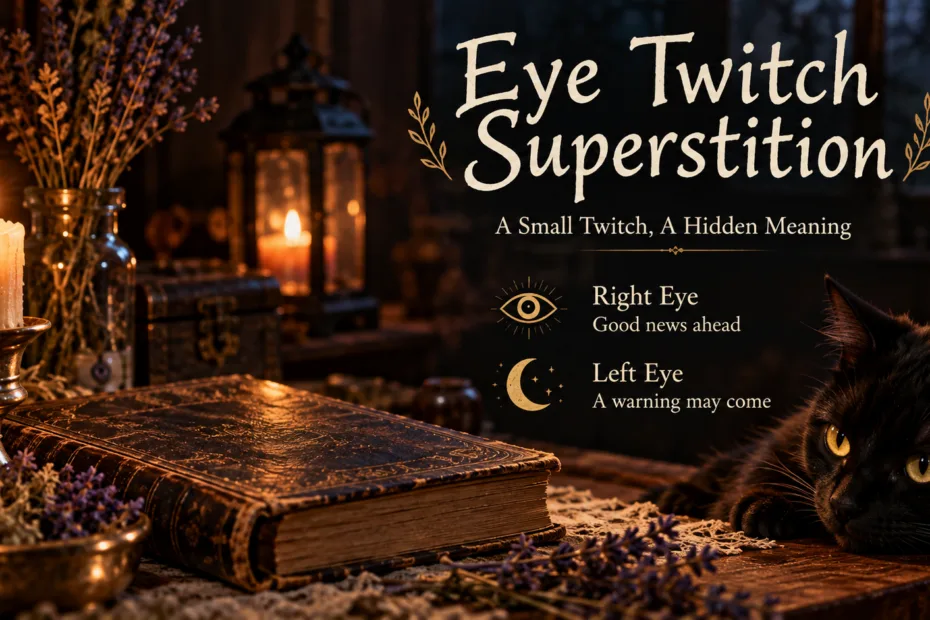
An eye twitch is treated in many folk traditions as an omen: a small, involuntary movement that may announce luck, trouble, news, a meeting, or another approaching event. The meaning is not universal. Which eye twitches, where the movement occurs, when it happens, and who experiences it can all change the interpretation.
What an Eye Twitch Is Believed to Mean
The basic superstition turns an involuntary eyelid movement into a predictive sign. Rather than being caused by the event it supposedly represents, the twitch is read as appearing before something happens.
Good luck and bad luck are common interpretations, but the belief is broader than a simple lucky-eye versus unlucky-eye rule. Recorded versions may connect an eye twitch with receiving news, meeting someone, money, tears, conflict, travel, or witnessing an unusual event.
Statements such as “the right eye means good luck” or “the left eye means bad luck” describe particular versions of the belief, not a worldwide rule. Other traditions reverse those meanings or use additional details before assigning an omen.
Why the Left and Right Eye Can Have Different Meanings
Many versions divide the body into meaningful sides. Once that distinction is applied to eye twitching, the left and right eye can become separate signs. One side may be favorable while the other warns of an unwanted event.
The direction of that contrast is not stable across traditions. A well-known Chinese saying associates a twitching left eye with fortune and a twitching right eye with misfortune. Other recorded beliefs use different assignments, so replacing local rules with one global chart can give a misleading picture of the folklore.
The same left–right distinction appears in other bodily sensations interpreted as omens. For example, an itching right hand is believed to predict incoming money in some English-speaking traditions, while other versions reverse the meanings assigned to the two hands. Both examples show how the side of the body can influence a prediction without producing a consistent rule across different communities.
Some eye-twitch traditions also distinguish between the upper and lower eyelid. In those systems, knowing only that the “left eye” or “right eye” twitched may not be enough to determine the supposed omen.
Some Traditions Read More Than the Side of the Eye
Eye-twitch interpretations can become quite detailed. Depending on the tradition, a reading may take account of several features:
- Left or right eye: the most familiar distinction in many popular versions.
- Upper or lower eyelid: different parts of the same eye may carry different predictions.
- Time of the twitch: some systems change the interpretation according to the hour or period of the day.
- The person experiencing it: certain traditions give different readings according to gender or social category.
- The kind of expected event: the omen may concern luck, visitors, news, relationships, travel, money, or another future occurrence.
This helps explain why two people can know apparently contradictory versions of the same superstition. They may be drawing on different inherited systems rather than remembering one rule incorrectly.
Eye Twitching Belongs to an Older Tradition of Twitch Omens
Interpreting involuntary body movements as signs is much older and broader than the familiar eye-twitch sayings found today. Historical texts describe forms of twitch divination, sometimes called palmomancy, in which movements of different parts of the body were matched with predicted events.
Evidence for this wider practice reaches back to Mesopotamian omen traditions and later appears in Greek, Syriac, Hebrew, Arabic, and other textual traditions. Surviving manuals could arrange predictions in a simple pattern: if a particular body part twitches, a particular event is expected.
The eyes appear within this larger body-omen tradition. Ancient and later records contain interpretations for twitching eyes or eyelids, although the predicted outcomes are not consistent enough to support a single ancient rule that explains every present-day version.
The historical continuity is in the practice of interpreting involuntary movement, not necessarily in one unchanged meaning for a left or right eye. Individual readings could shift as the belief circulated through different languages, communities, and periods.
Why Eye-Twitch Charts Often Contradict One Another
Popular charts sometimes present highly specific meanings as though they belong to one shared system. Folklore records show a less orderly picture. Eye-twitch beliefs can be transmitted through family sayings, local custom, oral tradition, omen manuals, almanacs, and later popular media.
As a result, the same physical sensation can acquire opposite meanings. One tradition may welcome a left-eye twitch, another may fear it, while another may not treat left versus right as the main distinction at all.
These contradictions are part of the history of the belief. They are also why an eye twitch cannot be assigned a culturally neutral meaning such as “left always means luck” or “right always means trouble.”
The Physical Twitch and the Folk Omen Are Different Things
The sensation behind the superstition is real even though the predicted event belongs to folk belief. A common form of eyelid twitching is called eyelid myokymia, an involuntary movement that usually affects one eyelid at a time, often the lower eyelid.
Fatigue, stress, lack of sleep, caffeine, eye strain, and similar everyday factors can accompany ordinary eyelid twitching. Most brief episodes are harmless and stop on their own.
The American Academy of Ophthalmology, in its August 13, 2026 explanation of eyelid spasms, distinguishes ordinary eyelid twitching from two less common conditions: essential blepharospasm and hemifacial spasm.
Essential blepharospasm involves involuntary eyelid closure, sometimes affecting both eyes and becoming severe enough to interfere with vision. Hemifacial spasm involves contractions of muscles on one side of the face. These may begin near the eye before spreading to the cheek or other facial muscles.
A twitch that becomes progressively worse, persists for an extended period, forces the eyelids closed, interferes with vision, or spreads beyond the eyelid warrants assessment by an eye-care or healthcare professional. These symptoms should not be interpreted solely through traditional omen meanings.