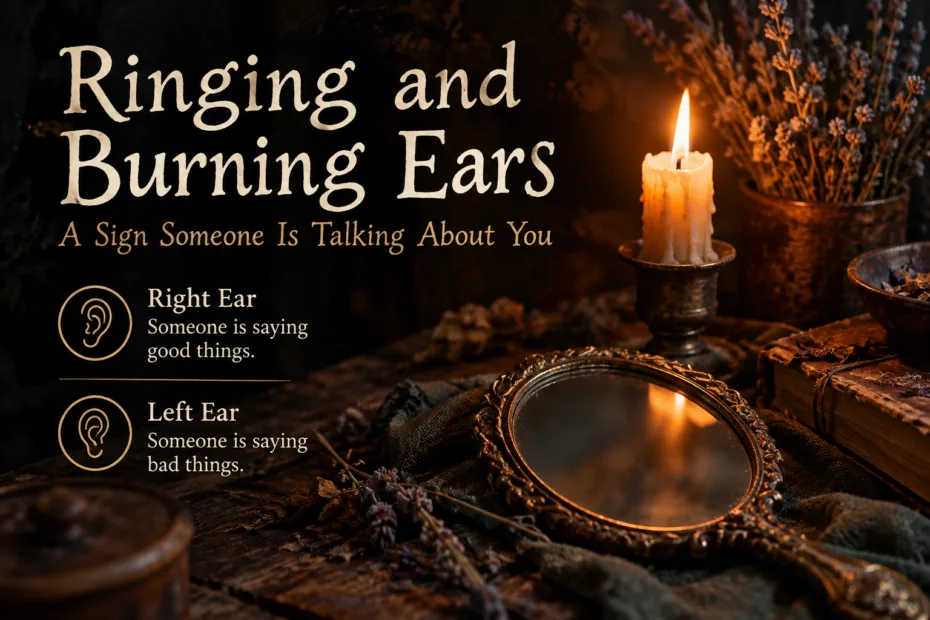
A sudden ringing, tingling, or burning sensation in the ears has long been interpreted in folk belief as a sign that an absent person is talking about you. The central idea is old, but the meanings assigned to the right ear, left ear, and both ears have changed across recorded traditions.
What Ringing or Burning Ears Are Said to Mean
The simplest form of the superstition connects an unusual ear sensation with being mentioned in a conversation somewhere else. Ringing, tingling, warmth, redness, and burning can all appear in versions of this belief.
Some versions stop there. Others try to reveal whether the unseen conversation is favorable or unfavorable by assigning different meanings to the two ears.
| Ear Sensation | Common Folk Interpretation |
|---|---|
| Ringing or tingling | An absent person is speaking about you. |
| Burning or unusually warm ears | You are being discussed or mentioned. |
| Right ear | Often linked with praise, kind words, or favorable thoughts. |
| Left ear | Often linked with criticism, gossip, or unfavorable thoughts. |
| Both ears | Some recorded versions give this a separate meaning, but no single interpretation is shared across the tradition. |
The right-good and left-bad pattern is well documented, but it should not be treated as a universal rule. Recorded versions sometimes reverse the sides or give them entirely different meanings.
The Older Record Refers to Tingling, Not Burning
An early written example appears in Natural History by the Roman author Pliny the Elder. In Book XXVIII, Pliny records the belief that people who are absent can receive a warning that others are speaking about them through a tingling sensation in the ears.
This detail matters because the passage is sometimes described as if it recorded the complete modern burning-ear superstition. It does not. Pliny’s surviving passage establishes the older connection between an ear sensation and distant conversation, but it does not state the familiar rule that a burning right ear means praise while a burning left ear means criticism.
Historical distinction: the ancient written record concerns tingling ears. Burning ears and detailed right-versus-left interpretations are preserved more clearly in later folklore records.
Burning Ears Developed Several Recorded Meanings
By the nineteenth century, collections of English-language folk belief recorded several versions of the burning-ear superstition side by side. Fanny D. Bergen’s 1896 collection Current Superstitions, based on oral traditions, shows how much the details could vary even within one body of material.
- One widely recorded version says the right ear burning means someone is speaking well of the person, while the left ear means someone is speaking badly of them.
- A Pennsylvania record changes the wording to someone thinking kindly or unkindly about the person.
- The same Pennsylvania entry says that when both ears burn, a friend and an enemy are contending over the person.
- Another recorded version assigns the right and left ears according to whether a woman or a man is doing the talking.
- Some accounts simply say that burning ears mean people are talking about you, without giving each ear a separate message.
These differences are part of the folklore itself. The sensation stays recognizable while families and communities change the interpretation attached to it.
Why the Right and Left Ear Can Switch Meanings
The familiar formula of right for favorable talk and left for unfavorable talk appears in several historical collections. Other records reverse that arrangement.
Early twentieth-century material on Macedonian folklore, for example, describes ringing or tingling ears as a sign that absent friends are speaking about someone. It also notes that some places associated the left ear with good speech and the right with bad speech, while elsewhere the meanings were reversed.
This makes a fixed chart of ear meanings misleading. The more stable part of the superstition is not which side means praise or criticism. It is the idea that an unexplained sensation in the ears somehow reveals speech occurring beyond the person’s hearing.
Ringing and Burning Belong to the Same Belief Family
Ringing and burning are physically different sensations, yet folk records often place them in the same group of body signs. Ringing, buzzing, tingling, heat, itching, and redness can each become a supposed signal that another person is speaking, thinking, praising, or criticizing from elsewhere.
This helps explain why one tradition may speak of ringing ears while another uses burning ears without changing the central story. The ear becomes symbolically appropriate because the unseen event is itself an act of speech: someone is talking about a person who cannot actually hear the conversation.
Some historical versions also include a response to the omen. Bergen’s collection records the idea that pinching an ear would cause the person doing the talking to bite their tongue. Such details belong to particular recorded forms of the belief rather than to a shared rule.
Persistent Ringing Has a Separate Medical Meaning
Folklore interpretation is separate from medical explanation. Ringing, buzzing, humming, or similar sounds heard without an outside sound source can be described medically as tinnitus. Repeated or persistent symptoms should not be interpreted through the superstition alone.
The folk belief concerns the cultural meaning people have attached to a bodily sensation. It does not establish that distant conversations can physically cause ringing or burning ears.
“My Ears Are Burning” Became an Everyday Expression
The superstition also survives in ordinary English through phrases such as “my ears are burning” and “were your ears burning?” They are commonly used when someone discovers, suspects, or jokingly suggests that other people have been talking about them while they were absent.
In that setting, no literal burning sensation is required. The old body-sign belief has become an idiom that can be used humorously whenever a person turns out to have been the subject of a conversation.