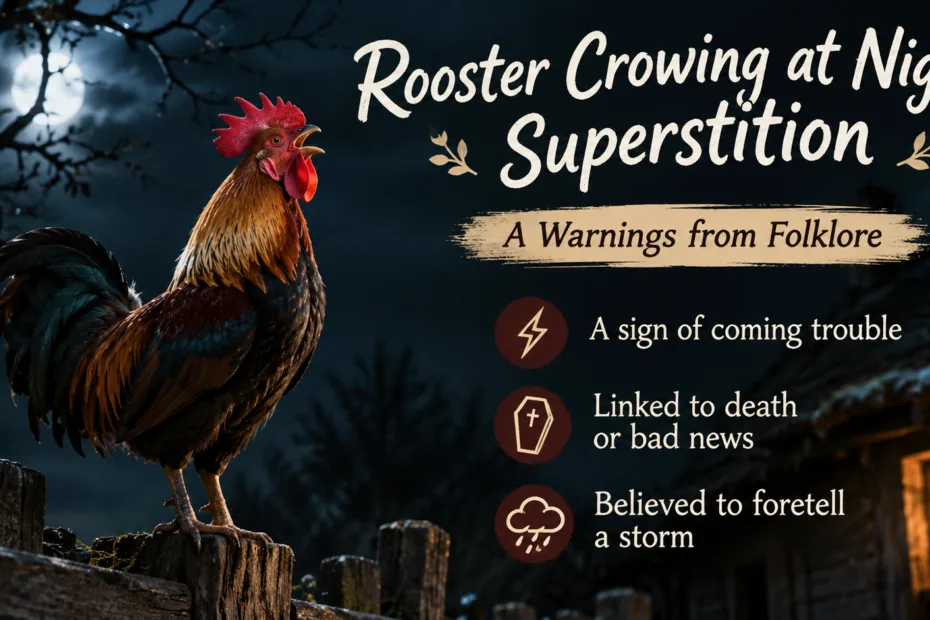
A rooster crowing in the middle of the night has traditionally been regarded as an omen in several folk belief systems. Some accounts associate the unexpected call with death, illness, bad news, or approaching danger. Others treat it as a protective sound that warns against evil spirits or marks the end of their nighttime activity.
The interpretation can depend on more than the hour. In recorded superstitions, the direction the rooster faces, whether it crows once or three times, and whether the sound comes before midnight or near dawn may change its supposed meaning.
The Midnight Crow as a Death Omen
One of the best-documented superstitions holds that a rooster crowing at midnight foretells a death. The warning might concern someone living in the household or another person in the surrounding community.
In the Irish National Folklore Collection’s Schools’ Collection, a record from County Cavan describes a midnight crow as a sign that someone in the house would die. A separate account from County Donegal states that a rooster crowing three times at midnight foretold a death in the townland, a local rural district.
The expected time was not always exactly midnight. A record collected in Hollyford, County Tipperary, describes a belief that crowing between eleven o’clock and midnight warned of a death in the neighborhood. In that account, the rooster had to crow three times in succession, and the direction it faced supposedly indicated where the death would occur.
These accounts preserve particular local beliefs rather than a single rule shared by every community. They also show that the supposed warning could concern different people depending on the circumstances of the crowing.
When the Doorway and Number of Crows Matter
In some household traditions, the rooster’s position was as important as the sound itself. A bird crowing toward the door could be interpreted differently from one facing away from it.
Two Irish records illustrate how an almost identical action could carry opposite meanings.
| Recorded Circumstance | Traditional Interpretation |
|---|---|
| Rooster crowing while facing the doorway | Good news, in a County Galway record |
| Rooster crowing while facing away from the doorway | Bad news, in the same Galway record |
| Rooster crowing three times inward through the doorway | Illness or death, in a County Cavan record |
| Rooster crowing three times outward through the doorway | Good luck, in the same Cavan record |
The Cavan account makes a particularly clear distinction between inward and outward crowing. The number of calls remains the same, but their direction changes the omen from misfortune to good luck.
Other records offer different readings. A County Cork account regards three crows at the house door as a death omen, without describing the same inward-versus-outward distinction. Three calls therefore had no fixed meaning independent of local tradition.
The Rooster That Crows at the Wrong Hour
The unusual timing of the crow was itself an important part of the superstition. A rooster was expected to announce the approach of morning, so calling well before dawn could be interpreted as a warning that something was out of order.
Persian folklore preserves this idea in the expression khorus-e bi-mahal, meaning a rooster that crows at an inappropriate time. The expression is also used figuratively for someone who speaks or acts at the wrong moment.
Traditional accounts discussed in the Encyclopaedia Iranica associate a rooster’s nighttime crow with approaching danger or misfortune. Some historical versions describe people removing the bird from the household in an attempt to avert the feared event.
The timing could also affect a weather prediction. A recorded Persian belief treats a crow shortly after nightfall as a sign of approaching bad weather. Here the warning concerns the conditions expected outside rather than a death within the home.
These interpretations belong to particular folkloric records. They do not establish a universal rule that crowing after sunset predicts misfortune.
Why Roosters Can Crow During the Night
Roosters do not depend entirely on visible sunlight to begin crowing. Their calls are partly regulated by an internal biological clock, which helps explain why a rooster may vocalize while the surroundings are still dark.
A 2013 study published in Current Biology found that the timing of predawn crowing is controlled by the rooster’s circadian rhythm. Light and the calls of other roosters can also trigger crowing, although the bird’s internal clock influences its response.
Researchers reported another feature of this behavior in a 2015 study published in Scientific Reports. Within the groups they observed, the highest-ranking rooster generally began the predawn calls, and other males followed in social order.
Several ordinary circumstances may therefore help explain a crow heard at an unexpected hour:
- Early predawn calling: A rooster may begin crowing before daylight becomes visible.
- Light exposure: External light can stimulate crowing even when the natural light cycle would not normally prompt it.
- Other roosters: Hearing a nearby rooster can encourage another bird to call.
- Environmental disturbance: Activity or sudden changes in the surroundings may provide a stimulus, although the precise response varies.
An isolated nighttime call is therefore not necessarily an unusual biological event. The traditional omen concerns the meaning people assigned to the timing, rather than an established ability of the bird to predict future events.
When Rooster Crowing Was Believed to Drive Away Spirits
Nighttime crowing did not always indicate danger. In some traditions, the sound was believed to protect people from supernatural beings associated with darkness.
The County Cavan folklore record that describes midnight crowing as a death omen also states that ghosts and fairies vanish after the rooster crows. The same bird could therefore be viewed as a messenger of misfortune and as a creature whose voice ended the activity of night spirits.
This protective interpretation appears in Zoroastrian tradition as well. The rooster was associated with Sraoša, a divine figure connected with prayer and protection during the night. Its call announced the approaching day and was believed to drive away demonic forces.
In the Vidēvdād, the rooster is connected with the period before dawn, when its call urges people to awaken and attend to their religious duties. Another interpretation preserved in Persian Zoroastrian sources treats crowing during the night as a warning against a demon entering the household.
The distinction is meaningful: the rooster could be understood as warning that danger was present without being regarded as the cause of that danger.
English literary tradition also preserves the idea that spirits withdraw at cockcrow. In Shakespeare’s Hamlet, the crowing rooster interrupts the appearance of the ghost, reflecting the belief that certain supernatural beings cannot remain abroad once the bird announces morning.
Night Crowing in Islamic Tradition
An explicitly favorable interpretation appears in Islamic religious tradition. A narration reported by Abu Hurayra and preserved in Al-Adab al-Mufrad, Hadith 1236, specifically concerns hearing a rooster crow during the night.
According to the narration, the rooster’s call is associated with seeing an angel, and the listener is encouraged to ask Allah for His favor. A related report appears in Sahih al-Bukhari, Hadith 3303.
The religious meaning differs from the death and misfortune omens preserved in some local superstitions. The nighttime call is associated with a favorable spiritual encounter rather than a prediction of illness or an approaching death.