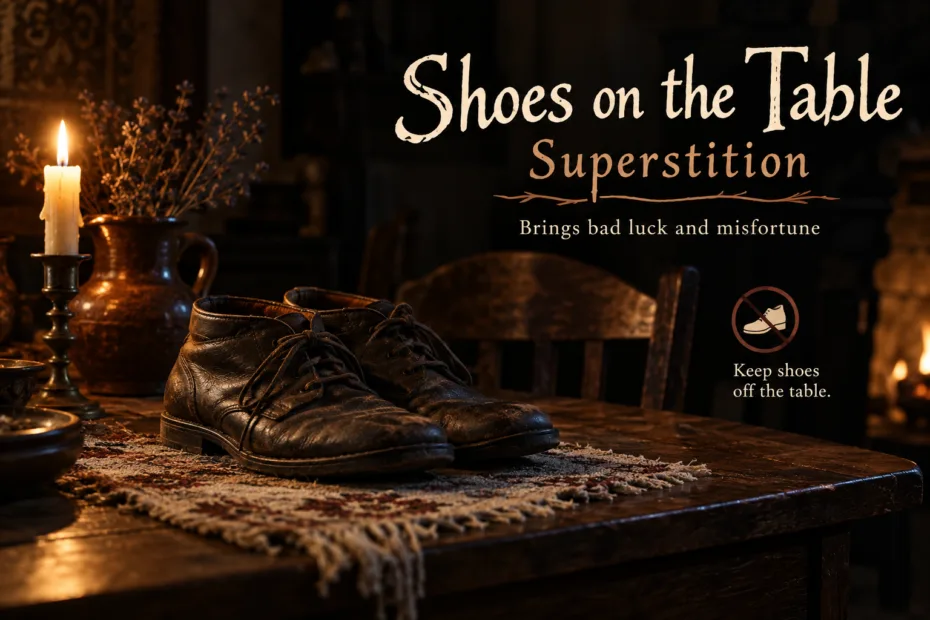
The superstition warns against placing shoes on a table, especially a dining or kitchen table. The act is traditionally associated with bad luck, although the misfortune attached to it varies considerably between families and folklore records.
The Basic Rule: Keep Shoes off the Table
The simplest form of the belief says that putting shoes on a table brings bad luck. An American folklore archive preserves a Detroit version learned in 1925 in almost exactly that form, showing that the rule was already circulating as a short household warning rather than a story requiring a detailed explanation.
Some traditions apply the taboo to any shoes. Others specifically warn against new shoes on the table. Folklore records also show that the belief can remain strong even when the person following it does not know why the action is considered unlucky.
The taboo concerns placing footwear on the table itself. Related habits involving shoes, feet, beds or other furniture may belong to separate beliefs and should not automatically be treated as the same superstition.
What Is Supposed to Happen?
There is no single fixed consequence. General bad luck is one of the clearest recorded forms, but other versions attach a more specific outcome to the act.
- A quarrel or fight: several recorded versions say shoes on the table will cause an argument in the household or lead the person to fight with someone.
- Death or severe misfortune: some family traditions interpret the act as an omen connected with death rather than ordinary bad luck.
- A long period of bad luck: individual family versions sometimes give the misfortune a set duration.
- Marriage-related bad luck: a recorded Italian-American family version warned that someone who put shoes on the table would never marry.
These differences are typical of orally transmitted folk belief. The action remains recognizable while the predicted consequence changes as the rule passes between households and generations.
Why Are New Shoes Often Singled Out?
The wording new shoes on the table appears repeatedly in recorded tradition. A folklore archive entry describes that form as a belief known in London, while another collected account from a South African informant likewise treats putting newly purchased shoes on a table as especially unlucky.
This creates two overlapping forms of the superstition. In one, all footwear is prohibited. In the other, the warning is specifically triggered by a new pair. It would therefore be misleading to claim that the superstition always concerns either new shoes or worn shoes exclusively.
The special treatment of new footwear also shows that cleanliness alone cannot explain every version. Brand-new shoes that have barely or never been worn may still fall under the taboo.
The Mining Story Behind the Superstition
One widely repeated explanation connects the belief with coal-mining communities in northern England. According to this tradition, the boots or shoes of a miner killed at work were brought home and placed on a table. Shoes appearing there could therefore evoke a death rather than an ordinary household scene.
The explanation fits versions of the superstition that connect shoes on a table with death, and it has been repeated in later discussions of British folklore. It should not, however, be treated as a proven single point of origin. The superstition itself is better documented than a definitive account of how it first began.
Historical explanations attached to old superstitions often circulate alongside the beliefs themselves. A recorded taboo can be well established even when its original cause cannot be identified with certainty.
Arguments Are a Distinct Recorded Version
The quarrel interpretation is not merely a modern explanation for why dirty shoes might annoy someone. Folklore records explicitly state that placing shoes on a table will lead to a fight.
Irish collected folklore also preserves the closely related warning that putting new shoes on a table is a sign of a coming row. This makes household conflict one of the better-attested specific consequences attached to the superstition.
The form is notable because it turns an ordinary domestic action into an omen concerning relationships inside or around the household. It does not require the stronger death association found in other versions.
How the Rule Survives Without an Explanation
Collected accounts show people learning the superstition from parents, relatives or friends without receiving a clear origin story. The practical instruction can be as brief as do not put shoes on the table, followed by a warning about bad luck.
This allows the rule to survive even when its older explanation is forgotten. One generation may associate the act with death, another with arguments, and another simply with unspecified misfortune, while all continue to recognize the same prohibited action.
The distinction between belief and ordinary etiquette can also blur. Keeping footwear away from a surface used for meals already fits common ideas about cleanliness and household order. That practical preference may reinforce the custom, but it does not establish the historical origin of the superstition.