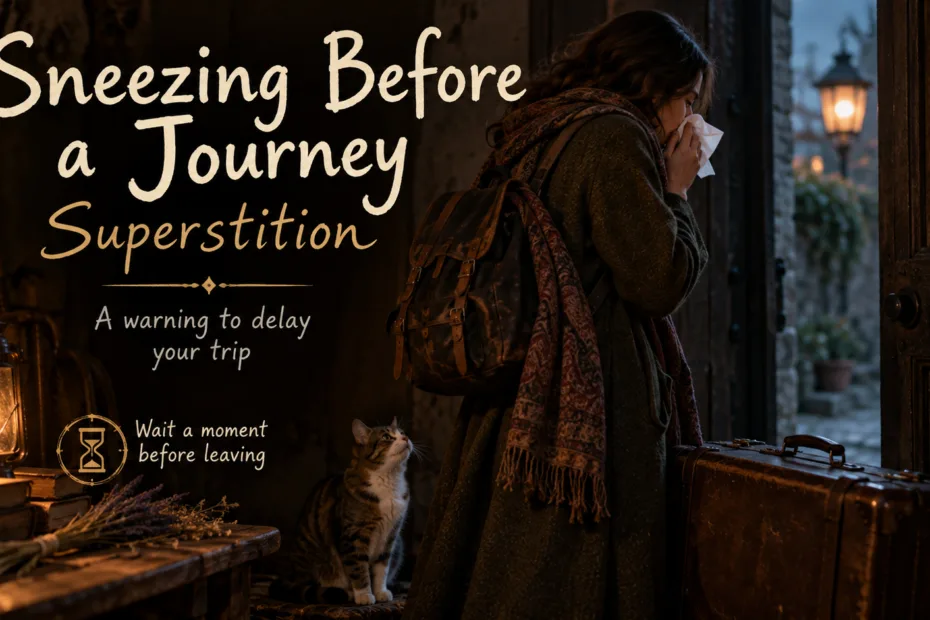
In several recorded folk traditions, a sneeze heard or made just as a person is setting out can be interpreted as a warning to pause, delay the departure, or begin again. The belief is tied closely to the moment of starting, and its details vary between communities.
Why a Sneeze Before Departure Can Be an Omen
In this belief, an ordinary sneeze during the day does not necessarily carry the same meaning. The omen appears when the sneeze coincides with the beginning of a journey, errand, or other intended action. Historical folklore records often treat the first moments of an undertaking as a time when small, unexpected events could be read as signs about whether to continue.
William Crooke’s nineteenth-century collection of northern Indian folklore records a version in which one sneeze while starting on a journey was ominous, while two sneezes allowed the traveller to proceed. Other regional records from the Indian subcontinent describe a sneeze immediately before departure as a reason to stop temporarily or reconsider the start.
The Timing Is the Main Feature
The superstition concerns the coincidence between a sneeze and departure. It is not simply a belief that every sneeze predicts trouble.
One Sneeze and Two Sneezes Do Not Always Mean the Same Thing
Some recorded versions distinguish between the number of sneezes. Crooke described a rule in which a single sneeze at departure warned against immediately setting out, while a second sneeze changed the situation and permitted the journey to continue.
This pattern should not be treated as a universal rule. Records from southern India contain other sneeze-counting traditions, including examples in which one sneeze was considered favorable and two unfavorable. The meaning therefore depends on the particular tradition and situation rather than on a fixed worldwide code.
Single Sneeze
In some departure traditions, it acts as a warning to pause or postpone the start.
Second Sneeze
In certain recorded versions, a second sneeze removes or reverses the unfavorable interpretation.
Who Sneezes Can Matter
The traveller does not always have to be the person who sneezes. Some folklore records describe an omen created when another person sneezes as someone is about to leave or begin an important task.
Early twentieth-century folklore material from Gujarat gives an especially detailed example. A sneeze directly in front of someone preparing to start a journey could be interpreted unfavorably, while a sneeze from behind could carry a favorable meaning. This shows that the superstition could depend not only on the sneeze itself but also on where the sneezer was in relation to the departing person.
Such detailed directional rules belong to particular recorded traditions. They should not be extended to all Indian communities or treated as a general rule for sneezing omens.
Pausing and Starting Again
A common response in several historical accounts is not permanent cancellation of the journey but a short interruption. The traveller waits, sits down, restarts the activity, or leaves after the unfavorable moment has passed.
This idea also appears outside South Asia. Robert Means Lawrence’s nineteenth-century survey of sneezing folklore described a practice from Celebes in which a person who sneezed while about to leave a gathering would sit down again for a time before making another start. Historical accounts from Persia likewise describe a single sneeze at the point of departure as unfavorable, sometimes leading travellers to delay setting out.
Departure Is About to Begin
The traveller is preparing to leave or has reached the moment of setting out.
A Sneeze Interrupts the Moment
In traditions that regard it as unfavorable, the unexpected sneeze is interpreted as a warning connected with the planned departure.
The Start Is Reset
The person may wait briefly or begin again rather than treating the first attempt to leave as uninterrupted.
The Belief Is Not Limited to One Region
The association between sneezing and the start of a journey appears in folklore collected from more than one part of the world. Edward B. Tylor recorded a Tongan belief in which a sneeze at the start of an expedition was considered an unfavorable sign. Historical Persian accounts also connect a sneeze at departure with a reason to delay a journey.
These parallels do not mean that the traditions share a single origin or identical rules. Sneezing has carried many different meanings in folklore. Depending on the place and context, it has been interpreted as favorable, unfavorable, confirming spoken words, or requiring a customary blessing. The journey superstition is one particular use of the sneeze as an omen, defined mainly by its occurrence at the instant of departure.
What Counts as the Journey Omen
- The sneeze occurs immediately before or while setting out.
- It may come from the traveller or, in some versions, another nearby person.
- A single sneeze may be treated differently from repeated sneezing.
- Some traditions respond by waiting and then starting again.
- Regional versions may also consider the position or direction from which the sneeze is heard.
The defining feature is therefore not sneezing alone but the sneeze’s place within the act of departure. Historical records preserve several forms of the belief, including versions that conflict with one another, so no single interpretation represents every community in which journey-related sneeze omens have been recorded.