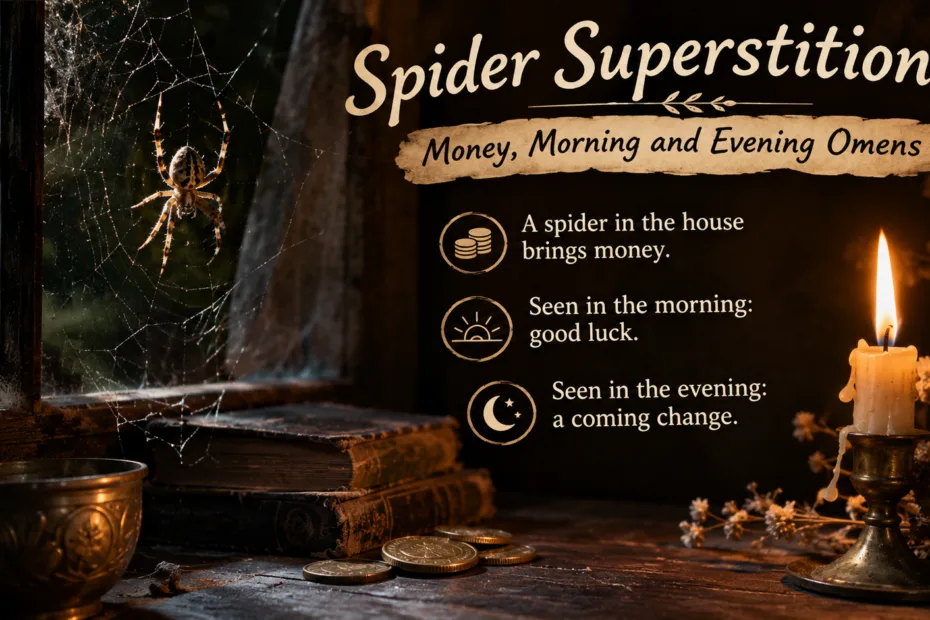
A spider found on someone’s clothing was traditionally taken as a sign of approaching money, while a spider seen in the morning or evening could carry a different meaning. In several European folk sayings, morning spiders foretold sorrow and evening spiders offered hope. Midday was less predictable: depending on the recorded version, it could promise profit, pleasure, or worry.
These beliefs depend on the circumstances of the encounter. A small spider landing on a person, one descending from above, and one noticed at a particular hour do not necessarily carry the same omen.
The Money Spider and the Promise of Wealth
The belief that a spider on clothing announces incoming money has a long written history in England. In The Worthies of England, published in 1662, Thomas Fuller described the familiar expectation that finding a spider on one’s clothes meant money was coming.
Fuller also connected the spider’s industry with the possibility of earning wealth. Its ability to produce silk and weave a web offered a natural comparison with productive work. His account preserves both the popular prediction and a moral interpretation of it.
The omen did not specify an amount of money or promise a particular kind of payment. Its meaning was simply that the person would receive money in the near future.
New Clothes Instead of Money
A closely related belief predicted new clothing rather than cash. William Henderson’s Notes on the Folk-Lore of the Northern Counties of England and the Borders, first published in 1866, records an Irish saying that a spider running over a woman’s dress or shawl meant the garment would soon be replaced.
Another traditional explanation imagined the tiny spider arriving to weave a new set of clothes for the person it landed on. When clothing represented a considerable expense, receiving new garments could itself be understood as a form of material good fortune.
The clothing and money interpretations share the same basic encounter but promise different results. One concerns money received; the other concerns acquiring something valuable.
A Spider Descending From Above
Henderson also recorded an omen in which a spider descending from the roof onto a person indicated that the person would soon receive a legacy from a friend.
Here, the spider’s movement matters. The prediction concerns an inheritance or bequest, rather than an unspecified financial gain. It is a more particular reading than the familiar money-spider belief.
What Is a Money Spider?
The name money spider does not identify a single species. In Britain, it is commonly applied to very small spiders belonging to the family Linyphiidae. The British Arachnological Society describes this family as including hundreds of British species, with money spiders generally measuring less than 5 millimeters in body length.
The small, shiny, dark spiders associated with the traditional name include members of the genus Erigone. Many linyphiid spiders construct fine sheet webs rather than the large circular webs commonly associated with garden spiders.
Some disperse through a behavior known as ballooning. They release silk into the air and are carried by air currents, sometimes landing on people or becoming caught in their hair.
This behavior helps explain why a small spider might unexpectedly appear on someone’s clothing. The British Arachnological Society connects such encounters with the belief that the person would soon come into money.
A distinction in the name: A spider need not be identified as a member of Linyphiidae for an older money omen to apply. Historical sayings often describe a spider on someone’s clothing without specifying its species. The modern common name and the traditional omen therefore overlap without being identical.
Seeing a Spider in the Morning: Sorrow and Worry
A different superstition assigns meaning to the hour when a spider is seen. One of the best-known French sayings is « Araignée du matin, chagrin ; araignée du soir, espoir. » It associates a morning spider with sorrow and an evening spider with hope.
The morning prediction concerns general sadness or trouble. It does not, by itself, specify illness, death, or any particular misfortune.
A similar German proverb, Spinne am Morgen bringt Kummer und Sorgen, links a morning spider with distress and worries. The comparable French and German expressions show how the same time-based contrast appears in more than one language.
These sayings concern the sighting of a spider at a certain time. They do not require it to land on a person, crawl across clothing, or descend from a ceiling.
Midday Spider Omens: Profit, Pleasure, or Trouble
The midday spider has no single meaning across the recorded sayings. Some versions promise profit, while others associate the encounter with pleasure, worry, annoyance, or rain.
French folklorist traditions preserve several forms of the midday expression, including profit, plaisir, and souci. A nineteenth-century Walloon collection gives another unfavorable reading.
In his 1892 work Le Folklore wallon, Eugène Monseur recorded a verse in which a morning spider meant great sorrow, a midday spider meant great vexation, and an evening spider meant great hope.
This variation is important because it prevents the midday omen from being treated as an established promise of money. The same hour could receive different meanings within related traditions.
| Time of Sighting | Traditional Meaning | Interpretation |
|---|---|---|
| Morning | Sorrow or worry | An unfavorable encounter in familiar French and German sayings |
| Midday | Profit, pleasure, worry, or vexation | The meaning changes between recorded versions |
| Evening | Hope or favorable fortune | A generally positive encounter in the familiar sayings |
The Evening Spider as a Sign of Hope
In the familiar French expression, an evening spider represents espoir, or hope. The expected outcome is positive, although the saying does not identify a particular reward.
The German evening expression, Spinne am Abend, erquickend und labend, likewise gives the evening a favorable character. Its words suggest something refreshing, comforting, or sustaining.
Hope and financial gain are separate meanings. Seeing a spider in the evening is not automatically the same omen as finding a money spider on one’s clothing. One interpretation depends on the hour; the other depends on the spider’s contact with the person.
The traditional evening sayings also provide no precise clock-time boundary. Their wording should not be extended into a fixed rule about sightings at midnight or during the early hours of the following morning.
Does Killing a Spider Cancel the Luck?
Some spider traditions hold that harming or killing the animal destroys the favorable prediction attached to its appearance. In accounts associated with the evening spider, killing it could be understood as destroying the person’s good fortune.
Other recorded customs assigned different outcomes to the act, so the belief was not uniform. The omen could depend on both the time of the encounter and what happened to the spider afterward.
Money-spider folklore also includes traditional handling customs intended to encourage good fortune, such as passing a spider over the shoulder or circling it on its silk. These are descriptions of older folk practices, not requirements for the money omen to take effect.
Did the Morning and Evening Saying Originally Refer to Spinning?
The German proverb has also been explained through the older occupation of spinning yarn. According to this interpretation, having to spin from the morning indicated financial hardship, while spinning in the evening could be a more relaxed, social activity.
The wording makes this explanation plausible because German Spinne refers to a spider, while spinnen means to spin. Duden presents the occupational interpretation in its discussion of the proverb.
Its historical origin is nevertheless disputed. Linguistic scholar Rosemarie Lühr has argued for an earlier wording involving spinning, while proverb specialist Rolf-Bernhard Essig has challenged the idea that domestic spinning was the original source. Essig treats the occupational story as a later explanation and emphasizes the older tradition of spiders as omens.
The disagreement concerns how the saying developed, rather than whether morning and evening spider beliefs were recorded. The animal-based interpretation has its own history in European folklore, including expressions that explicitly refer to seeing a spider.