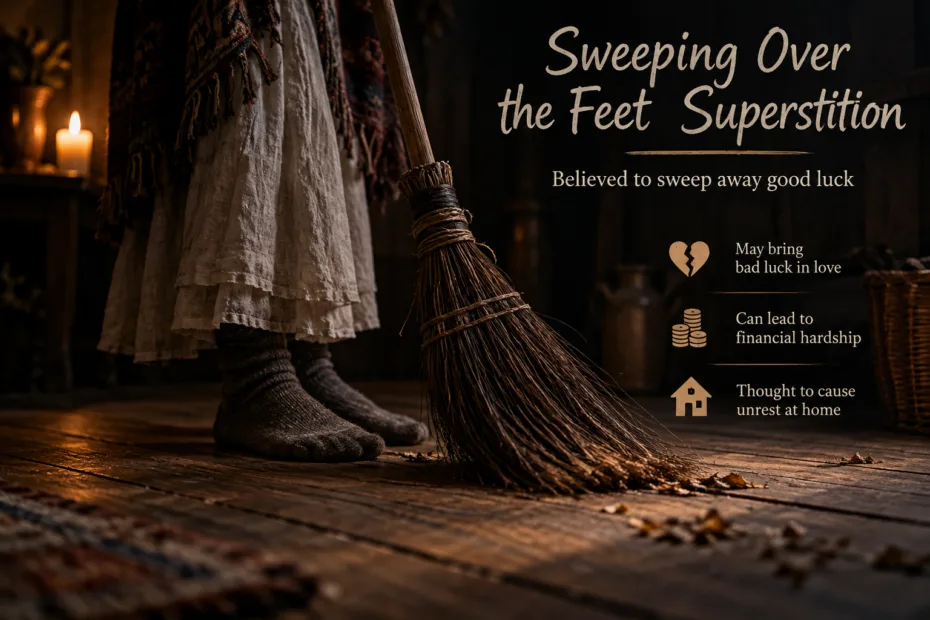
The sweeping-over-the-feet superstition holds that allowing a broom to pass across or beneath a person’s feet can bring an unwanted consequence. The best-known version connects the act with never marrying, but documented traditions also associate it with ordinary bad luck and other forms of misfortune.
What Sweeping Over the Feet Is Believed to Mean
The basic action is simple: while one person is sweeping a floor, the broom passes across, beneath, or directly against another person’s feet. In the folk belief, that accidental contact is treated differently from ordinary sweeping.
One widely recorded version says that the person whose feet are swept will not marry. The warning may be phrased as “never let anyone sweep under your feet” or as a caution that a broom touching the feet will prevent a future marriage.
Marriage is not the only consequence found in folklore records. Other versions describe the act more generally as bringing bad luck. This difference matters because there is no single universal interpretation of the superstition.
Recorded versions refer to sweeping over the feet, under the feet, sweeping someone’s foot, or touching a person with the broom while sweeping. These phrases describe closely related forms of the same household taboo rather than one fixed ritual action.
The Marriage Version
The association with marriage appears repeatedly in collected folklore. Records preserved by the James T. Callow Folklore Archive include warnings that a person whose feet are swept will never marry. Similar wording has also been collected from family traditions in which children were told to move their feet while someone was cleaning.
The rule can apply to anyone, although some tellings have been directed especially toward unmarried young people. In those versions, the broom does not merely bring vague misfortune. It is said to interfere specifically with the person’s prospects of marriage.
The same idea has been recorded in more than one cultural setting. A Mexican family tradition collected by the USC Digital Folklore Archives, for example, preserves the warning that a person should not allow someone to sweep their feet because they may end up unmarried. A Haitian account in the same archive gives a closely related form.
These records show that the marriage interpretation is well established, but they do not prove that all versions came from one original tradition. Similar household beliefs can spread, change, and acquire new explanations as they move between families and communities.
Other Recorded Consequences
Some traditions attach a very different result to the same action. African American folklore records from the United States include versions in which sweeping someone’s feet is said to lead to jail or arrest. Newbell Niles Puckett’s 1926 collection Folk Beliefs of the Southern Negro contains earlier material of this type, and later folklore archives preserve related examples.
Other collected forms reduce the warning to bad luck without naming a particular event. A Detroit record, for example, states simply that sweeping a person’s feet with a broom brings bad luck even when it happens by mistake.
Another Southern U.S. telling interprets sweeping over someone’s feet as symbolically sweeping dirt into that person’s grave. That version is quite different from the marriage belief and should not be treated as the hidden meaning behind every form of the superstition.
Why Sweeping Becomes More Than Cleaning
The exact origin of the superstition cannot be traced with confidence to a single place or event. Explanations that assign one ancient origin to every version go beyond what the surviving records can establish.
What the records do show is that sweeping often carries symbolic meaning in household folklore. A broom physically removes dirt from a space, so folk explanations can extend that action to things that cannot literally be swept away: luck, marriage prospects, prosperity, or personal fortune.
This makes the language of the belief easy to understand. If sweeping removes something from the floor, then sweeping across a person can be imagined as removing something connected with that person. The exact thing supposedly lost depends on the tradition.
This is a useful way to read the superstition without treating later explanations as proven historical origins. The symbolism fits the action, but the documentary record preserves several meanings rather than one fixed interpretation.
Spitting on the Broom as a Counteraction
Some versions of the superstition include a way to cancel the supposed bad luck. Spitting on the broom after the feet have been swept appears in several recorded traditions.
The James T. Callow Folklore Archive preserves examples from Alabama, Georgia, Detroit, and other collections in which the affected person is told to spit on the broom. One Detroit record gives a more elaborate version involving turns and repeated spitting, while simpler versions require only a single response.
The variations show how a basic belief can acquire local rules. The counteraction is therefore part of certain forms of the superstition, not a required feature of every tradition about swept feet.
The act of spitting on a broom belongs to the folklore record as a customary response to the superstition. It should be understood as part of the belief tradition rather than as a method with a demonstrated effect on future events.
A Household Rule Passed by Word of Mouth
Many accounts describe the belief as something learned at home rather than from a formal ceremony. A parent, grandparent, or other relative warns someone to move their feet when the broom approaches. The explanation may be given immediately, or the rule may be repeated without much detail.
This kind of transmission helps explain why several meanings can exist side by side. One family may connect swept feet with marriage, another with general bad luck, and another with a different misfortune. The physical action remains recognizable even when the predicted outcome changes.
For that reason, “sweeping over the feet” is best treated as a family of closely related broom taboos. The recurring element is the warning against sweeping across a person. The consequence attached to that act belongs to the particular tradition in which the belief was learned.