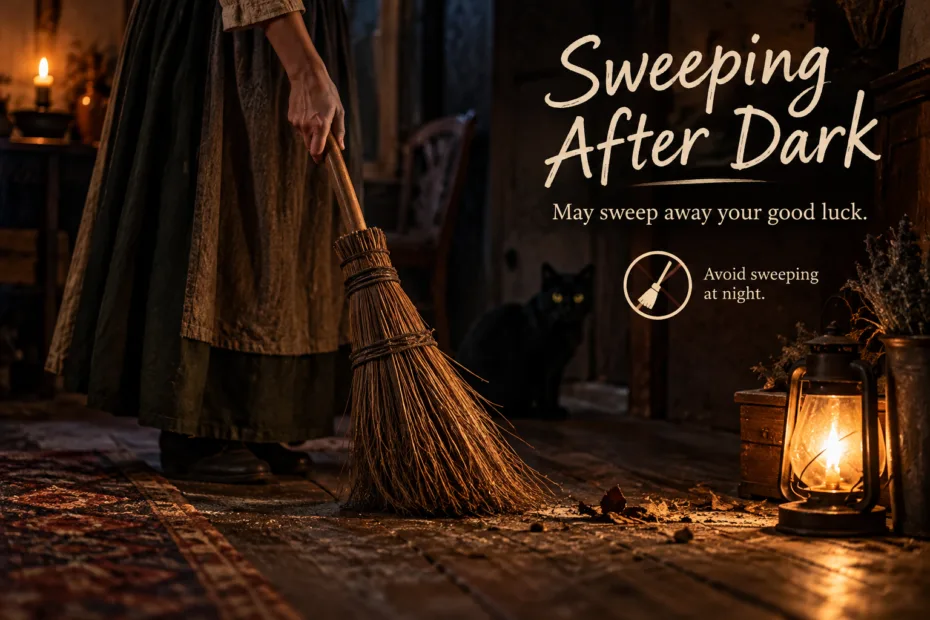
The sweeping after dark superstition warns that sweeping a home after sunset or during the night may remove money, luck, prosperity, or household blessings along with the dirt. Historical and modern folklore records show related versions in widely separated communities, but the exact warning—and what counts as breaking the rule—varies.
What Sweeping After Dark Is Believed to Do
The most common form of the belief treats sweeping as more than ordinary cleaning. Because a broom physically moves unwanted material out of a room, folklore can give the same action a symbolic meaning: something desirable may be moved out as well.
In some tellings, the warning is specifically about money or wealth. A person who sweeps at night is said to be sweeping money out of the household. Other versions replace money with good luck, prosperity, fortune, or blessings.
The Basic Folk Logic
The broom removes something from the home. The superstition extends that visible action to something intangible, so removing dust after dark can symbolically become removing the household’s fortune.
This does not mean every recorded version carries exactly the same consequence. Folklore collections contain warnings about poverty, lost money, departing luck, and other forms of household loss. These are related expressions of the same broader idea rather than one fixed rule shared everywhere.
The Doorway Can Matter as Much as the Broom
Some versions object to sweeping at night in any form. Others focus more narrowly on what happens to the sweepings.
A Filipino-American folklore record collected by the USC Digital Folklore Archives, for example, describes a distinction between gathering dirt inside the house and sweeping it out through the door. In that telling, pushing the dirt through the doorway at night is the unlucky action because good luck may be pushed out with it.
This detail fits a recurring pattern in household folklore. A doorway is not merely part of the floor plan. It marks the point where things enter and leave the domestic space. When sweeping moves debris across that boundary, the gesture can be interpreted as expelling more than physical dirt.
Broader Version
Avoid sweeping the house once it is dark.
Threshold Version
Sweeping may be tolerated, but pushing the sweepings out through the door is avoided.
Nighttime Sweeping Has a Long Folklore Record
The superstition cannot be securely traced to one known place or one moment of invention. Written records instead show related nighttime sweeping taboos in more than one folklore tradition.
Jukichi Inouye’s Sketches of Tokyo Life, published in 1895, included the statement that house-sweeping at night was believed to lead to poverty among a list of popular Japanese beliefs.
A later study published in the journal Folklore in 1919 discussed Japanese broom beliefs and compared the nighttime sweeping prohibition with material recorded elsewhere. Its notes mention traditions in parts of Central and Eastern Europe in which sweeping or throwing out sweepings after sunset was avoided for fear of expelling good fortune. The same discussion also records beliefs connecting nighttime sweepings with spirits or returning dead in some communities.
Modern folklore archives continue to record the money-and-luck form of the belief. A Dartmouth folklore collection documented a Mexican family tradition stating that sweeping at night could mean sweeping away one’s money. The USC Digital Folklore Archives also preserve nighttime sweeping warnings reported by people with Filipino and Tongan family backgrounds.
These records support treating the belief as a recurring household folklore pattern, not as a custom that can automatically be assigned to a single culture or explained by one universal origin story.
Why Wealth Becomes Attached to Sweeping
The connection between a broom and prosperity is unusually direct. Sweeping is an act of removal. Coins, food, jewelry, useful objects, dust, and rubbish can all lie on the same floor, so the physical act already carries the possibility of accidentally discarding something worth keeping.
That made money an especially natural subject for a warning. Instead of merely saying that a valuable object might be lost, the folk rule turns the danger into a broader statement: sweeping after dark sweeps wealth away.
In some South Asian household traditions, the idea is expressed through Lakshmi, the Hindu goddess associated with prosperity and good fortune. The warning may say that sweeping after sunset sends prosperity away or causes Lakshmi to leave the home. This is one culturally specific interpretation of the nighttime sweeping taboo, not an explanation that should be applied to every version found elsewhere.
Darkness Also Produced a Practical Explanation
Folklore writers have long noticed an everyday reason that could support the rule. Before bright household lighting became ordinary, sweeping after nightfall made it harder to see small objects mixed with dust and debris.
The 1919 discussion of Japanese broom folklore noted an earlier explanation that the prohibition might reflect fear of accidentally sweeping valuable objects away at night. A modern Dartmouth folklore record gives a similar interpretation: poor visibility could make it easier to discard something unintentionally.
That explanation is plausible as a reason for preserving or reinforcing the custom, but it should not be treated as the proven historical origin of every nighttime sweeping superstition. Folk rules often survive with several explanations attached to them, and later practical reasoning may exist beside older symbolic meanings.
Origin Is Not the Same as Explanation
Limited lighting can explain why avoiding nighttime sweeping was useful, while beliefs about money, luck, blessings, or spirits explain how particular communities understood the rule. Existing records do not establish one universal origin for all versions.
Why Sunset Is Often the Boundary
The wording commonly uses night, after dark, or after sunset rather than a precise clock time. The transition from daylight to darkness creates the meaningful boundary.
That boundary works on two levels. In practical terms, daylight once determined how easily household work could be done. In folk belief, sunset can also mark a change in the character of domestic space and acceptable activity. Historical records sometimes connect the nighttime prohibition with supernatural beings or the returning dead, while other versions contain no spirit element at all and speak only of money or luck.
For that reason, there is no universal folklore rule saying that sweeping becomes unlucky at a particular hour such as 6:00 or 8:00 p.m. The restriction belongs to a traditional division between daytime and nighttime rather than standardized clockkeeping.
Sweeping and Throwing Away the Dirt Are Not Always the Same Act
One useful distinction in the recorded material is the difference between collecting dirt and removing it from the household.
- Some versions prohibit the sweeping itself once night begins.
- Some emphasize sweeping toward or through a doorway, where fortune is imagined to leave with the debris.
- Some focus on throwing sweepings outside after sunset rather than moving a broom indoors.
- Some attach the warning specifically to wealth, while others refer more generally to luck or blessings.
These differences matter because folk beliefs are commonly transmitted through families and communities rather than through a single written rulebook. Two households may recognize the same superstition while following it differently.
What Counts as Breaking the Superstition?
There is no single answer preserved across all versions. In the strictest form, using a broom after sunset is enough. In narrower forms, the feared act is sending the sweepings outside, especially across the household threshold.
The tradition is also specifically associated with sweeping in many records. It should not automatically be expanded to claim that every kind of nighttime cleaning—washing dishes, wiping a surface, mopping, or using modern cleaning equipment—carries the same folk meaning unless a particular tradition says so.
The safest description of the canonical belief is therefore simple: sweeping the home after dark is traditionally avoided because the act is said to remove money, luck, prosperity, or blessings from the household. The details surrounding the doorway, disposal of dirt, supernatural explanations, and exact consequence belong to particular tellings rather than to one universal rule.