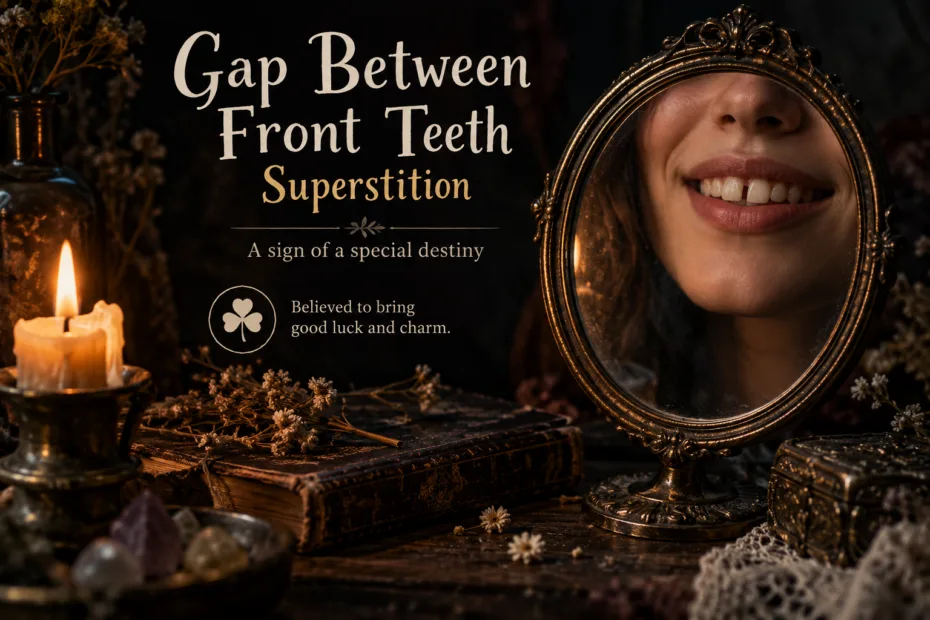
A visible gap between the two upper front teeth has been read as a lucky sign in some traditions, yet older folklore records also attach very different meanings to it. The belief is best understood as a group of local interpretations rather than one universal superstition.
What the Front-Tooth Gap Is Believed to Mean
The space between the two upper central incisors is known in dentistry as a diastema. In folk belief, that small physical feature has sometimes been treated as a sign from which a person’s fortune or character could be read.
Older records connect widely spaced front teeth with luck, prosperity, wealth, happiness, or future travel.
Some local collections instead associate the same feature with talkativeness, difficulty keeping secrets, or dishonesty.
These meanings do not form a consistent system. Even records gathered within the same country can disagree with one another.
Luck, Prosperity, and Travel in English Folk Records
One of the clearer nineteenth-century descriptions treats widely separated teeth as fortunate. Thomas Firminger Thiselton-Dyer’s Domestic Folk-Lore, published in 1881, records the idea that teeth set far apart were a sign of prosperity and future happiness.
The book also repeats an older anecdote from Notes and Queries. A young woman explains that she had been considered lucky at school because her teeth were far apart. According to the belief remembered in the anecdote, the feature meant that she would be lucky and would travel.
This gives the front-tooth gap a form of fortune-telling meaning: a visible feature of the body was interpreted as predicting a person’s future rather than merely describing appearance.
American Folklore Recorded Conflicting Meanings
Fanny D. Bergen’s 1896 collection Current Superstitions shows why broad statements about this belief can be misleading. The book records several tooth-gap superstitions from different American communities, and their meanings contradict one another.
- A record from Mansfield, Ohio, says that a gap between the two upper front teeth signifies wealth.
- A belief collected in Boston says that widely spaced front teeth mean a person cannot keep a secret.
- A record from Biddeford, Maine, associates a broad space between the teeth with dishonesty.
The important detail is the geography. Bergen did not present these sayings as a single national rule. They were recorded from particular places. The same physical trait could therefore receive a favorable reading in one community and an unfavorable one elsewhere.
France’s “Teeth of Happiness”
French provides one of the best-known positive expressions connected with the feature. The phrase dents du bonheur, literally “teeth of happiness”, refers to separated upper central incisors.
French dictionary usage preserves the folk idea behind the phrase: people with these teeth are traditionally said to be lucky. The expression also appears as dents de la chance, or “teeth of luck.”
The name does not mean that a tooth gap is believed to produce good fortune. It reflects a traditional association between the visible feature and a person who is considered fortunate.
The Wife of Bath and the Older “Gap-Toothed” Reading
The history of the idea is sometimes connected with Geoffrey Chaucer’s Canterbury Tales. The Wife of Bath is described as gat-toothed, a Middle English expression commonly interpreted as having teeth set apart.
Later editor Walter W. Skeat linked this description with the folk belief about luck and travel. He cited the nineteenth-century account in which widely separated teeth were said to predict both. Because Chaucer describes the Wife of Bath as an experienced traveler immediately around the gap-toothed description, the association attracted scholarly attention.
That interpretation should not be treated as proof that medieval England had one fixed tooth-gap superstition. The literary passage has received more than one reading, and later folklore evidence cannot automatically establish what every medieval audience believed.
Beauty and Good Fortune Are Separate Traditions
A gap between the front teeth can also carry a positive meaning without functioning as an omen. Dental research examining perceptions in parts of West Africa has documented strong appreciation for the appearance of a midline diastema, particularly in studies involving Nigerian and Ghanaian populations.
This is better described as an aesthetic preference than automatically labeled a superstition. A community may regard a tooth gap as beautiful, attractive, or desirable without believing that it predicts wealth or future events.
Keeping those ideas separate prevents several different traditions from being flattened into a claim that “a gap tooth means good luck everywhere.” The documented folk record is far more local: in one setting the gap may suggest fortune, in another travel, and somewhere else an entirely different character trait.