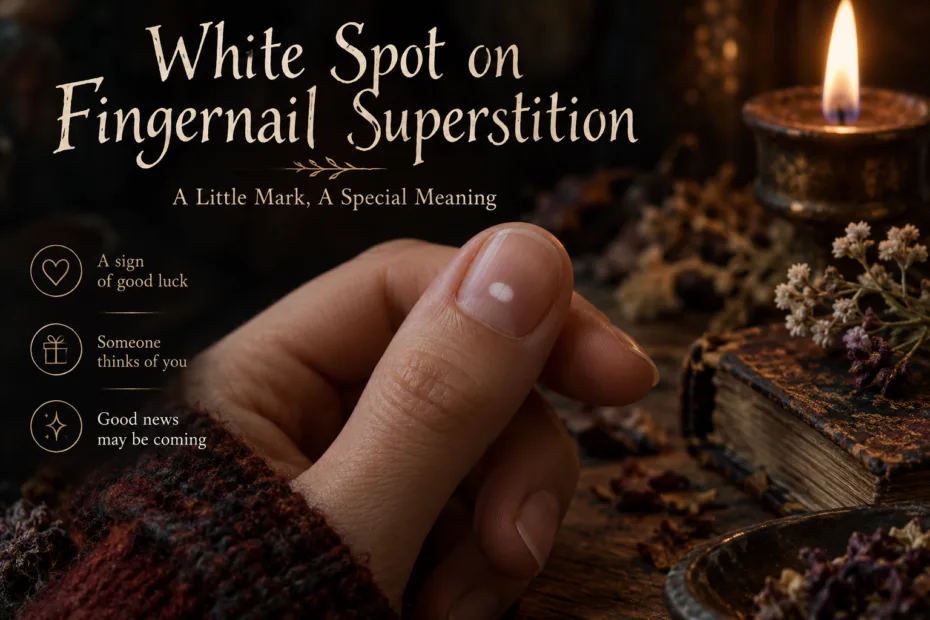
A white spot on a fingernail has been treated in English-language folk belief as a small omen that may announce a gift, mark a lie, or predict an event according to the finger on which it appears. The meanings vary because several separate traditions developed around the same ordinary nail marking.
What Does a White Spot on a Fingernail Mean in Superstition?
One of the best-recorded beliefs says that a white spot means a gift or present is coming. In some versions, the prediction is not fulfilled immediately. The spot must travel outward as the nail grows, and the gift is expected when the marked part reaches the tip and can be cut away.
This idea was established in English-language folklore long before modern internet superstition lists. An early eighteenth-century issue of the British Apollo discussed the little white nail marks and noted that people called them gifts. Later British folklore collections recorded the same association.
In several recorded versions, the white mark acts almost like a small countdown. As the nail grows, the predicted gift or event is imagined to be getting nearer.
The Gift Tradition
Nineteenth-century records from West Cornwall describe white specks on the nails as signs of coming presents. The expected present could be looked for once the nail had grown far enough for the marked section to be clipped.
The belief was also expressed through a short folk rhyme that distinguished the thumb from the other fingers. The general idea was that a mark connected with the thumb promised a gift more directly, while a mark elsewhere might imply delay.
American folklore collections preserved a closely related belief. Fanny D. Bergen’s Current Superstitions, published in the late nineteenth century from material gathered among English-speaking communities, records a Boston belief that a white spot in the nail means a present, received when the spot reaches the end of the nail.
Different Fingers Could Predict Different Events
Another branch of the superstition treats the location of the white spot as more important than the spot itself. The fingers form a sequence, with each one assigned a different prediction.
| Finger | Recorded Folk Meaning |
|---|---|
| Thumb | Gift or present |
| Index finger | Friend |
| Middle finger | Foe or enemy |
| Ring finger | Sweetheart or beau |
| Little finger | Journey |
This sequence appears in several forms. A version recorded in Ohio used the pattern of friend, foe, gift, beau, and journey, while later family traditions rearranged some of the meanings. The variation is typical of orally transmitted fortune-telling formulas: the basic structure survives even when individual words change.
A twentieth-century tradition collected in Northern California, for example, used the sequence gift, friend, foe, sweetheart, journey. The informant had learned it from her father, showing that the fingernail omen could continue as a family rhyme rather than as a belief learned from a printed fortune-telling book.
White Spots as Marks of Lies
Not every tradition treats the spots as lucky. A separate belief says that white marks on the fingernails reveal lies that a person has told.
Current Superstitions records a version from Maine and central Illinois in which the number of white spots on the nails of the left hand represented the number of lies told. Similar examples survived much later in collected American folklore.
The James T. Callow Folklore Archive at the University of Detroit Mercy contains records from the late 1960s stating that a person receives a white spot under the fingernail for every lie told. These records show that the lie interpretation was still circulating independently of the gift interpretation.
A white nail spot may represent a gift in one tradition and a lie in another. Other versions use the number or location of the spots for fortune telling. These are parallel folklore variants rather than parts of one fixed system.
Counting the Spots
Some traditions focus on how many white spots appear rather than which finger carries them. Recorded interpretations have linked the number of marks with friends, romantic admirers, children, future events, or lies.
A Tennessee belief collected in the 1970s interpreted the number of white spots on a girl’s fingernails as the number of boyfriends she had. Other folklore references give different counting rules. The shared feature is the treatment of a naturally appearing mark as something that can be counted and converted into information about a person’s social or future life.
Why the Belief Became Attached to Fingernails
White spots lend themselves easily to omen-making because they appear unexpectedly and then slowly move toward the end of the nail as it grows. That visible movement allowed storytellers to attach a future event to the moment when the mark finally reached the edge.
Historical writers were already commenting on this kind of nail divination centuries ago. Some older fortune-telling systems assigned different meanings not only to individual fingers but also to the position of a mark near the base, middle, or tip of the nail. Popular oral traditions simplified these elaborate systems into memorable rules about gifts, friends, enemies, sweethearts, journeys, and lies.
The white spot itself therefore became a convenient small personal omen: visible enough to notice, temporary enough to create anticipation, and variable enough for communities and families to give it different meanings.
White Spots and the Medical Term Leukonychia
The physical nail marking is commonly described medically as leukonychia, with small white spots often called punctate leukonychia. Medical writing has discussed such marks separately from their folkloric interpretation for well over a century.
The superstition does not depend on a particular physical cause. Its subject is the meaning people assigned to the visible mark: a present on the way, a remembered lie, or a prediction attached to a particular finger. That distinction helps explain why several contradictory interpretations can exist around the same type of nail spot.