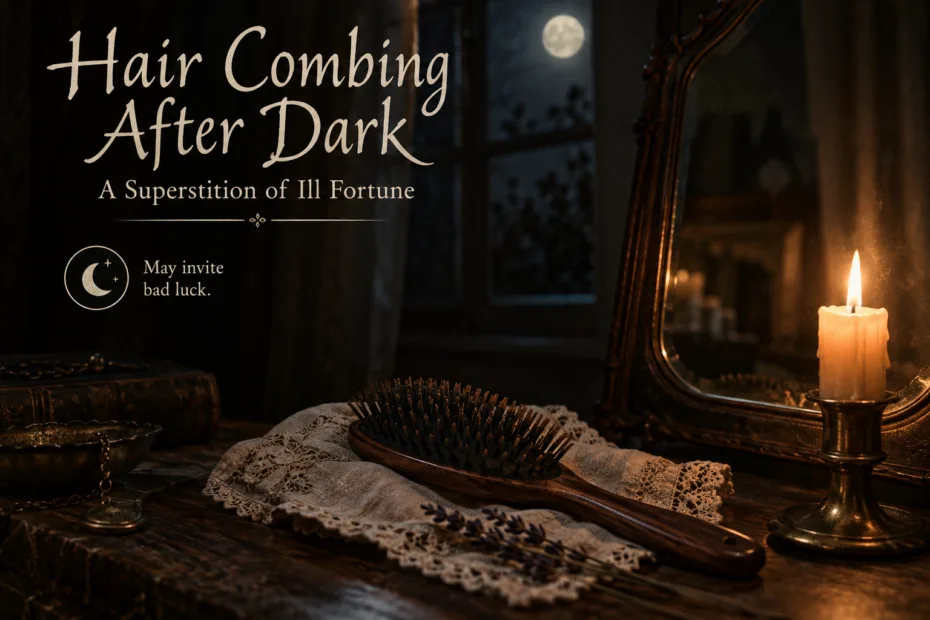
The superstition warns against combing the hair after dark. Folklore records attach several different consequences to the act, including bad luck, forgetfulness, family misfortune and danger to relatives away at sea.
The Rule Was Simple, but the Warning Was Not
In its basic form, the belief says that hair should not be combed at night or after sunset. The prohibition appears in folklore records from more than one place, but there is no single consequence shared by every version.
Some traditions describe nighttime combing simply as unlucky. Others give the warning a much more specific result. Historical collections record claims that a person could become forgetful, suffer sorrow, lose a parent, or bring danger to a family member.
The recurring element is the timing of the combing: night, darkness or the period after sunset. The misfortune attached to breaking the rule changes between communities and individual records.
Forgetfulness and Bad Luck After Sunset
One well-documented branch of the superstition connects nighttime hair combing with forgetfulness. American folklore collections preserve versions stating that combing the hair at night, after dark or after sunset would make a person forgetful or absent-minded.
A large collection of folk beliefs from Adams County, Illinois, records several related sayings together. One calls combing the hair in front of a mirror at night unlucky. Another associates combing after dark with sorrow, while additional versions say that doing it after sunset causes forgetfulness.
The variation within the same collection is useful because it shows how a short household prohibition could circulate with different explanations. The action remained recognizable even when the predicted result changed.
Family Misfortune in Philippine Records
Historical Philippine material preserves stronger family-centered versions of the belief. A collection of Tagalog folk beliefs from Pinamalayan, Mindoro, published in the Philippine Sociological Review in 1956, records the warning that a person should not comb their hair at night because they would become an orphan.
An earlier set of beliefs collected in Santo Tomas, Batangas, in 1925 gives a closely related but more specific consequence: nighttime hair combing was said to risk the death of the person’s mother.
These records should not be treated as evidence that every Filipino community shared an identical rule. They document particular recorded forms of the superstition, and even these closely related examples differ in what they predict.
In Scottish Tradition, the Warning Could Reach Out to Sea
A distinctive version was recorded in the Scottish Highlands. John Gregorson Campbell’s Superstitions of the Highlands and Islands of Scotland, published in 1900 from material collected from oral tradition, states that a person should not comb their hair at night.
The same account adds a special restriction for a woman whose brother was at sea: she was not supposed to comb her hair at night. Other Scottish maritime folklore preserves comparable warnings concerning women combing their hair while close male relatives were away fishing or sailing.
Campbell’s record also connects the danger with the loose hairs left by combing. Hair removed during nighttime combing was supposed to be burned so that it would not cause trouble in the darkness. This places the rule within a wider group of older beliefs about the careful handling of shed or cut hair.
Why Loose Hair Could Matter in Folklore
Hair has often been treated differently from ordinary household waste because it comes directly from the body and remains visibly identifiable after being cut, shed or combed out. Older folklore collections contain many rules about where loose hair could be placed, whether it should be burned, and what might happen if animals carried it away.
This helps explain why the superstition is not always merely a rule about grooming at an inconvenient hour. In some recorded traditions, the concern extends to what happens to the hair removed by the comb.
Older comparative folklorists sometimes interpreted such customs through the idea that separated hair retained a symbolic connection with its former owner. That interpretation can describe a recurring pattern in historical folklore, but it does not prove that every community developed its nighttime-combing taboo for the same reason.
Nighttime Combing Is a Family of Beliefs, Not One Fixed Superstition
| Recorded Form | Consequence Attached to Combing |
|---|---|
| After dark or after sunset | Bad luck, sorrow or forgetfulness |
| Nighttime combing in Philippine records | Loss of a parent or becoming an orphan |
| Nighttime combing in Scottish Highland tradition | Misfortune connected with the loose hair |
| Combing while a close male relative was at sea | Danger associated with the relative’s voyage |
The historical evidence therefore supports a broad canonical form: combing the hair after dark is avoided because it may invite misfortune. The exact misfortune is secondary and varies substantially between recorded traditions.
This variation is part of the belief itself. A warning that begins as a short household rule can be transmitted with a new consequence while retaining the same recognizable action, making nighttime hair combing a recurring folklore motif rather than a superstition with one universal meaning.
United States
Combing one’s hair after dark is interpreted as a sign of sickness.