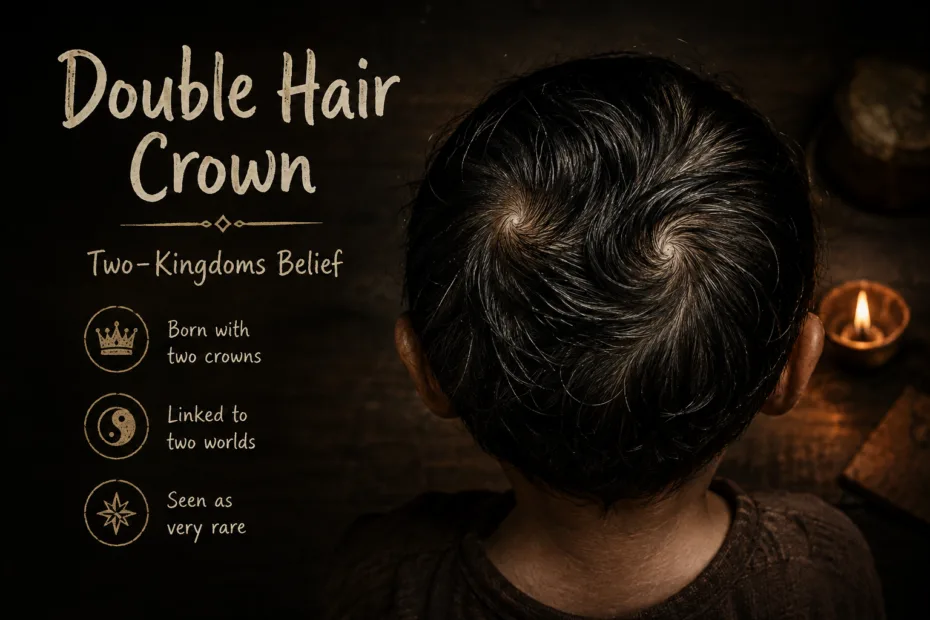
The double hair crown belief treats two distinct hair whorls on the crown of the head as a sign that a person will one day live, travel, or make a life in two different lands. Older versions describe this fate as living or “eating bread” in two kingdoms.
What the Two-Kingdoms Belief Says
In this belief, a double crown means two natural whorls or centers of hair growth on the upper part of the head. The word “crown” refers to their position on the head, not to a royal crown.
The traditional prediction connects the two visible crowns with two places in a person’s future life. A child with two crowns might be expected to live in two kingdoms, spend part of life under two governments, cross between two countries, or live on two continents.
The Basic Pattern
Two hair crowns were read as two future lands: one physical feature on the head supplied the number, while the belief turned that number into a prediction about where the person would live.
Why Older Versions Speak of “Eating Bread” in Two Kingdoms
Some recorded versions do not simply say that the person will visit two places. They say that someone with two crowns will eat bread in two kingdoms. In this wording, eating bread suggests actually living and sustaining oneself somewhere rather than making a brief journey.
The expression therefore points more naturally to residence, migration, or a life divided between different lands. It does not mean that the person will rule two kingdoms or receive two royal titles.
The geographical wording was flexible. Folklore collectors recorded “kingdoms,” “countries,” “governments,” and “continents” in closely related versions. The repeated idea was a future extending beyond one homeland.
An Early Literary Appearance
The saying was already recognizable in the nineteenth century. Henry Wadsworth Longfellow used it in his 1839 novel Hyperion. During a conversation about a man who has two crowns on his head, a character explains the feature as a sign that he will eat his bread in two kingdoms.
This literary appearance shows that the expression was in circulation well before the later American folklore collections that documented it more formally. The passage itself does not establish where the belief first arose, so it is better treated as an early written witness than as proof of a single point of origin.
The Belief in American Folklore Records
Fanny D. Bergen’s Current Superstitions, published for the American Folk-Lore Society in 1896, preserves two closely related forms. A Massachusetts record says that a baby with two crowns will live in two continents or kingdoms. A Northern Ohio version says that a double crown means its owner will break bread in two kingdoms.
The belief also appears in Edwin Miller Fogel’s 1915 collection Beliefs and Superstitions of the Pennsylvania Germans. There, two cowlicks on a child’s head are associated with going far in the world and living in two kingdoms. Fogel also records the related wording about a child eventually eating bread in two kingdoms.
Harry Middleton Hyatt’s 1935 Folk-Lore from Adams County, Illinois preserves the same structure in several forms. Two crowns could indicate future life in two countries, governments, or kingdoms, while another version predicts eating bread on two continents.
Taken together, these records show a stable belief with changing vocabulary. The number two remained constant, while the imagined destinations could be kingdoms, nations, governments, countries, or continents.
A Physical Trait Turned Into a Life Prediction
A double crown is simply a description of two hair whorls. Folklore, however, often assigned future character or fortune to visible features noticed soon after birth. In this case, the unusual feature offered an easy numerical pattern: two crowns could be matched with two future homes.
The belief did not require any ritual or action. Nothing had to be done to the child’s hair, and the prediction did not depend on changing the whorls. The feature itself served as the omen.
This also distinguishes the two-kingdoms belief from other interpretations attached to double crowns. Historical collections sometimes gave the same feature different meanings, including restlessness, intelligence, stubbornness, luck, or extensive travel. Those interpretations belong to related hair-whorl folklore, while the two-kingdoms form specifically connects two crowns with life in two different lands.
United States
A double crown of hair is interpreted as a sign that the person will later live or spend significant time in two countries.