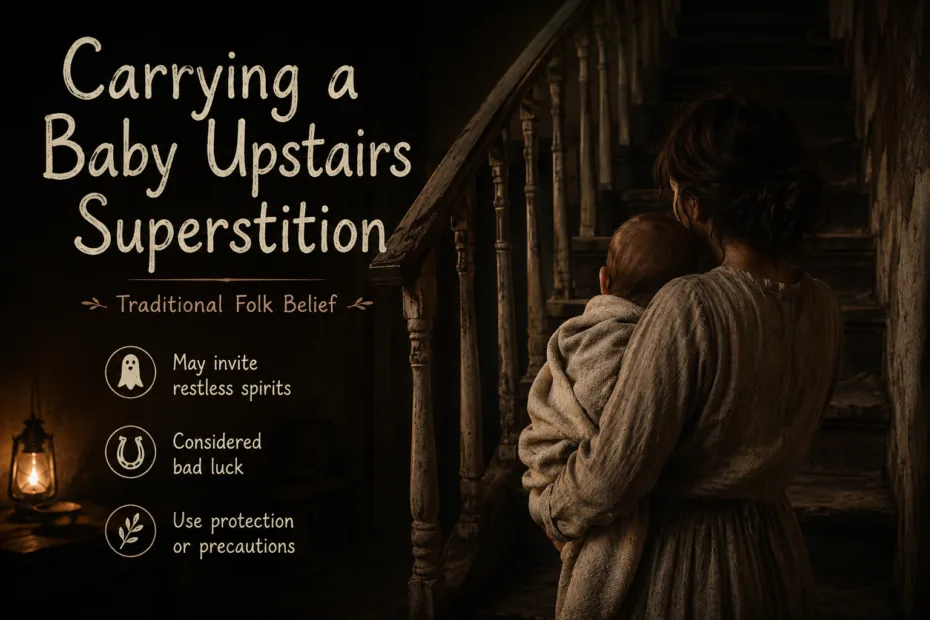
The carrying-a-baby-upstairs superstition holds that a newborn’s first journey away from the birth room should begin with an upward movement. Carrying the child upstairs was traditionally associated with future prosperity, advancement, and the hope that the child would later “rise in the world.”
Why the Baby Was Carried Upward
The belief turns a physical direction into a sign for the child’s future. Going up represented advancement. Beginning by going down could therefore be interpreted as an unfavorable start, especially in versions concerned with future wealth or social position.
This explains why historical descriptions often connect the custom directly with the expression “rise in the world.” The staircase itself was not believed to possess a special quality. What mattered was that the baby’s first directional movement beyond the room was upward.
The custom belonged to a wider body of birth folklore in which a newborn’s earliest experiences could be treated as signs of later fortune. In this case, the first movement carried more meaning than later journeys. Once the symbolic upward beginning had been made, ordinary movement through the house was no longer the focus of the belief.
The First Journey from the Birth Room
Older records are more precise than the shortened modern phrase “carry the baby upstairs.” Several describe the relevant moment as the first time the child was taken from its mother’s room after birth.
James Napier’s nineteenth-century account of folk beliefs in western Scotland records that it was considered lucky to take the child upstairs and unlucky to take it downstairs when the baby was first carried outside the bedroom. The expected result of the upward movement was prosperity.
T. F. Thiselton Dyer also described the practice in Domestic Folk-lore. His account explains the belief through the idea that a child should “go up in the world before it goes down.” A downward journey made first was associated in the tradition with remaining low in later life rather than attaining riches or distinction.
What If There Was No Higher Floor?
The ways people adapted the custom show that an upward motion mattered more than reaching an actual upstairs room.
If the mother and baby were already on the highest floor, some recorded versions allowed the person carrying the child to step onto a chair. Accounts from northern England also mention substitutes such as a table or chest when another flight of stairs was unavailable.
A western Scottish record describes another solution. In a house without stairs, the carrier could ascend several steps of a ladder or a temporary raised structure while holding the child. The brief ascent fulfilled the symbolic requirement without requiring a conventional staircase.
The Important Part Was the Ascent
Chair, ladder, table, attic, and staircase versions all preserve the same basic idea: the baby’s first movement should include a rise before any descent takes place.
Recorded Forms of the Belief
The superstition appears in several nineteenth-century collections rather than in a single isolated account. A West Sussex folklore collection describing beliefs lingering in 1868 includes the rule that a baby should be carried upstairs before being taken down.
The belief was also recorded in Scotland and northern England. An 1894 folklore collection from Berkshire states that a newborn should be carried upstairs so that the child would rise in the world, with standing on a chair offered as an alternative when the birth room was already at the top of the house.
Related versions were collected across parts of the United States by the end of the nineteenth century. Fanny D. Bergen’s Current Superstitions records a Pennsylvania form in which carrying a child upstairs or to the attic first was intended to make the child rise in the world. Another record from Massachusetts states the rule directly: the baby had to go upstairs before going downstairs or the child would never rise in the world.
These collections document particular local traditions and informants. They do not establish that every family in those regions followed the custom.
Prosperity Was the Most Common Meaning
The clearest recurring interpretation is future advancement. The language varies between prosperity, riches, distinction, and simply rising in the world, but each treats upward movement as a favorable beginning.
Some recorded traditions attached different consequences to the same upward-first action. One New England version connected the ascent with the child becoming bright, while a Holyoke, Massachusetts account describes a nurse taking a young baby up a short stepladder before the child’s first descent because of a fear that the child might otherwise die before reaching one year of age. A North Carolina record gave the upward movement a religious meaning instead.
Those additional outcomes are local forms rather than a single fixed explanation. The more widely repeated structure is simpler: carry the newborn upward first so that the child’s future will also move upward.
Why Ordinary Stair Climbing Was Not the Same Custom
The superstition concerns a ceremonial first movement, not the everyday act of carrying an infant between floors. Historical descriptions repeatedly place the action at a beginning: the first departure from the mother’s room, the first time downstairs, or the first movement through the house after birth.
That timing gives the custom its folkloric logic. The initial direction served as a small omen for the direction of the child’s life. Once that beginning had been established, later trips upstairs or downstairs did not carry the same recorded meaning.
United States
To help a child “rise in the world,” the baby should first be carried upward, such as upstairs or toward an attic.