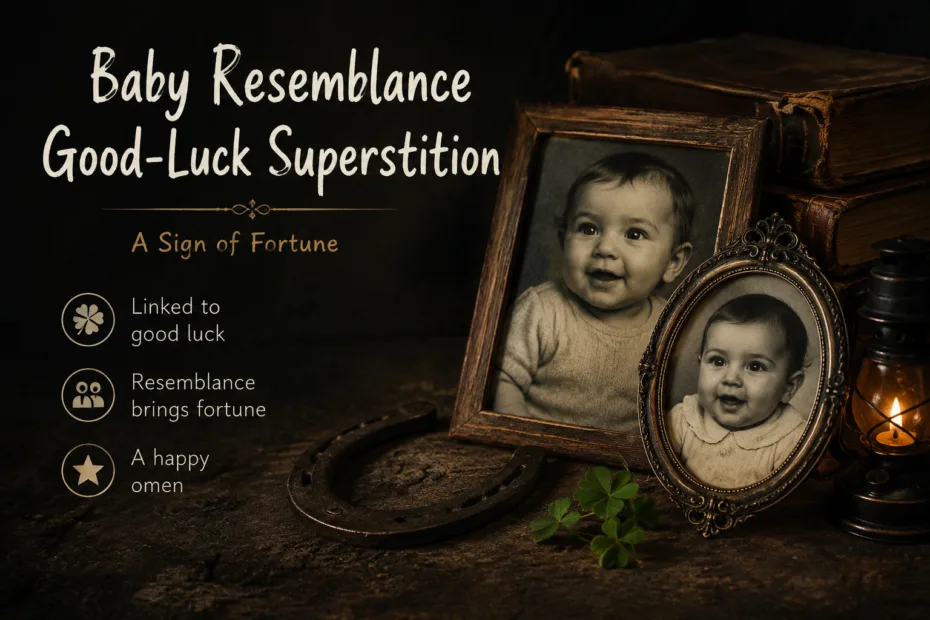
A baby’s resemblance to its parents has sometimes been treated as more than a family observation. In documented folk belief, looking like one or both parents could be read as a favorable sign about love, harmony, and the relationship between the parents.
When Resemblance Becomes a Favorable Sign
The belief does not have one universal rule. Rather, certain traditions gave a positive meaning to a newborn’s resemblance within the family.
A documented Filipino example recorded in the twentieth century held that when an infant resembled both parents, the resemblance could be interpreted as a sign that the couple were happily married. Another recorded version connected a child’s resemblance to the father with the mother’s love for her husband.
In these forms, the baby’s appearance was not simply treated as inherited facial similarity. It became a visible expression of the parents’ relationship.
What the Good Fortune Refers To
The favorable meaning is best understood as family well-being rather than a promise that the child will become wealthy, unusually successful, or lucky in every part of life.
The resemblance could suggest that affection between the parents was strong or that the household was in harmony. A baby who appeared to carry features from both sides of the family therefore offered an easy image of unity: two parents visibly represented in one child.
The Meaning Is Social, Not Genetic
The superstition interprets resemblance as a sign about relationships. It does not describe the biological process that determines which facial features a baby inherits.
Why the Father’s Resemblance Can Receive Special Attention
Comments that a newborn looks like the father have appeared in more than one cultural setting, although their meanings differ. In some traditions, paternal resemblance could be praised because it strengthened the visible connection between father and child.
Anthropological accounts also show that saying a baby resembles its father can function as a socially positive remark. The comment may affirm family connection, reassure relatives, or simply follow an accepted form of politeness around a newborn.
This helps explain why resemblance beliefs are not always literal predictions. Saying that the baby has the father’s face, the mother’s eyes, or features from both parents may carry an additional message about belonging and family closeness.
Resembling Both Parents
The version involving resemblance to both parents has a particularly clear symbolic logic. A baby’s mixed appearance can be interpreted as a physical reflection of the couple themselves.
Resemblance to Both Parents
Can be interpreted as a favorable sign of marital happiness or harmony.
Resemblance to the Father
In some recorded traditions, can be connected with affection between the mother and father.
These interpretations belong to particular folk traditions and should not be expanded into a rule for all Filipino communities or for other cultures. Even within the same broad cultural area, recorded beliefs about resemblance could differ from one locality to another.
Resemblance as Family Language
Newborns naturally invite comparison. Relatives may search for a familiar nose, eyes, mouth, expression, or face shape almost immediately after birth. Folk belief can give those comparisons an extra layer of meaning.
Under the good-luck interpretation, resemblance becomes a small favorable omen within family life. The important point is not that a certain facial feature produces good fortune. The feature is read as evidence of closeness, affection, or harmony according to the belief.
This also makes the superstition different from beliefs that predict a child’s future character or destiny from appearance. Its focus is mainly on what resemblance is thought to reveal about the family relationship surrounding the child.
United States
A child who is thought to favor or resemble the father is regarded as likely to prosper.