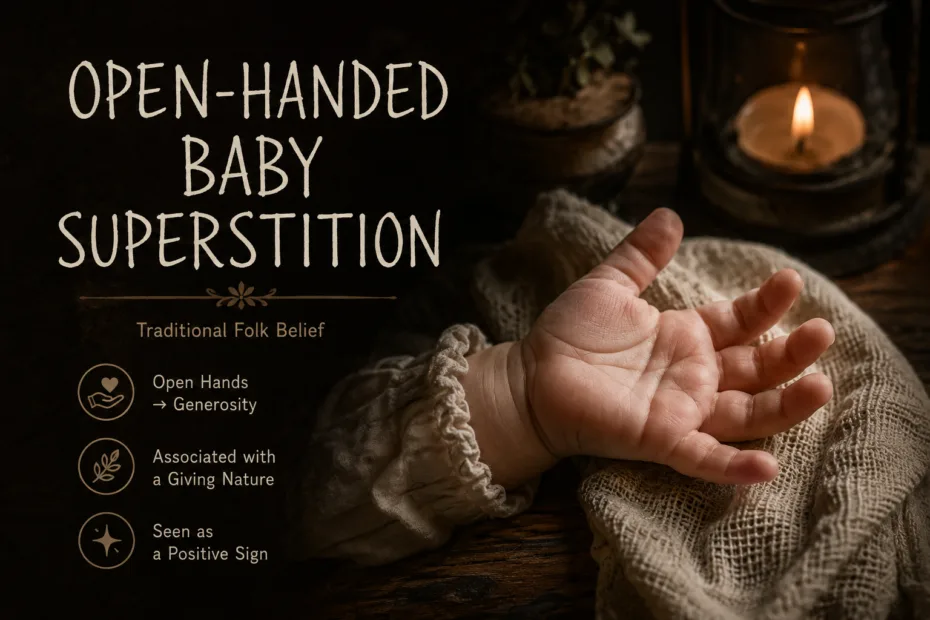
An old English folk belief held that a baby born with its hands open would grow up to be generous and willing to give freely to others.
What the Open Hands Were Believed to Predict
The belief treated the position of a newborn baby’s hands as a sign of future character. A child whose hands were open at birth was expected to have a bountiful or generous disposition.
This was primarily a character omen rather than a prediction of wealth, health, or general good fortune. The open hands supposedly indicated what kind of person the child would become, particularly in relation to generosity and giving.
The Belief in English Folklore Records
The superstition appears in nineteenth-century collections of English domestic and childhood folklore. In Domestic Folk-Lore, T. F. Thiselton Dyer included it among beliefs that attempted to read an infant’s future from small details observed around birth. His 1881 account records the idea that children born open-handed were expected to have a bountiful disposition.
Frank H. Stauffer’s 1882 collection The Queer, the Quaint and the Quizzical also records the tradition, describing the predicted child as generous or “frank-handed.” The belief continued to be noted in later treatments of English birth folklore, including the reference work of folklorists Jacqueline Simpson and Steve Roud.
The surviving documentation places this belief within English birth and infancy folklore. It should not automatically be treated as a universal belief or attributed to cultures for which comparable evidence has not been established.
Why an Open Hand Suggested Generosity
The symbolism closely matches the English expression open-handed, meaning generous or willing to give freely. An open hand could therefore serve as a visible image of giving, while the newborn’s hand position became an omen of the personality supposedly waiting to develop.
This made the belief a form of traditional character prediction: an ordinary physical detail observed at birth was interpreted as a sign of an adult trait. Similar forms of infancy folklore attempted to infer future temperament or fortune from other features and early actions of a child.
A Folklore Sign, Not a Measure of Personality
Nothing about a newborn’s open hands establishes that the child will later be generous. The connection belongs to traditional belief rather than to a demonstrated relationship between hand position at birth and personality.
The significance of the superstition lies instead in the symbolism attached to the gesture: an open hand represented a giving nature, allowing a moment observed at birth to be interpreted as a hopeful sign of future character.
United States
An infant who keeps an open hand is taken as a sign of generosity, while closed fingers suggest a close-fisted disposition.