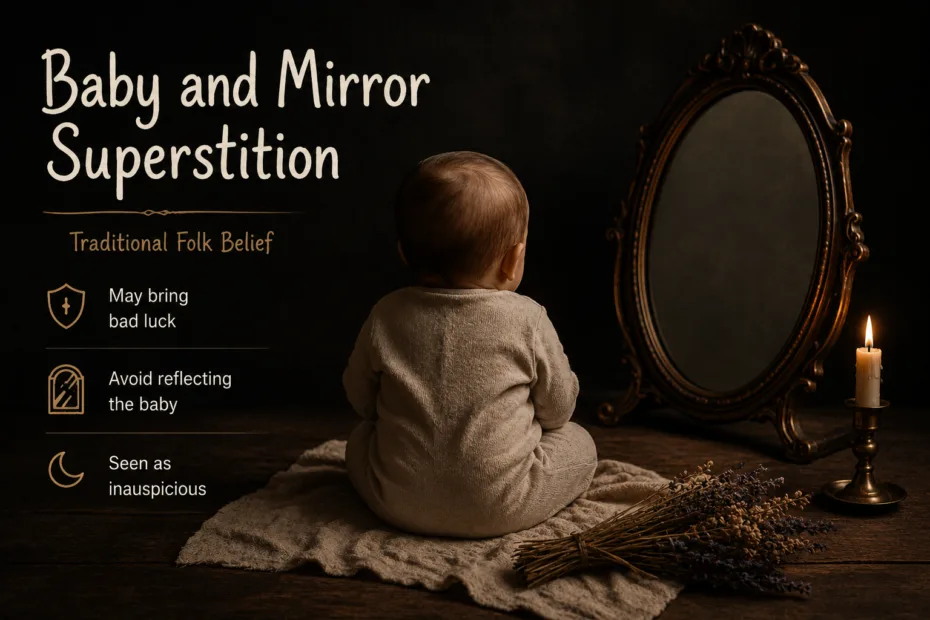
The baby and mirror superstition warns against letting an infant see its reflection too early. The forbidden period is not fixed: some versions say before the first tooth, others name a particular number of months, and many older records use the first birthday as the boundary.
What the Mirror Rule Actually Says
The stable part of the belief is simple. A very young child should not look into a mirror, or should not deliberately be shown its own reflection, until a certain stage of infancy has passed.
Seeing one’s reflection too early is treated as an action that may bring an unwanted consequence to the baby. The age limit and the predicted consequence depend on the version being told.
Historical records do not preserve one universal rule. Instead, they show a family of closely related beliefs. The recurring elements are:
- a baby or young child sees its reflection;
- the event happens before an accepted age or developmental milestone;
- some form of trouble is expected afterward.
This variation is important because phrases such as “never show a baby a mirror” can make the superstition sound more uniform than the folklore record actually is.
The Age Limit Changes Between Versions
Some collected versions prohibit mirrors only during the earliest weeks of life. Others set the limit at six months, nine months, or one year. A different form does not use an age at all and instead says that the baby should not see a mirror before teething or before the first tooth appears.
The one-year boundary occurs repeatedly in older English-language folklore collections. It appears in rules telling caregivers not to let a child see itself in a looking-glass before its first birthday. Yet the presence of shorter limits shows that twelve months was never the only formula.
These changing thresholds also explain why family versions of the superstition can sound contradictory. One person may remember being told to wait until the first tooth, while another remembers six months or a full year. Both can belong to the same broader mirror belief.
What Was Supposed to Happen?
Teething Trouble
Difficulty with teething is one of the clearest recurring outcomes in older records. Several collected sayings warn that a child who looks into a mirror too soon will cut its teeth badly or have trouble while teething.
This version sometimes produces the rule that mirrors become acceptable once the baby has begun teething. The tooth is therefore not presented merely as an age marker; within that form of the belief, it marks the end of the period during which the mirror is avoided.
Bad Luck or Misfortune
Other versions are less specific. They simply describe the act as unlucky or say that some misfortune will follow. Records using this wording often keep the first birthday as the dividing line.
Illness also appears in some oral accounts. Here the mirror is treated as something from which a very young child should temporarily be protected, without a detailed explanation of how the reflection is supposed to cause harm.
Warnings About the Child’s Future
A different branch of the superstition connects the mirror with character. Some collected beliefs say that seeing one’s reflection during infancy will make the child proud or vain. This shifts the expected result away from immediate physical trouble and toward a future personality trait.
The Strongest Historical Warnings
Some nineteenth- and twentieth-century collections preserve much harsher versions. These claim that a baby shown a looking-glass before a stated age will not survive infancy or will die before reaching a later birthday.
Such wording belongs to the historical superstition itself. It should not be treated as a prediction about an actual child. Its value in the folklore record is that it shows how strongly the mirror prohibition could be expressed in some communities.
A Rule Often Recorded Without an Explanation
One difficulty with tracing this superstition is that collectors frequently recorded the rule and its consequence without recording a reason for either. A short entry may say only that a baby must not see a mirror before one year old, followed by the expected result.
For that reason, there is no good basis for assigning every baby-and-mirror belief to one universal idea about souls, spirits, reflections, or supernatural doubles. Mirrors have many separate associations in folklore, but a similarity between two mirror beliefs does not prove that one developed from the other.
The baby rule is more securely understood as part of a larger body of traditional infant precautions. In older collections it appears beside beliefs about measuring babies, cutting their nails, rocking empty cradles, stepping over children, weighing newborns, and other actions that were thought capable of affecting growth, health, temperament, or luck.
How the Belief Appears in Older Folklore Records
Fanny D. Bergen’s Current Superstitions, published in 1896 from material gathered from English-speaking oral tradition, preserves several distinct forms. One says a baby should not look into a glass before reaching one year. Another links the act with difficult teething, while a Georgia record gives a much shorter limit of one month.
Later regional collections show the same flexibility. Harry Middleton Hyatt’s extensive collection from Adams County, Illinois, includes versions involving general bad luck, unspecified misfortune, vanity, and the stronger warning that the infant would not survive its first year.
The Frank C. Brown collection of North Carolina folklore also records the mirror prohibition from several informants and notes comparable material from numerous earlier collections. The repeated documentation shows that the motif circulated well before modern parenting discussions, while the differences between records show that its wording, age limit, and feared outcome were never completely standardized.
United States
Allowing a baby under one year old to look into a mirror is believed to endanger the child’s life.