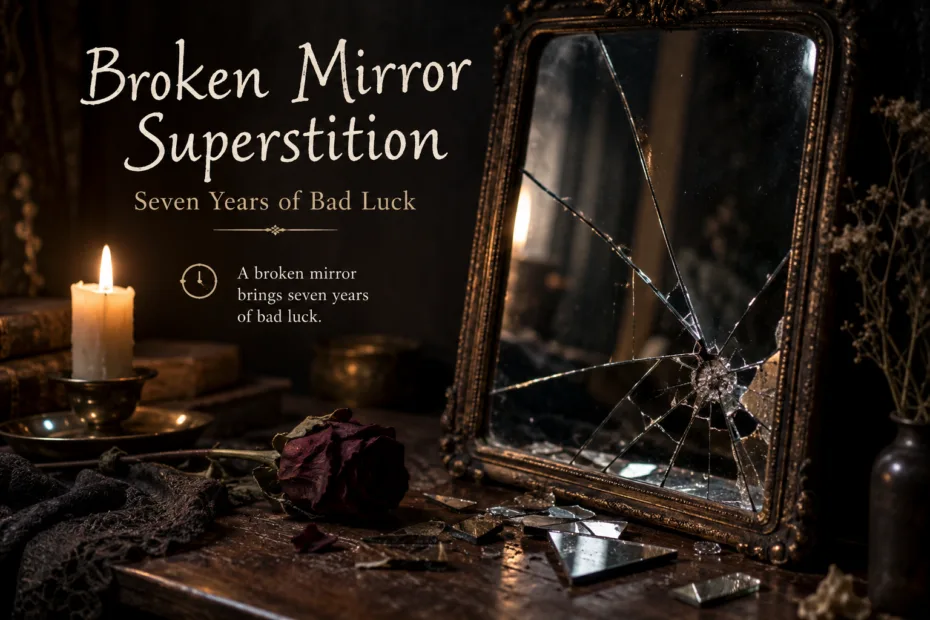
According to one of the best-known mirror superstitions, breaking a mirror brings seven years of bad luck. Historical records show that mirror breakage was considered ominous before the familiar seven-year formula became established.
What the Broken Mirror Superstition Says
The familiar form of the belief is simple: a person who accidentally breaks a mirror will experience bad luck for the next seven years. Some oral versions extend the warning to cracking a mirror even when it does not completely shatter.
The misfortune is usually attached to the person responsible for breaking the mirror. Older records, however, do not always follow this form. A broken looking-glass could instead be treated as an omen affecting its owner, a household, or someone within the family.
This difference matters because the modern formula is only one stage in a longer history of mirror beliefs. Earlier traditions could connect a damaged mirror with death, loss, or general misfortune without mentioning seven years at all.
The Historical Record of the Belief
English antiquarian John Brand wrote that breaking a looking-glass was regarded as a very unlucky accident. He connected the belief with the older use of mirrors in divination. His account did not mention a seven-year punishment.
Francis Grose recorded a darker version in A Provincial Glossary: breaking a looking-glass was said to foretell a death within the family, commonly that of the head of the household.
An item published in The Scourge described a woman distressed because her daughter had broken a looking-glass, which was believed to foretell seven years of ill luck. This is an early clear printed example of the familiar seven-year form.
Later folklore collections repeatedly record the same formula, often in very short form: breaking a mirror means seven years without luck or seven years of bad luck. The belief also continues to circulate through family conversation, popular culture, and oral tradition.
Why a Mirror Became an Omen
Mirrors had associations beyond ordinary grooming long before modern household mirrors became common. Reflective surfaces were used in forms of divination, and historical discussions of mirror folklore often connect their unusual status with the image they reproduce.
A mirror does something visually distinctive: it creates a recognizable double of the person standing before it. When the surface breaks, that image is divided into fragments. Folk explanations could therefore treat damage to the reflected image as symbolically connected with damage or misfortune affecting the person.
The often-repeated claim that an ancient person literally believed a piece of the soul was trapped inside every mirror should be treated carefully. Beliefs linking reflections, identity, divination, and the self are old, but individual explanations differ across periods and traditions.
This symbolic connection also helps explain why the superstition concerns a mirror rather than ordinary broken glass. The important element in the traditional belief is the damaged reflective image.
Why Seven Years of Bad Luck?
The number seven is now inseparable from the broken-mirror superstition, but its exact route into the belief is difficult to reconstruct.
A widely repeated explanation attributes the period to ancient Rome and claims that Romans believed the human body or soul renewed itself every seven years. The historical picture is less tidy. Ancient Greek and later Greco-Roman thought did include schemes that divided human life into seven-year stages. Aristotle referred to people who divided the stages of life into seven-year periods, while traditions associated with Solon and Hippocratic writings also used seven-year divisions.
What surviving evidence does not clearly establish is the missing step: there is no equally clear ancient record showing that breaking a mirror caused exactly seven years of bad luck because a damaged person had to wait through one seven-year renewal cycle.
The safest distinction is therefore between two facts: seven-year divisions of human life existed in ancient thought, and breaking a mirror is explicitly linked with seven years of ill luck in nineteenth-century records. The familiar story connecting the two is a traditional explanation rather than a securely documented ancient origin account.
Older Versions Were Not Always About Seven Years
The earliest recorded forms show that the meaning of a broken mirror was not fixed. In one source it was simply an unlucky accident. In another it foretold a death in the household. Later folklore could associate it with the loss of a friend, general misfortune, or the now-standard seven-year period.
This development is common in orally transmitted beliefs. The central action remains recognizable while the predicted consequence becomes more specific, changes emphasis, or acquires a memorable number.
The seven-year version eventually became especially durable because it gives an otherwise vague warning a precise duration. Instead of merely saying that breaking a mirror is unlucky, the formula defines both the cause and the supposed length of the misfortune.
Does a Cracked Mirror Count?
Traditional wording most often refers to breaking a looking-glass or mirror. Modern oral versions sometimes include a mirror that cracks without falling apart. Folklore records contain both forms.
There is no single rule governing whether a small chip, accidental crack, deliberately smashed mirror, or already damaged mirror carries the same meaning. Those details belong to individual versions of the superstition rather than to one universal tradition.
The same applies to ownership. Some accounts place the bad luck on whoever breaks the mirror, while older forms may treat the event as an omen for the owner or household.
Ways People Tried to Cancel the Bad Luck
Countermeasures appear in some local traditions, but they are far less consistent than the seven-year warning itself. There is no single established ritual for cancelling the supposed bad luck.
One record in Ireland’s Schools’ Collection, for example, states that a person who broke a mirror would suffer seven years of ill luck unless the broken mirror was buried beneath an oak tree before sunset. Other communities transmitted the warning without giving any remedy at all.
Such practices are best understood as local additions to the central belief. The durable element is the broken mirror as an unlucky sign; the methods for avoiding its consequences vary much more widely.
Why the Seven-Year Formula Survived
The superstition has several features that make it easy to remember and repeat. The triggering event is unmistakable, the object is familiar, and the consequence is expressed through the unusually precise period of seven years.
It also turns the appearance of a shattered reflection into a simple cause-and-effect story. That combination has allowed the saying to circulate even among people who repeat it jokingly or do not otherwise treat mirror omens as literal predictions.
Modern folklore records still preserve the short form recognizable from earlier collections: break a mirror, and seven years of bad luck follow. Behind that compact saying is a longer history in which damaged mirrors were associated with several different forms of misfortune before the seven-year version became dominant.
United States
Breaking a looking-glass or mirror is interpreted as a sign that a death in the family will occur before the year ends.