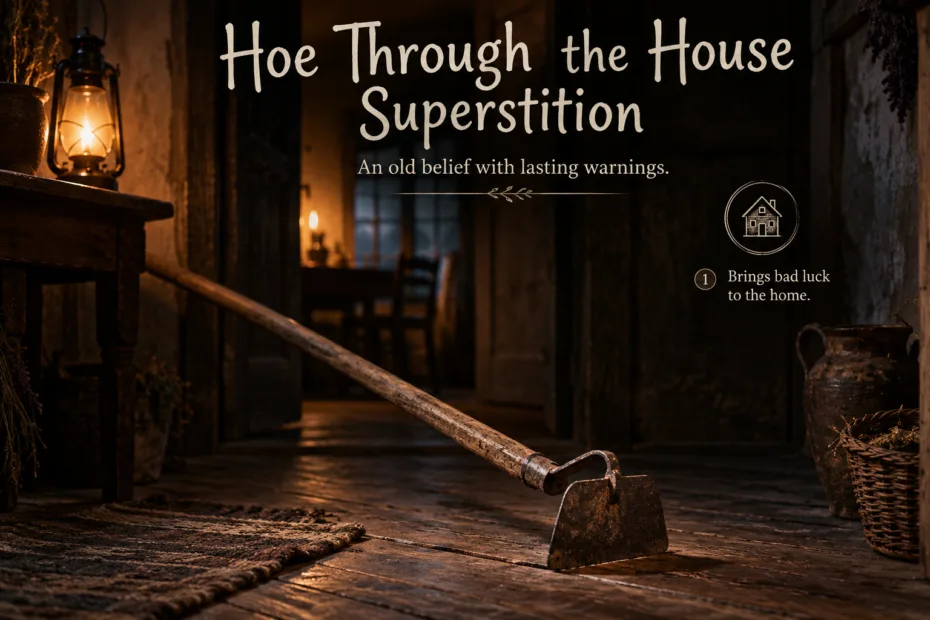
The hoe-through-the-house superstition warns against carrying a hoe inside or through a home. In its simplest recorded form, the act brings bad luck. Other versions turn the warning into a death omen, sometimes saying that carrying the tool through the house foretells a death before the year is over.
The Belief in Its Simplest Form
One of the clearest historical forms of the superstition is very short: carrying a hoe through the house is considered unlucky. The warning concerns the movement of the tool indoors rather than ordinary gardening or the ownership of a hoe.
Fanny D. Bergen’s 1896 collection Current Superstitions: Collected from the Oral Tradition of English Speaking Folk records the belief as an Alabama tradition. The entry states that taking a hoe through the house brings ill luck.
Recorded Form
The nineteenth-century record does not give a required ritual, a set period of bad luck, or a particular misfortune. The forbidden action itself is enough to create the omen.
When the Hoe Becomes a Death Omen
A more severe form appears in the same body of American folklore. One record from Mansfield, Ohio, says that if a hoe is carried through a house, someone will die before the year is out. A Virginia version places the hoe together with the spade and axe and treats carrying any of these tools through the house as a sign of a death in the family.
These records show that the superstition did not always carry exactly the same consequence. For some informants it meant undefined bad luck. For others, the warning had become closely tied to death.
The “Digging Your Own Grave” Version
Later folklore collections preserve an especially direct version of the belief. A Tennessee record collected in the twentieth century says that bringing a hoe into the house means a person is “digging your own grave.”
This wording connects the tool’s normal purpose with the feared outcome. A hoe belongs with digging and working the soil, while the saying turns that ordinary association into a death-related image. The record helps explain how at least one version of the superstition was understood, but it does not prove that this idea was the original source of the belief.
What Counts as Breaking the Rule?
Folklore records use several forms of the warning. The hoe may be described as being brought into, carried through, carried inside, or even dragged through the house.
Bringing It Indoors
Some versions treat simply bringing a hoe into the house as the unlucky act.
Carrying It Through
Other records specifically describe moving the hoe through the house, suggesting passage across the indoor space rather than mere storage.
Dragging It Through
A recorded variant substitutes dragging for carrying while keeping the same warning of bad luck.
The wording therefore varies more than the central rule. The repeated element is an outdoor working tool crossing into or through domestic space.
The Hoe Is Sometimes Part of a Larger Tool Belief
The hoe does not stand alone in every historical record. Some versions extend the warning to a spade, shovel, axe, or other iron implement. In these forms, carrying certain working tools through a home is treated as the dangerous action.
This does not mean that every tool superstition is interchangeable. Records that name only the hoe preserve a distinct form of the belief, while broader versions place it within a group of household warnings involving tools normally associated with outdoor labor.
The consequences also vary. A record that says “bad luck” should not automatically be rewritten as a death omen. Likewise, a death-omen version should not be treated as though every person who knew the superstition understood it in that stronger form.
How Far Back the Recorded Belief Goes
The superstition was already in print by 1896, when Bergen’s collection documented both the general bad-luck form and death-related forms from American oral tradition. The book was published for the American Folk-Lore Society and was intended to preserve beliefs that were circulating orally rather than to invent or standardize them.
The belief continued to appear in later collecting. The James T. Callow Computerized Folklore Archive at the University of Detroit Mercy preserves twentieth-century records from places including Tennessee and Kentucky. Entries collected during the 1960s and 1970s include warnings against bringing or carrying a hoe inside a house, along with versions linking the act to bad luck or death.
Those collection dates show when particular statements were recorded. They do not establish when a family or community first began repeating them.
Why the Wording Changes from One Record to Another
This superstition circulated as oral tradition, so there is no single fixed sentence that defines every version. One household might warn simply against taking a hoe indoors. Another might describe carrying it all the way through the house. A third might attach a specific consequence such as a death within the year.
The variations preserve the same recognizable pattern while changing the details. This is common in orally transmitted beliefs: the short rule survives, while its explanation, wording, or predicted result can differ between informants.
For the hoe superstition, the most securely documented core is straightforward: a hoe should not be carried into or through the house because doing so is believed to bring misfortune. The death prediction belongs to a documented but more specific form of that belief.
What the Historical Record Does Not Establish
The surviving records do not identify a single creator, exact starting date, or proven place of origin for the superstition. They document where particular versions were collected, not where the belief was necessarily born.
They also preserve belief statements rather than evidence that carrying a hoe indoors causes misfortune. Their value is in showing how a household warning was remembered, repeated, and altered within folk tradition.
United States
Carrying a hoe through the house is believed to foretell a death before the year ends.