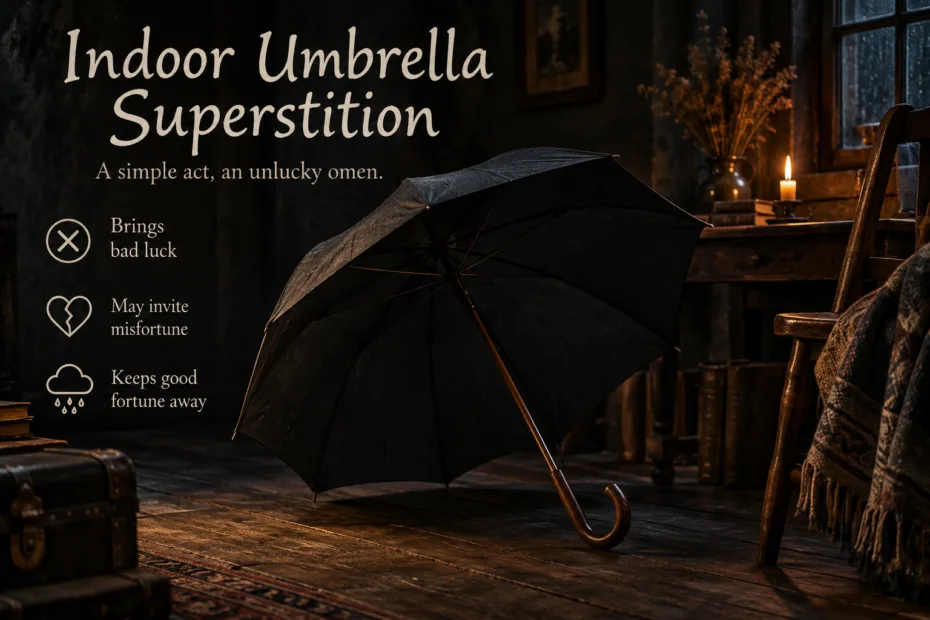
Opening an umbrella inside a house is traditionally treated as an unlucky act. Older folklore records sometimes give the rule a narrower and more severe form: the omen becomes especially ominous when the open umbrella is held over a person’s head indoors.
The Core Prohibition
The basic belief warns against putting up or opening an umbrella inside the house. In its simplest form, no exact consequence is named. The action is merely described as unlucky or as something that will bring bad luck to the person or household.
Historical records show that carrying a closed umbrella through a house is not necessarily the same taboo. The prohibited action is usually the opening of the canopy under a roof. Some traditions also attach bad luck to leaving an umbrella on a table or bed, but those appear as separate umbrella beliefs rather than required parts of the indoor-opening superstition.
Several early versions distinguish between simply opening the umbrella and holding the open umbrella over the head. The second action could carry a more specific omen.
The 1883 Shropshire Record
One of the clearest early printed records appears in Charlotte Sophia Burne’s Shropshire Folk-Lore, published in 1883. The collection describes opening an umbrella in the house as unlucky and adds that holding it over the head could be interpreted as a sign of death.
Iona Opie and Moira Tatem later placed this Shropshire example as the earliest quotation under their “Umbrella Opened Indoors” entry in A Dictionary of Superstitions. This makes the 1883 record an important reference point for the documented history of the belief, although it does not prove that the superstition began in that year.
The wording also shows that the older tradition was not always the vague “bad luck” warning familiar today. In at least one documented form, the position of the umbrella and the fact that it was held over someone mattered.
How the Omen Changes in Folklore Records
The records show several forms living alongside one another. The highly specific death omen did not completely disappear, but the shorter rule—do not open an umbrella indoors because it brings bad luck—became easy to repeat without an accompanying explanation.
Why the Origin Is Uncertain
The superstition is often given a neat origin story, but the surviving folklore record does not establish one uncontested starting point. The documented household taboo belongs mainly to relatively recent folklore sources, while popular explanations sometimes push its beginnings much further back.
The Ancient Egypt Explanation
Ancient Egyptians did use parasols and sunshades, including objects associated with status and protection from the sun. A modern explanation claims that opening such a shade indoors would have offended the sun god Ra and therefore brought misfortune.
The existence of ancient Egyptian sunshades is historical, but a direct line from those objects to the later European rule about opening a rain umbrella inside a house has not been demonstrated by the folklore records normally used to document the superstition. The Egyptian story is therefore better treated as a popular origin explanation rather than a settled history of the indoor taboo.
The Indoor-Safety Explanation
Another explanation focuses on the construction of older umbrellas. Rigid ribs and forceful opening mechanisms could make a large umbrella awkward in a small room. Opening one close to another person, furniture, lamps, or fragile household objects could plainly cause trouble.
This offers a practical reason for discouraging the behavior and may have helped reinforce the rule. It does not, however, establish that mechanical danger created the superstition. The 1883 folklore record presents the action as an omen of misfortune rather than as a warning about damaged property or injury.
Why “Over the Head” Matters
The detail about holding the umbrella over the head appears more than once in recorded versions and should not be dismissed as a minor wording difference. It suggests that some tellings distinguished between an umbrella that happened to be opened inside and one being used indoors as though it were providing shelter.
In the Shropshire record, the over-the-head position changes a general unlucky act into a specific omen. A later Worcestershire version preserves the same distinction. Twentieth-century North American records also include informants who said that indoor opening was unlucky only when the umbrella was placed over the head.
Open indoors: commonly described as unlucky.
Open indoors and held overhead: in some older versions, associated with a more specific household omen.
From “In the House” to “Indoors”
Many older records use the wording in the house rather than the broader modern term indoors. This places the belief within household folklore, where ordinary objects and actions could be interpreted as signs affecting the home or its occupants.
Later tellings sometimes widen the boundary. North American folklore records include versions applying the warning to a house or another building, and contemporary usage often treats almost any enclosed space as covered by the superstition.
The familiar phrase “never open an umbrella indoors” is therefore a convenient modern form of a belief that was often recorded more specifically as never open an umbrella in the house.
No Fixed Countermeasure Accompanies the Core Belief
Many superstitions include a second action intended to cancel the first, but the historical umbrella records commonly state the prohibition without giving a standard remedy. There is no single corrective ritual that consistently belongs to the documented indoor-umbrella tradition.
This separates the belief from customs in which the response is almost as recognizable as the taboo itself. In the umbrella tradition, the memorable rule is primarily preventive: keep the umbrella closed while inside.
United States
Raising an umbrella inside a house is interpreted as a sign of an approaching death.